Einstein
by Walter Isaacson · 2007
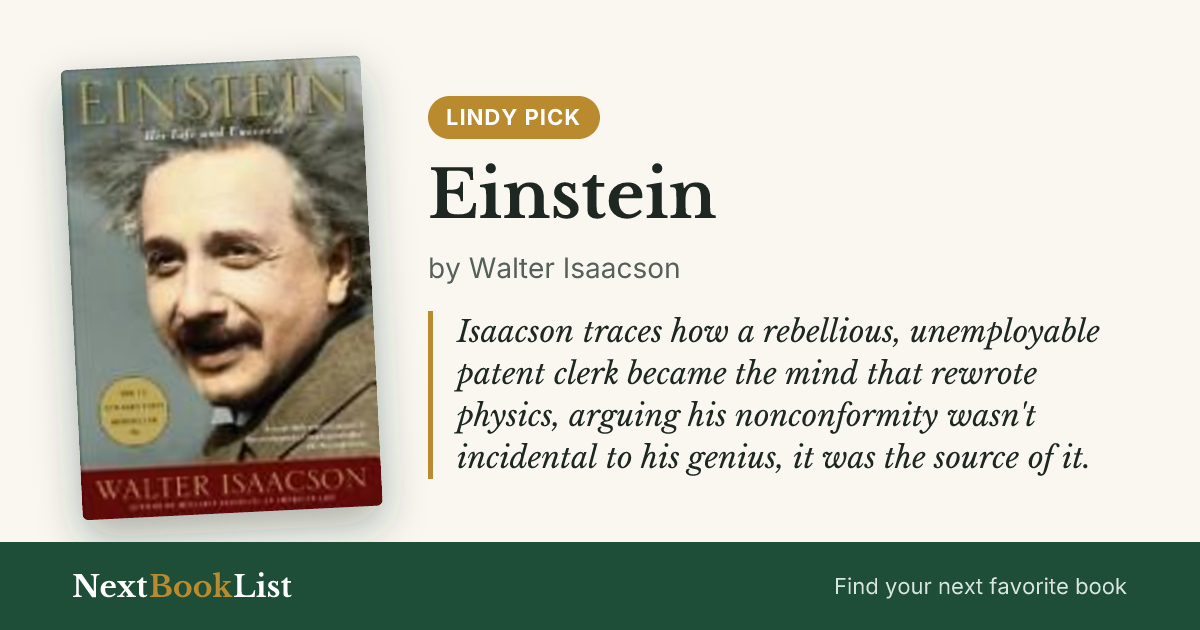
Isaacson traces how a rebellious, unemployable patent clerk became the mind that rewrote physics, arguing his nonconformity wasn't incidental to his genius, it was the source of it.
Worth reading? Isaacson's Einstein spent his twenties failing to land an academic job, working as a Swiss patent clerk, and being generally dismissed by the physics establishment, before publishing four papers in 1905 that reshaped modern physics. Isaacson's central argument is that Einstein's outsider status and instinct to question authority weren't obstacles he overcame despite his genius, they were the actual mechanism of it, the same skepticism toward received wisdom that made him a difficult employee made him willing to question assumptions (like the fixed nature of time) no one else would touch. Read it as a study of nonconformity as an intellectual asset, not just a personality quirk. Skip it if you want the physics itself explained in technical depth, this is biography, not a physics textbook.
| Full Title | Einstein: His Life and Universe |
|---|---|
| Author | Walter Isaacson |
| Published | 2007 |
| Category | Biographies & Memoirs |
| Favorite quote | “The important thing is not to stop questioning. Curiosity has its own reason for existing.” |
The Verdict
Isaacson’s real thesis isn’t “here’s what Einstein discovered,” it’s “here’s why the same trait that made him hard to employ also made him willing to question what everyone else assumed was settled.” That’s the founder-biography lens that makes this land differently than a standard science history.
readers who want a founder-style biography that connects intellectual rebellion directly to scientific breakthrough
you want deep physics equations explained in technical detail, Isaacson keeps the science accessible
Book Summary
Isaacson traces a direct line between Einstein's personal temperament, rebellious, skeptical of authority, uninterested in credentialed status, and his scientific breakthroughs, arguing his willingness to question assumptions institutional physicists took for granted (the fixed nature of time and space) required exactly the kind of outsider mindset that had also made him a mediocre, difficult student.
The biography also covers Einstein's political engagement (his pacifism, his warnings about nuclear weapons, his advocacy during McCarthyism) and personal life with equal weight to his scientific work, presenting a fuller picture of someone whose nonconformity extended well past physics into how he lived and what he was willing to publicly say.
Top 7 Lessons from Einstein
- Nonconformity and skepticism toward institutional authority can be the actual mechanism behind a breakthrough, not just a personality quirk alongside it.
- Being dismissed by credentialed gatekeepers early in a career doesn't predict later impact, and can sometimes correlate with it.
- Willingness to question foundational assumptions (like the fixed nature of time) is rarer and more valuable than raw technical skill alone.
- A patent clerk job, seemingly a career failure, gave Einstein time and independence his 1905 papers required.
- Scientific genius and political courage (Einstein's pacifism, his nuclear warnings) can come from the same underlying temperament.
- Isaacson treats intellectual rebellion as a trainable disposition worth studying, not just an innate trait.
- A full biography, covering politics and personal life alongside the science, explains more about the person than the equations alone would.
Top 2 Quotes from Einstein
"The important thing is not to stop questioning. Curiosity has its own reason for existing."
Walter Isaacson, Einstein
"Imagination is more important than knowledge. For knowledge is limited, whereas imagination embraces the entire world."
Walter Isaacson, Einstein
Frequently Asked Questions
Is Einstein: His Life and Universe worth reading?
Yes, especially for its argument that Einstein's nonconformity and skepticism toward authority were the actual source of his scientific breakthroughs, not incidental traits alongside them.
What is Einstein: His Life and Universe about?
Walter Isaacson's biography tracing Albert Einstein from a struggling, dismissed young academic to the physicist who rewrote our understanding of time and space, connecting his rebellious temperament directly to his scientific insight.
Does this book require a physics background?
No. Isaacson keeps the science accessible for general readers, focusing more on Einstein's life, temperament, and historical context than on technical derivations.
Ready to read it?
Get Einstein on Amazon