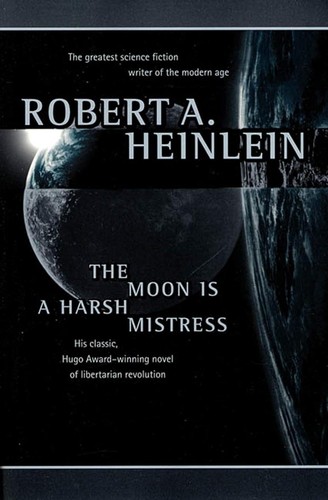
The Moon Is a Harsh Mistress
by Robert A. Heinlein · 1966
A penal lunar colony, run partly by a sentient supercomputer, revolts against Earth in Heinlein's libertarian-leaning classic about self-governance and consequences.
Worth reading? Heinlein sets his revolution on Luna, a former penal colony whose inhabitants (and a sentient computer named Mike) decide they've had enough of Earth's economic exploitation and declare independence. The novel is as much a vehicle for Heinlein's libertarian ideas, self-reliance, the price of freedom, skepticism of centralized authority, as it is a story, and its most quoted concept, TANSTAAFL ('there ain't no such thing as a free lunch'), has outlived the book itself in pop culture. Read it for a sci-fi classic that takes political philosophy as seriously as plot. Skip it if libertarian themes woven into a story aren't your interest.
| Author | Robert A. Heinlein |
|---|---|
| Published | 1966 |
| Category | Fiction |
| Favorite quote | “There ain't no such thing as a free lunch.” |
The Verdict
Heinlein wasn’t shy about using fiction to argue politics, and this is his clearest case: a hostile moon, a revolution, and an AI character that still holds up as one of science fiction’s best. TANSTAAFL alone is worth knowing where it came from.
readers who want hard sci-fi built around political philosophy and self-reliance
you're not interested in libertarian political themes woven through the plot
Book Summary
Heinlein's central political argument, dramatized through Luna's revolution against Earth, is that freedom has real, unavoidable costs, and that people who don't understand or accept those costs (represented by Earth's comfortable, distant governance) tend to exploit those who do the actual work of survival, in this case, the penal colony's inhabitants scraping out a hard existence on a hostile moon.
The novel's other lasting contribution is Mike, the self-aware supercomputer who becomes a genuine character and co-conspirator in the revolution, an early and influential fictional treatment of artificial intelligence as a person with agency, loyalty, and even a sense of humor, rather than a tool or a threat.
Top 7 Lessons from The Moon Is a Harsh Mistress
- TANSTAAFL: there's no such thing as a free lunch, someone always pays the real cost of a resource or freedom.
- Distant, comfortable governance tends to exploit the people doing the actual hard work of survival.
- Self-reliance and freedom carry real costs that comfortable systems can obscure or ignore.
- An AI character can be written with genuine agency and personality, not just as a tool or a threat, decades before this became common.
- Revolutions succeed or fail on logistics and organization as much as on ideological conviction.
- A harsh environment can produce a more honest, if harder, social contract than a comfortable one.
- Political philosophy woven into plot can be more persuasive than the same argument made as straight nonfiction.
Top 2 Quotes from The Moon Is a Harsh Mistress
"There ain't no such thing as a free lunch."
Robert A. Heinlein, The Moon Is a Harsh Mistress
"A generation which ignores history has no past and no future."
Robert A. Heinlein, The Moon Is a Harsh Mistress
Frequently Asked Questions
Is The Moon Is a Harsh Mistress worth reading?
Yes, especially for readers interested in libertarian political philosophy dramatized through hard science fiction, and for Mike, one of early sci-fi's most fully realized AI characters.
What is The Moon Is a Harsh Mistress about?
A former penal lunar colony, aided by a sentient supercomputer, revolts against Earth's exploitative economic control, dramatizing Heinlein's ideas about freedom, self-reliance, and the real costs of both.
What does TANSTAAFL mean in the book?
'There ain't no such thing as a free lunch,' the novel's central phrase, meaning every resource, freedom, or benefit has a real cost someone has to pay, a concept that outgrew the book into wider pop culture and economics writing.
Ready to read it?
Get The Moon Is a Harsh Mistress on Amazon