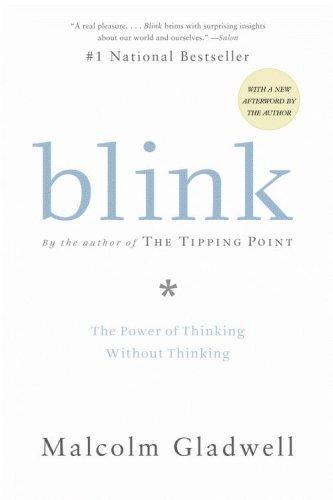
Blink
by Malcolm Gladwell · 2005
Your gut is running calculations your conscious brain never sees -- Gladwell's case for taking it seriously (and knowing when not to).
Worth reading? Blink and Daniel Kahneman's Thinking, Fast and Slow cover the same territory -- snap judgment versus deliberate analysis -- but Kahneman is the rigorous version and Gladwell is the readable one. Kahneman will actually teach you the cognitive biases and give you the research methodology. Gladwell will make you understand, viscerally, why an art expert's gut rejected a fake statue that fooled scientific testing, and why that same instinct fails badly under stress or bias. Read Blink first if you want to get hooked on the topic. Read Kahneman next if you want to actually understand the mechanics. Skip Blink if you already know the cognitive science and want depth over anecdote -- Gladwell is a storyteller first, and some of his examples (Warren Harding, the Getty kouros) work better as narrative hooks than as tight scientific proof. For anyone who hasn't thought seriously about when to trust a fast read versus slow down, it's still the most entertaining door into the subject.
| Full Title | Blink: The Power of Thinking Without Thinking |
|---|---|
| Author | Malcolm Gladwell |
| Published | 2005 |
| Publisher | Little, Brown and Company |
| Category | Business & Money |
| Favorite quote | “There can be as much value in the blink of an eye as in months of rational analysis.” |
The Verdict
Malcolm Gladwell built Blink around a genuinely useful tension: your gut is sometimes right in ways your conscious mind can’t explain, and sometimes catastrophically wrong in ways you never see coming. He never fully resolves which is which – which is honest, because nobody has – but the stories he picks make the tension worth sitting with.
you make fast, high-stakes calls (hiring, triage, negotiation) and want to know when to trust your first read
you want a rigorous cognitive-science text -- go to Kahneman for the mechanics, this is the stories
Book Summary
Gladwell's argument is that the unconscious mind is doing sophisticated pattern-matching work all the time, and that this "thin-slicing" -- making sense of a situation from a tiny window of experience -- can be as accurate as, or more accurate than, months of deliberate analysis. His signature example is art experts who instantly sensed something was wrong with a fake Greek kouros statue that had passed fourteen months of scientific testing.
But the book isn't a blanket endorsement of gut instinct. Gladwell spends real time on when thin-slicing goes wrong: the Warren Harding error (mistaking a commanding presence for actual competence), the way priming and implicit bias corrupt snap judgments about race and gender, and how police shootings under extreme stress show instinct collapsing into panic rather than useful pattern recognition.
The resolution he lands on is that expert intuition is trainable and valuable -- but only in domains where you've had enough real feedback to build genuine pattern recognition, and only when you've controlled for the biases (priming, stress, prejudice) that corrupt it. Untrained gut reaction and trained expert intuition look the same from the inside; they are not the same thing.
Top 10 Lessons from Blink
- Thin-slicing (judging from a tiny window of experience) can outperform months of analysis -- in the right domain.
- The Warren Harding error: mistaking a commanding presence or appearance for real competence.
- Implicit bias and priming corrupt snap judgments long before you're aware anything happened.
- Expert intuition is trainable, but only through real feedback in a specific domain -- it doesn't generalize.
- Extreme stress collapses fast thinking into panic, not useful pattern recognition.
- Untrained gut reaction and trained expert intuition feel identical from the inside -- they aren't the same.
- More information doesn't always mean a better decision -- sometimes it adds noise.
- Structured, blind evaluation (removing identifying cues) reduces bias in fast judgments.
- First impressions in interviews are often about fluency and confidence, not competence.
- Knowing when to trust your gut matters more than whether gut instinct is 'good' in general.
Top 5 Quotes from Blink
"There can be as much value in the blink of an eye as in months of rational analysis."
Malcolm Gladwell, Blink
"We live in a world that assumes that the quality of a decision is directly related to the time and effort that went into making it."
Malcolm Gladwell, Blink
"Truly successful decision making relies on a balance between deliberate and instinctive thinking."
Malcolm Gladwell, Blink
"Snap judgments and first impressions can be educated and controlled."
Malcolm Gladwell, Blink
"The key to good decision making is not knowledge. It is understanding. We are swimming in the former. We are desperately lacking in the latter."
Malcolm Gladwell, Blink
Frequently Asked Questions
Is Blink worth reading?
Yes, if you make fast, high-stakes calls and want a readable case for when to trust your gut and when not to. Skip it if you want the rigorous cognitive science -- go to Kahneman's Thinking, Fast and Slow instead.
What is the main idea of Blink?
The unconscious mind performs real pattern-matching (thin-slicing) that can be as accurate as slow deliberate analysis, but only in domains where you've had genuine training and feedback -- and only when bias and stress aren't corrupting it.
What is thin-slicing in Blink?
Gladwell's term for the mind's ability to find patterns in situations based on very narrow windows of experience -- sometimes just seconds -- and make surprisingly accurate judgments from them.
Is Blink better than Thinking, Fast and Slow?
They're not really competing. Blink is the accessible, story-driven introduction; Thinking, Fast and Slow is the deeper, research-heavy treatment of the same fast-versus-slow thinking divide. Most people are better served reading both, starting with Blink.
Ready to read it?
Get Blink on Amazon