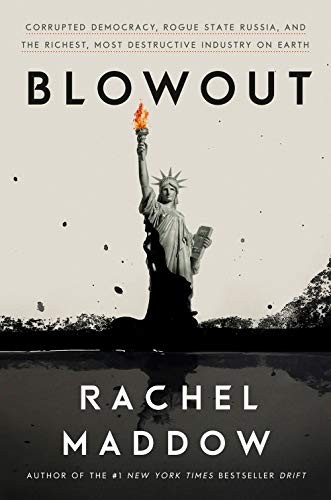
Blowout
by Rachel Maddow · 2019
A cable news anchor traces how the modern oil and gas industry's wealth and reach corrupts democracies and props up authoritarian petrostates, from an Oklahoma earthquake swarm caused by fracking waste to Russia's 2016 election interference.
Worth reading? Maddow's throughline is that the oil and gas industry generates such extraordinary, concentrated wealth that it routinely overwhelms the normal checks -- regulatory agencies, courts, even entire national governments -- that would otherwise constrain it, and she demonstrates this through a set of specific, well-reported case studies rather than abstract argument: Oklahoma's fracking-wastewater-induced earthquake swarm and the state's slow regulatory response, Equatorial Guinea's oil-funded dictatorship, ExxonMobil's decades-long relationship with Russia, and Russia's own oil-dependent economy as context for its 2016 US election interference. The book reads fast because Maddow is a broadcast storyteller by trade, and that's both its appeal and its limit -- individual chapters sometimes read like extended segments rather than a single unified academic argument, but each one is genuinely well-reported and the connective tissue (petrostates behave differently, and dangerously, because oil wealth doesn't require a healthy broader economy or an accountable government to keep flowing) holds up across the disparate examples.
| Full Title | Blowout: Corrupted Democracy, Rogue State Russia, and the Richest, Most Destructive Industry on Earth |
|---|---|
| Author | Rachel Maddow |
| Published | 2019 |
| Publisher | Crown |
| Category | Sociology & Culture |
| Favorite quote | “The oil and gas industry is set up to inflate the ambitions of already ambitious men to nation-threatening size.” |
The Verdict
Maddow’s background as a broadcast storyteller shows in the best way here – each chapter is a genuinely gripping, well-reported story on its own (the Oklahoma earthquakes alone are worth the read), and she’s disciplined about sourcing even while keeping the pace of a segment rather than a textbook. The throughline connecting Oklahoma to Equatorial Guinea to Russia is looser than a single unified academic thesis, but the underlying pattern – oil wealth outrunning accountability – holds across all of it.
Read it if you want a fast, well-reported narrative connecting oil and gas wealth to democratic corrosion and authoritarian power, told story by story. Skip it if you need a rigorous academic energy-policy text with heavy economic modeling – this is journalism, built for pace and narrative, not a wonk’s reference book.
you want a fast-paced, reported narrative connecting the oil and gas industry's global political power to specific, documented events (state-caused earthquakes, Equatorial Guinea's kleptocracy, Russian election interference) rather than a dry industry history
you want a rigorous academic energy-policy text with heavy sourcing and economic modeling -- Maddow writes as a broadcast journalist telling connected stories for a general audience, not as an energy economist
Book Summary
Oil and gas wealth is uniquely disconnected from the health of the broader economy or the consent of the governed -- a petrostate's rulers can extract enormous revenue and stay in power through resource wealth alone, without needing a functioning economy, an educated population, or genuine democratic legitimacy, which Maddow argues explains why oil-rich authoritarian states (Russia, Equatorial Guinea) behave so differently from resource-poor ones.
Fracking-related wastewater injection directly caused a dramatic surge in earthquakes in Oklahoma starting around 2009, a scientifically documented phenomenon that state regulators were slow to act on given the industry's political and economic weight in the state -- Maddow uses this as a close-to-home case study of the same dynamic (concentrated industry wealth outpacing regulatory capacity) that plays out at country scale elsewhere in the book.
Russia's economy is deeply oil-and-gas dependent, and Maddow argues this dependency shapes its foreign policy incentives directly -- a state whose revenue depends on global oil and gas prices and pipeline politics has a direct interest in destabilizing rivals and expanding its energy leverage over Europe, which she connects to both Russia's actions in Ukraine and its interference in the 2016 US election.
Top 8 Lessons from Blowout
- Oil and gas wealth can fund a functioning authoritarian state without a healthy broader economy or genuine democratic legitimacy, which is part of why petrostates behave differently from resource-poor authoritarian regimes.
- Wastewater injection from fracking operations directly and measurably caused a surge in earthquakes in Oklahoma starting around 2009, a scientifically documented link that state regulators were slow to act on.
- Concentrated industry wealth can outpace the regulatory and political capacity meant to check it, at both the state level (Oklahoma) and the national level (petrostates globally).
- Equatorial Guinea's oil wealth funded an entrenched, personally enriching dictatorship rather than broad national development, illustrating the 'resource curse' pattern where natural resource wealth undermines rather than builds functioning institutions.
- ExxonMobil built a deep, decades-long commercial relationship with Russia's state oil interests, which Maddow argues shaped corporate incentives around U.S.-Russia policy at the highest levels.
- Russia's state revenue is heavily dependent on oil and gas exports and pipeline politics, which gives it a direct economic incentive to maintain leverage over European energy markets and destabilize rival energy suppliers.
- Maddow connects Russia's oil-dependent economic incentives to its broader foreign policy actions, including positioning around Ukraine and interference in the 2016 U.S. election, as part of a single resource-driven strategic logic.
- Corporate and state actors in the oil and gas industry have historically operated with a level of secrecy and limited accountability that Maddow argues is enabled by the sheer scale of the wealth involved.
Top 1 Quotes from Blowout
"The oil and gas industry is set up to inflate the ambitions of already ambitious men to nation-threatening size."
Rachel Maddow, Blowout
Frequently Asked Questions
Is Blowout worth reading?
Yes, if you want a fast, well-reported narrative connecting oil and gas industry wealth to specific real-world events -- Oklahoma's fracking earthquakes, Equatorial Guinea's dictatorship, Russia's 2016 election interference -- told with broadcast-journalist pacing rather than academic density.
What is Blowout about?
Rachel Maddow traces how the extraordinary, concentrated wealth of the global oil and gas industry corrupts democratic accountability and props up authoritarian petrostates, using case studies from Oklahoma's fracking-induced earthquakes to Russia's oil-dependent foreign policy.
Does Blowout connect to Russian election interference?
Yes -- Maddow argues Russia's oil-and-gas-dependent economy shapes its foreign policy incentives directly, and she connects that dependency to Russia's 2016 U.S. election interference as part of the same resource-driven strategic logic.
Is Blowout a rigorous academic energy-policy book?
No. Maddow writes as a broadcast journalist for a general audience, using connected reported narratives rather than economic modeling or dense academic sourcing -- read it for the stories and the throughline, not a policy-wonk deep dive.
What is the Oklahoma earthquake connection in Blowout?
Maddow documents how wastewater injection from fracking operations caused a scientifically measurable surge in earthquakes in Oklahoma starting around 2009, and uses the state's slow regulatory response as a domestic case study of industry wealth outpacing accountability.
Ready to read it?
Get Blowout on Amazon