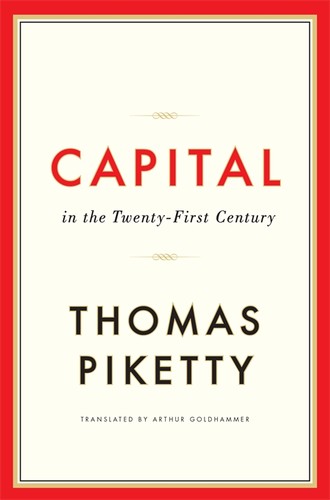
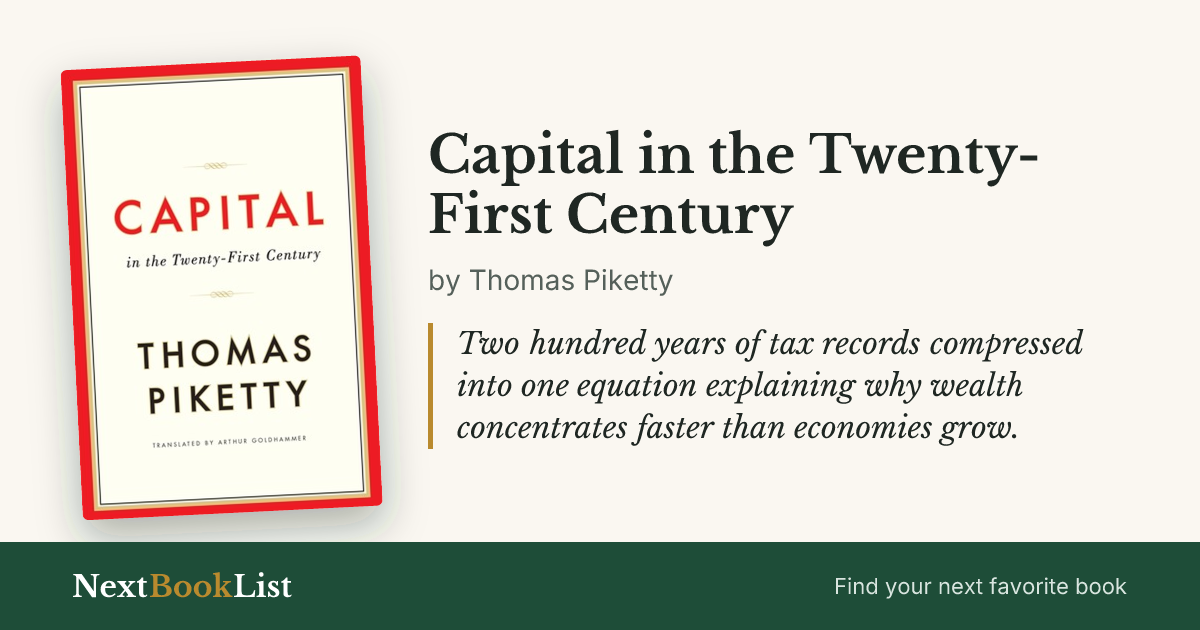
Capital in the Twenty-First Century
by Thomas Piketty · 2014
Two hundred years of tax records compressed into one equation explaining why wealth concentrates faster than economies grow.
Worth reading? Where most inequality books argue from anecdote, Piketty argues from two centuries of tax records across multiple countries, and that's both the book's strength and its wall. It's less readable than Robert Reich or Matt Taibbi's inequality books, but it's built on data those books don't have, which is why economists still argue with Piketty's numbers instead of dismissing them. Read it if you want the historical evidence behind "the rich get richer" instead of the slogan version. Skip it if you want something you'll actually finish in a weekend -- this rewards a slow, chapter-by-chapter read, and most people get more out of the first 200 pages (where the core argument lives) than the last 400 (which is mostly supporting data and policy proposals).
| Author | Thomas Piketty |
|---|---|
| Published | 2014 |
| Publisher | Belknap Press (Harvard University Press) |
| Category | Business & Money |
| Favorite quote | “When the rate of return on capital exceeds the rate of growth of output and income, capitalism automatically generates arbitrary and unsustainable inequalities.” |
The Verdict
Piketty didn’t write an opinion piece about inequality – he built two centuries of tax data first, then let the data make the argument. Whether or not you buy his wealth-tax prescription, the r > g diagnosis is hard to argue with once you’ve seen the numbers.
you want the historical data behind wealth inequality, not just another opinion piece about it
you want a quick read -- this is nearly 700 pages of data and argument, closer to a textbook than a business book
Book Summary
Piketty's central claim is captured in one inequality: when the rate of return on capital (r) exceeds the rate of economic growth (g), wealth concentrates automatically, because capital income compounds faster than wages or output ever can. This isn't a crisis-driven phenomenon, it's the normal state of capitalism absent deliberate intervention, which is why Piketty treats the mid-20th-century's relatively equal decades as the historical anomaly, not the modern spike in inequality.
He builds this case from an unprecedented dataset -- two centuries of tax and inheritance records from France, the UK, the US, and other countries -- showing wealth concentration was extremely high before World War I, fell sharply through the wars and postwar reconstruction (largely due to physical destruction of capital and high taxation), and has been climbing back toward pre-war levels since the 1980s.
His policy conclusion, a global progressive wealth tax, is more speculative than the historical data and has drawn the most criticism, but the underlying diagnosis -- that unmanaged capitalism trends toward concentration, not equilibrium -- is the part of the book that reshaped the economics debate regardless of whether you accept his prescription.
Top 8 Lessons from Capital in the Twenty-First Century
- When the return on capital (r) exceeds economic growth (g), wealth concentration is the automatic default, not an aberration.
- The relatively equal mid-20th century was a historical anomaly caused by wartime destruction and high taxation, not capitalism's natural state.
- Two centuries of tax records show wealth concentration was extremely high before World War I and has been climbing back since the 1980s.
- Inherited wealth grows faster than earned income in a low-growth economy, favoring existing fortunes over new ones.
- A progressive global wealth tax is Piketty's proposed fix, though it's the most speculative and contested part of the book.
- Economic growth rates matter more to equality than most policy debates admit -- low growth structurally favors capital over labor.
- Long-run historical data, not short-run anecdote, is the only reliable way to separate a cyclical trend from capitalism's default tendency.
- Rising inequality isn't a side effect of bad policy alone -- it's what happens by default unless policy actively counters it.
Top 2 Quotes from Capital in the Twenty-First Century
"When the rate of return on capital exceeds the rate of growth of output and income, capitalism automatically generates arbitrary and unsustainable inequalities."
Thomas Piketty, Capital in the Twenty-First Century
"The history of the distribution of wealth has always been deeply political, and it cannot be reduced to purely economic mechanisms."
Thomas Piketty, Capital in the Twenty-First Century
Frequently Asked Questions
Is Capital in the Twenty-First Century worth reading?
Yes, if you want the historical data behind wealth inequality debates, not just the talking points. Skip it if you want a quick read -- it's nearly 700 dense pages.
What is the main idea of Capital in the Twenty-First Century?
When the return on capital outpaces economic growth (r > g), wealth automatically concentrates over time -- a pattern Piketty traces across two centuries of tax data, not just recent decades.
Who should read Capital in the Twenty-First Century?
Anyone who wants the historical evidence behind inequality arguments, especially readers willing to sit with data-heavy economic history rather than a breezy narrative.
Do I need an economics background to read this?
Helpful but not required. Piketty explains the core r > g argument clearly in the first chapters; the later sections get more technical with policy modeling.
Ready to read it?
Get Capital in the Twenty-First Century on Amazon