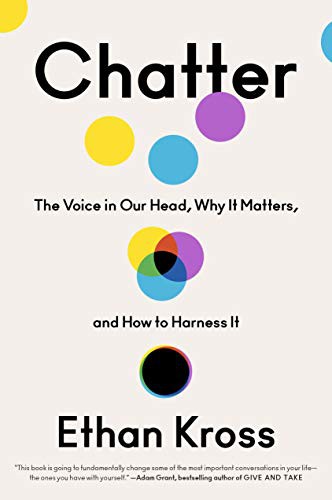
Chatter
by Ethan Kross · 2021
A psychologist explains the voice in your head that won't shut up, and the specific, research-tested tools for turning it from a spiral into a tool.
Worth reading? Kross's core distinction is between an inner voice that helps you (working through a problem, rehearsing a hard conversation) and 'chatter,' the same voice hijacked into unproductive rumination that hijacks focus and mood without resolving anything. The self-distancing technique -- referring to yourself by name or 'you' instead of 'I' when working through a problem in your head -- is the book's most immediately usable, research-backed tool, and it's simple enough to try on the next spiral you notice.
| Full Title | Chatter: The Voice in Our Head, Why It Matters, and How to Harness It |
|---|---|
| Author | Ethan Kross |
| Published | 2021 |
| Category | Self-Improvement & Psychology |
| Favorite quote | “The very same inner voice that can cause us tremendous grief also happens to be one of our most powerful tools for addressing that grief.” |
The Verdict
Kross runs an actual psychology lab studying this exact phenomenon, and the self-distancing technique is the kind of finding that sounds almost too simple to work until you try it mid-spiral and notice the shift. Read it the next time your own inner voice won’t quit – it’s built for exactly that moment, not just for calm reading beforehand.
your inner voice tends to spiral into rumination, replaying the same worry or conversation on a loop
you want deep clinical treatment for a diagnosed anxiety disorder -- this is aimed at general readers and everyday rumination, not a substitute for therapy
Book Summary
Chatter, in Kross's specific definition, is negative self-talk that spirals into rumination -- looping over the same worry or replaying the same conversation without making progress toward resolving it, which drains attention and mood without producing anything useful the way productive inner dialogue does.
His signature fix is self-distancing: talking to yourself in the third person or by name ("Ethan, what's actually bothering you here?") rather than first person ("I'm so stressed") measurably cools the emotional intensity of a spiraling thought and creates enough psychological distance to think about the problem instead of just feeling it. He also finds that venting to others, done poorly, can amplify chatter rather than easing it -- support that only validates the emotion without helping reframe it tends to entrench the spiral rather than resolve it.
Top 7 Lessons from Chatter
- Distinguish helpful inner dialogue (working through a problem) from 'chatter' (rumination that spirals without resolving anything).
- Use self-distancing -- refer to yourself by name or 'you' instead of 'I' -- to cool the emotional intensity of a spiraling thought.
- Zoom out: reframe a problem as smaller and more temporary than it feels in the moment of rumination.
- Rituals and order restore a sense of control that reduces the pull toward chatter under stress.
- Time in nature and moments of awe measurably reduce mental noise and rumination.
- Venting to others can amplify chatter instead of easing it, if the listener only validates the emotion without helping reframe it.
- Arrange your physical environment deliberately -- clutter and disorder feed the same loss-of-control feeling that fuels chatter.
Top 5 Quotes from Chatter
"The very same inner voice that can cause us tremendous grief also happens to be one of our most powerful tools for addressing that grief."
Ethan Kross, Chatter
"Distanced self-talk is a lever we can pull to give ourselves the psychological distance we need."
Ethan Kross, Chatter
"It is our ability to reason logically, solve problems, multitask, and control ourselves that allows us to manage work, family, and so many other crucial parts of our lives with wisdom, creativity, and intelligence."
Ethan Kross, Chatter
"What participants were thinking about turned out to be a better predictor of their happiness than what they were actually doing."
Ethan Kross, Chatter
"We are like Russian nesting dolls of mental conversations."
Ethan Kross, Chatter
Frequently Asked Questions
Is Chatter worth reading?
Yes, especially if your inner voice tends to spiral into rumination. It's practical and research-based, built for general readers rather than as clinical treatment.
What is the main idea of Chatter?
The inner voice can either help you work through problems or spiral into unproductive rumination ('chatter'), and specific techniques -- especially self-distancing -- can shift it from the second mode back to the first.
What is self-distancing in Chatter?
Referring to yourself by name or as 'you' instead of 'I' when working through a stressful thought in your head -- a small linguistic shift Kross's research shows measurably cools emotional intensity and creates useful psychological distance.
Who should read Chatter?
Anyone prone to overthinking, rumination, or a harsh internal critic. It complements CBT-based books like Feeling Good with a narrower focus specifically on the inner voice and self-talk.
Ready to read it?
Get Chatter on Amazon