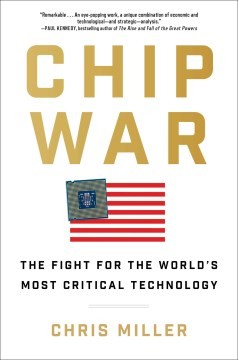
Chip War
by Chris Miller · 2022
The history of the semiconductor industry told as a geopolitical thriller, and the case that chips, not oil, are the resource great powers now fight over.
Worth reading? Chip War traces the semiconductor industry from Bell Labs and Texas Instruments through the rise of Japan, Korea, and above all Taiwan's TSMC, to today's chokepoint: a tiny number of companies (ASML above all) can produce the extreme ultraviolet lithography machines advanced chips require. Compared to a business biography like The Everything Store, this is industry-wide history with geopolitics baked in, not one company's story. It reads fast for a history this dense, and it explains genuinely confusing news (export controls, Taiwan's strategic importance) in plain terms. Skip it if you want investing tips. Read it if you want to actually understand the chip industry's chokepoints before the next headline about them.
| Full Title | Chip War: The Fight for the World's Most Critical Technology |
|---|---|
| Author | Chris Miller |
| Published | 2022 |
| Publisher | Scribner |
| Category | Business & Money |
| Favorite quote | “Software may seem to live in an ethereal world of bits, but its lifeblood is a physical process, moving electrons across silicon.” |
The Verdict
Miller’s real subject isn’t chips, it’s chokepoints: a handful of companies and one island (Taiwan) now sit at the center of a supply chain the entire global economy depends on. It’s the clearest explanation available for why export controls and TSMC keep showing up in geopolitical headlines.
you want to understand why Taiwan, TSMC, and export controls on chipmaking equipment dominate the news
you want current investing advice on chip stocks -- this is history and geopolitics, not a stock-picking guide
Book Summary
Modern chip manufacturing concentrated into an extraordinarily fragile supply chain: a handful of companies, ASML in lithography, TSMC in fabrication, dominate steps that the rest of the industry cannot replicate, making a small number of factories and even single machines globally systemic risks.
Taiwan's central role isn't accidental, it's the product of decades of deliberate industrial policy and TSMC's foundry model (making chips designed by other companies), which let it become indispensable to nearly every major tech company on earth, a fact now central to U.S.-China strategic calculations.
Export controls on chipmaking equipment have become one of the sharpest tools of great-power competition, restricting China's access to advanced lithography machines slows its military and AI ambitions more directly than most conventional sanctions ever could.
Top 7 Lessons from Chip War
- A handful of companies (ASML in lithography, TSMC in fabrication) control chokepoints the rest of the industry cannot replicate.
- Taiwan's dominance in chip fabrication is the result of deliberate decades-long industrial policy, not geographic or cultural accident.
- TSMC's foundry model, manufacturing chips designed by other companies, let it become indispensable without ever needing its own chip designs.
- Export controls on lithography equipment are now a primary tool of great-power competition, arguably sharper than traditional sanctions.
- Moore's Law's continuation depends on machines so specialized that only one company (ASML) can build them at the cutting edge.
- The chip industry's concentration means a natural disaster or conflict touching Taiwan would be a global economic shock, not a regional one.
- Japan and Korea's earlier rises in chipmaking show how quickly national dominance in this industry can shift with the right investment and policy.
Top 5 Quotes from Chip War
"Software may seem to live in an ethereal world of bits, but its lifeblood is a physical process, moving electrons across silicon."
Chris Miller, Chip War
"Taiwan produces 37 percent of the world's logic chips, and almost all of the most advanced ones."
Chris Miller, Chip War
"Whoever controls the chip supply chain controls the future of computing."
Chris Miller, Chip War
"Within four years of the iPhone's launch, Apple was making over 60 percent of all the world's profits from smartphone sales."
Chris Miller, Chip War
"China's import of chips -- $260 billion in 2017 -- was far larger than Saudi Arabia's export of oil. China spends more money buying chips each year than the entire global trade in aircraft. No product is more central to international trade than semiconductors."
Chris Miller, Chip War
Frequently Asked Questions
Is Chip War worth reading?
Yes, if you want to understand the geopolitics behind chip export controls and Taiwan's strategic importance. It's dense but reads faster than most industry histories.
What is the main argument of Chip War?
Semiconductor manufacturing is concentrated in a tiny number of companies and one island (Taiwan), and that concentration has turned chips into the central resource of great-power competition, replacing oil's old role.
Why does Taiwan matter so much in chip manufacturing?
TSMC's foundry model and decades of deliberate industrial policy made Taiwan the fabricator for most of the world's advanced chips, a concentration now central to U.S.-China strategic tension.
Ready to read it?
Get Chip War on Amazon