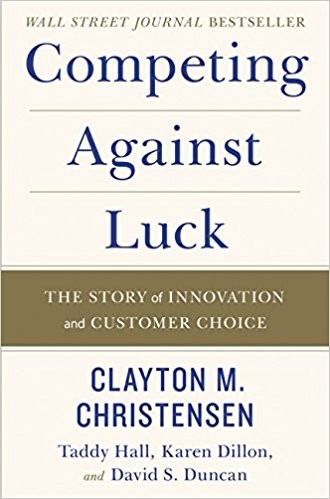
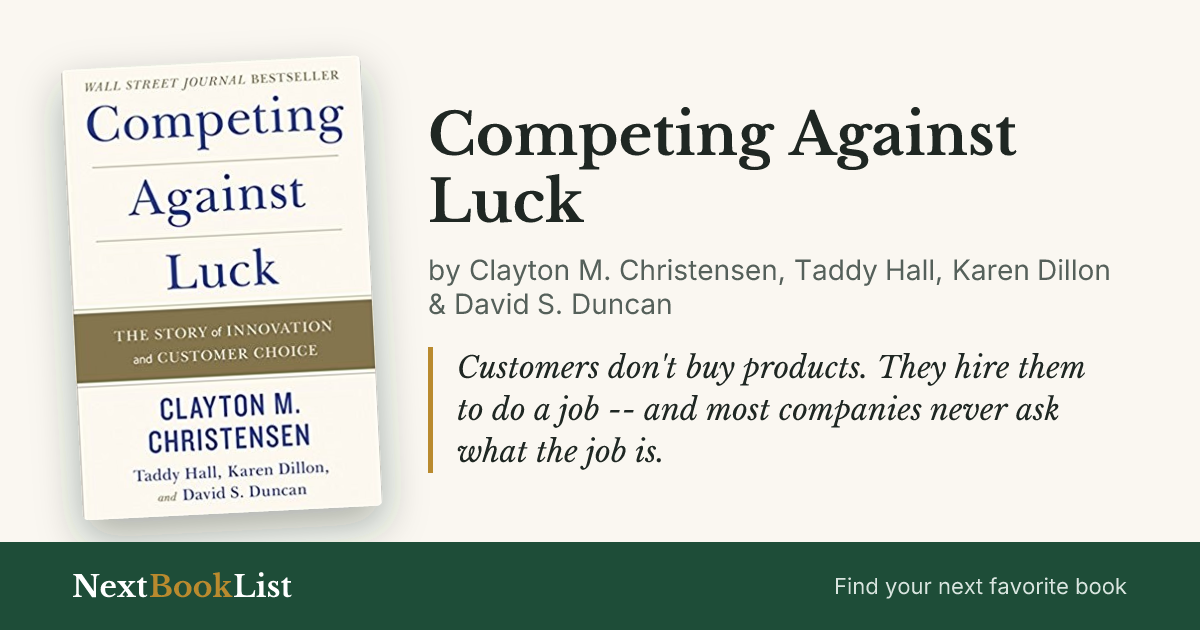
Competing Against Luck
by Clayton M. Christensen, Taddy Hall, Karen Dillon & David S. Duncan · 2016
Customers don't buy products. They hire them to do a job -- and most companies never ask what the job is.
Worth reading? Competing Against Luck gives you the theory; The Mom Test by Rob Fitzpatrick gives you the interview script to actually go find the job. Christensen, Hall, Dillon, and Duncan explain why most market research measures the wrong thing -- product attributes and demographics instead of the circumstance driving the purchase. Read this book for the framework, then use The Mom Test's questions to go do the interviews yourself. Skip Competing Against Luck if you already run disciplined JTBD interviews -- there's not much new tactic here past the theory.
| Full Title | Competing Against Luck: The Story of Innovation and Customer Choice |
|---|---|
| Author | Clayton M. Christensen, Taddy Hall, Karen Dillon & David S. Duncan |
| Published | 2016 |
| Publisher | Harper Business |
| Category | Business & Money |
| Favorite quote | “When we buy a product, we essentially 'hire' it to help us do a job.” |
The Verdict
Christensen spent decades studying why good companies fail at innovation, and this book is his cleanest answer to the flip side: how do you actually find what customers want before you build it? The milkshake study alone is worth the read – it’s the best five-minute explanation of why market research keeps missing the real reason people buy things.
you keep shipping features nobody uses and can't figure out why
you already run disciplined Jobs-to-be-Done discovery interviews -- this is the theory, not new tactics
Book Summary
The Jobs to Be Done theory, in Christensen's clearest form yet: people don't buy products or services, they hire them to make progress in a specific circumstance. The famous example is the fast-food chain that sells more milkshakes in the morning to solo commuters -- they're hiring the milkshake to make a boring commute more interesting and keep them full until lunch, not because a milkshake is a great breakfast food on paper.
Most market research asks the wrong question -- demographics and product attributes -- when it should ask about circumstance and struggle. The job is the real unit of analysis, not the customer segment. Two people with identical demographics can be hiring completely different products for completely different jobs, and two people who look nothing alike on paper can be hiring the exact same product for the exact same job.
Getting the job right changes everything downstream: product design, the marketing message, and even how you measure competition -- your milkshake competes with a bagel and a banana, not with other milkshakes. The book also warns about the gap between active and passive data: the surface-level data companies collect, like clicks and purchases, hides the actual story of the struggle that led to the purchase in the first place.
Top 10 Lessons from Competing Against Luck
- People don't buy products, they hire them for a job.
- The job is the real unit of analysis, not the customer demographic.
- Your true competition is whatever else gets the job done, not your category peers.
- Ask about circumstance and struggle, not preferences and feature wishlists.
- Two similar-looking customers can be hiring your product for two different jobs.
- Two different-looking customers can be hiring your product for the same job.
- Passive data like clicks and sales hides the actual story behind a purchase.
- Nail the job and the marketing message writes itself.
- Innovation usually fails from misunderstanding the job, not the technology.
- A milkshake's real competitor might be a banana, not another milkshake.
Top 5 Quotes from Competing Against Luck
"Customers don't buy products or services; they pull them into their lives to make progress."
Clayton M. Christensen, Taddy Hall, Karen Dillon & David S. Duncan, Competing Against Luck
"When we buy a product, we essentially 'hire' it to help us do a job."
Clayton M. Christensen, Taddy Hall, Karen Dillon & David S. Duncan, Competing Against Luck
"The job, not the customer, is the fundamental unit of analysis for a innovator seeking both to understand demand and to create products and services that customers will want to buy."
Clayton M. Christensen, Taddy Hall, Karen Dillon & David S. Duncan, Competing Against Luck
"For innovators, understanding the job is to understand what consumers care most about in that moment of trying to make progress."
Clayton M. Christensen, Taddy Hall, Karen Dillon & David S. Duncan, Competing Against Luck
"But what's important is that you focus on understanding the underlying job, not falling in love with your solution for it."
Clayton M. Christensen, Taddy Hall, Karen Dillon & David S. Duncan, Competing Against Luck
Frequently Asked Questions
Is Competing Against Luck worth reading?
Yes, if you keep shipping features that don't move usage or sales. The Jobs to Be Done framework explains why -- you're probably optimizing for demographics and feature lists instead of the actual circumstance driving the purchase.
What is the main idea of Competing Against Luck?
Customers 'hire' products to make progress in a specific situation, not because of demographic fit or a feature checklist. Understand the job -- the functional, social, and emotional progress someone's after -- and the rest of product and marketing gets much easier.
What is the milkshake example about?
A fast-food chain found morning milkshake buyers were mostly solo commuters hiring the milkshake to fight boredom and stay full until lunch. Its real competitors at that hour were bananas and bagels, not other milkshakes -- a fact no demographic study would have surfaced.
Is this the same as Jobs to Be Done theory from The Innovator's Solution?
It's the same underlying theory, but this book is Christensen's full, standalone treatment of it, written later and aimed directly at product and marketing teams rather than folded into a broader growth-strategy book.
Ready to read it?
Get Competing Against Luck on Amazon