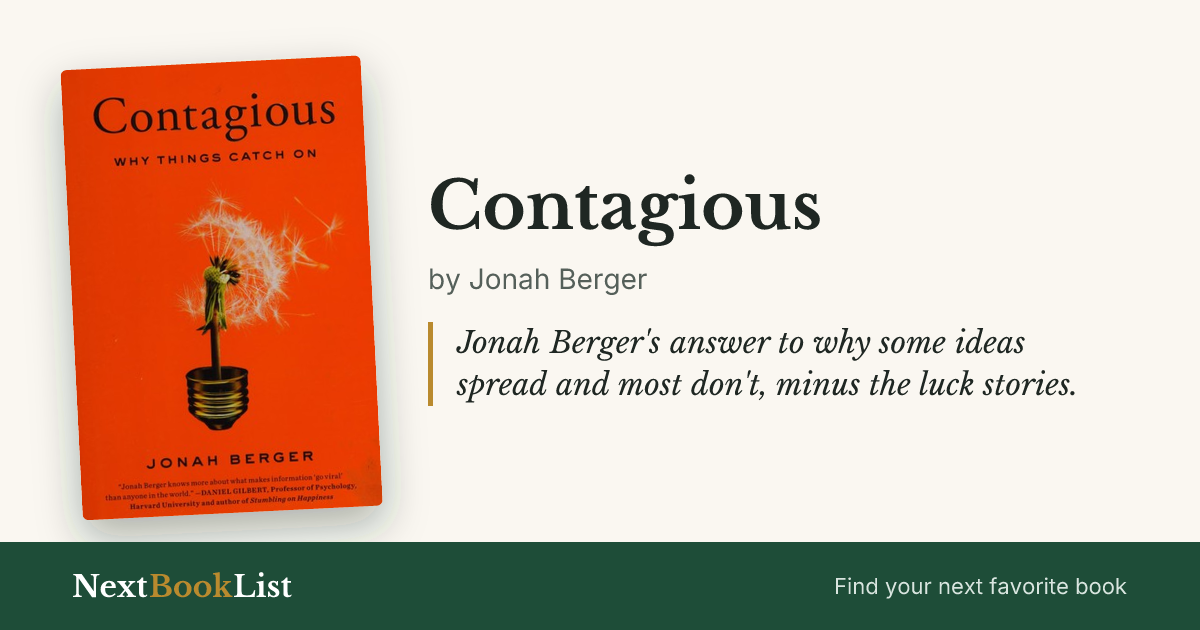
Contagious
by Jonah Berger · 2013
Jonah Berger's answer to why some ideas spread and most don't, minus the luck stories.
Worth reading? Contagious and Malcolm Gladwell's The Tipping Point both ask why some ideas spread and others die quietly, but Berger gives you something Gladwell doesn't: a repeatable framework (STEPPS) you can actually apply to your own product or message, backed by his own lab research rather than mostly historical case studies. Gladwell will make virality feel inevitable in hindsight. Berger gives you the levers before the fact. Skip it if you want Gladwell's narrative pull -- Contagious reads more like an organized research briefing than a story, and some chapters lean academic. For anyone who's tired of case studies that explain why something already went viral without telling you what to do next time, the STEPPS framework is the more actionable of the two.
| Full Title | Contagious: Why Things Catch On |
|---|---|
| Author | Jonah Berger |
| Published | 2013 |
| Publisher | Simon & Schuster |
| Category | Business & Money |
| Favorite quote | “We don't just care about the practical benefits of things; we also care what those things say about us to others.” |
The Verdict
Jonah Berger spent years running lab experiments on why people share one thing and ignore another, and Contagious is the practical output: a six-part framework instead of another collection of “here’s why this went viral” stories told after the fact. If you want levers you can actually pull, not just a better hindsight explanation, this is the more useful of the virality books.
you want the actual research behind virality, not another 'this brand went viral, here's why' case study
you want Gladwell-style storytelling over Berger's more academic, framework-driven approach
Book Summary
Berger's core question is why people talk about and share some things and not others, and his answer is that it's rarely random -- it follows a predictable set of levers he compresses into STEPPS: Social currency, Triggers, Emotion, Public, Practical value, and Stories. Anything engineered to hit several of these at once has a real, non-lucky shot at spreading.
Social currency means people share things that make them look good to share -- insider knowledge, remarkable facts, exclusive access. Triggers are environmental cues that keep an idea top of mind (a song tied to a location, a habit tied to a time of day). High-arousal emotions -- awe, excitement, anger, anxiety -- drive sharing far more than low-arousal ones like sadness or contentment, because arousal itself prompts action.
The rest of STEPPS covers public visibility (things built to be seen get imitated more), practical value (genuinely useful information gets forwarded, not just entertaining content), and stories (information travels further wrapped in a narrative than as a bare fact). Berger's case studies -- a $100 cheesesteak, a viral blender company, a chain email for kidney donation -- are chosen to show the framework working across completely different contexts, not just to entertain.
Top 10 Lessons from Contagious
- STEPPS: Social currency, Triggers, Emotion, Public, Practical value, Stories -- the six levers of contagious ideas.
- People share things that make them look good, smart, or in-the-know -- not just things they like.
- A trigger tied to a daily habit or environment keeps an idea circulating long after launch day.
- High-arousal emotions (awe, anger, anxiety) drive sharing far more than low-arousal ones like contentment.
- Anything built to be publicly visible gets imitated more than something used in private.
- Genuinely useful, practical information gets forwarded even without an emotional hook.
- Wrapping information in a story makes it travel further than the same fact presented bare.
- Virality isn't luck -- it's usually several of these six levers stacked at once.
- A remarkable product still needs a trigger to stay top of mind between purchases.
- Word of mouth outperforms advertising partly because it comes with built-in social proof.
Top 5 Quotes from Contagious
"Social currency is like the currency in your wallet: people use it to purchase psychological and social benefits."
Jonah Berger, Contagious
"We don't just care about the practical benefits of things; we also care what those things say about us to others."
Jonah Berger, Contagious
"Word of mouth is more effective than traditional advertising, and it's also more prevalent."
Jonah Berger, Contagious
"People don't think in terms of information. They think in terms of narratives. But while people focus on the story itself, information comes along for the ride."
Jonah Berger, Contagious
"Most people would rather look smart than dumb, rich than poor, and cool than geeky. Just like the clothes we wear and the cars we drive, what we talk about influences how others see us."
Jonah Berger, Contagious
Frequently Asked Questions
Is Contagious worth reading?
Yes, if you want a research-backed framework for why ideas spread rather than another retrospective case study. Skip it if you'd rather have Gladwell's narrative style -- Contagious reads more like an organized briefing than a story.
What is the main idea of Contagious?
Ideas and products spread predictably, not randomly, based on six factors Berger compresses into STEPPS: social currency, triggers, emotion, public visibility, practical value, and stories.
What is STEPPS in Contagious?
Berger's framework for why things catch on: Social currency, Triggers, Emotion, Public visibility, Practical value, and Stories. Ideas that hit several of these at once have a real shot at spreading.
Is Contagious better than The Tipping Point?
They ask the same question from different angles. The Tipping Point explains virality through narrative and hindsight; Contagious gives you an applicable framework backed by Berger's own research. Read Contagious if you want something to actually apply.
Ready to read it?
Get Contagious on Amazon