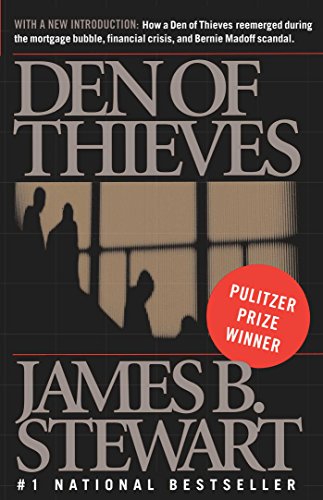
Den of Thieves
by James B. Stewart · 1991
The definitive account of the 1980s insider-trading scandal that took down Michael Milken and Ivan Boesky, reported like a thriller, sourced like investigative journalism.
Worth reading? Den of Thieves is investigative journalism at its most propulsive -- Stewart, a Pulitzer-winning reporter, reconstructs the Milken-Boesky insider-trading and junk-bond scandal with a level of sourcing and narrative pacing that made it a bestseller despite covering securities law violations, hardly the most naturally thrilling subject. It's the finance-crime counterpart to Liar's Poker's finance-culture memoir -- read both for a fuller picture of 1980s Wall Street excess from two different angles.
| Author | James B. Stewart |
|---|---|
| Published | 1991 |
| Category | Business & Money |
| Favorite quote | “Greed... had made him one of the richest men in America. But greed had also made him a criminal.” |
The Verdict
Stewart’s reporting holds up because it’s genuinely sourced, not reconstructed from press clippings – he had access most journalists covering the case didn’t, and it shows in the granular detail of how the scheme actually operated and unraveled. Read it as the definitive account of a case that reshaped securities enforcement for a generation.
you want a meticulously reported, thriller-paced account of how the biggest insider-trading and securities fraud case of the 1980s actually unfolded
you want investment or business strategy advice, this is investigative journalism about financial crime, not a how-to book
Book Summary
Stewart reconstructs how Michael Milken's junk-bond empire at Drexel Burnham Lambert, combined with arbitrageur Ivan Boesky's insider trading, created a scheme where illegally obtained nonpublic information about pending takeovers was traded on systematically, generating enormous profits until federal investigators, aided by Boesky turning informant in a plea deal, unraveled the network.
The book's larger argument is about how financial innovation (Milken's junk bonds genuinely did democratize corporate financing for companies that couldn't access investment-grade credit) can run parallel to and eventually enable systemic fraud, and how the same aggressive, secretive culture that produces genuine market innovation can also produce criminal conspiracy when incentives and oversight fail to keep pace.
Top 7 Lessons from Den of Thieves
- Insider trading schemes often unravel through a single participant turning informant under legal pressure, not through external detection alone.
- Financial innovation (junk bonds) and financial crime can develop from the same aggressive, secretive institutional culture.
- Regulatory and prosecutorial patience over years, building a case incrementally, can eventually unwind even a well-hidden conspiracy.
- Reputation built on genuine innovation (Milken's role in junk-bond financing) doesn't preclude later criminal liability.
- Complex financial instruments can obscure both risk and illegal information advantages from regulators for years.
- Plea deals from insiders (like Boesky's) are often the actual mechanism that exposes systemic fraud, not initial external investigation.
- Aggressive corporate culture that rewards secrecy and risk-taking without accountability creates conditions where fraud can flourish undetected.
Top 1 Quotes from Den of Thieves
"Greed... had made him one of the richest men in America. But greed had also made him a criminal."
James B. Stewart, Den of Thieves
Frequently Asked Questions
Is Den of Thieves worth reading?
Yes, especially if you want a meticulously reported, thriller-paced account of 1980s Wall Street's biggest insider-trading scandal. It's investigative journalism, not investment advice.
What is Den of Thieves about?
James B. Stewart's investigative account of the insider-trading and securities fraud scandal involving Michael Milken's junk-bond operation at Drexel Burnham Lambert and arbitrageur Ivan Boesky, and the federal investigation that unraveled it.
Who are the main figures in Den of Thieves?
Michael Milken, the junk-bond financier at Drexel Burnham Lambert, and Ivan Boesky, the arbitrageur whose plea deal and cooperation with prosecutors helped expose the broader scheme.
How is Den of Thieves different from Liar's Poker?
Den of Thieves is investigative journalism about a specific insider-trading and fraud case. Liar's Poker is a personal memoir about Wall Street trading-floor culture. Together they cover 1980s Wall Street excess from crime and culture angles respectively.
Ready to read it?
Get Den of Thieves on Amazon