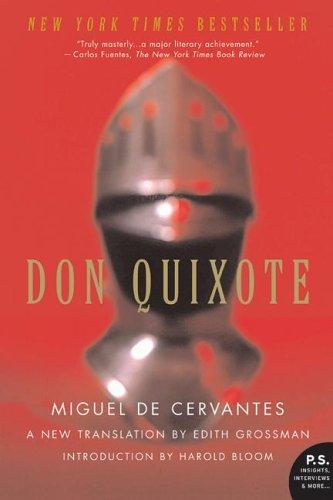
Don Quixote
by Miguel de Cervantes · 1605
A delusional old man convinces his neighbor to become his squire and go fight windmills he's certain are giants, and four hundred years later it's still the funniest, saddest book about believing your own story.
Worth reading? Don Quixote is worth the commitment because almost nothing else from 1605 still reads as funny and as sad in the same paragraph. Get the Edith Grossman translation specifically, older English versions flatten the comic timing. Skip it only if you want a tightly plotted story rather than a picaresque that circles the same joke from a dozen angles.
| Full Title | Don Quixote (Edith Grossman Translation) |
|---|---|
| Author | Miguel de Cervantes |
| Published | 1605 |
| Publisher | Ecco / Harper Perennial |
| Category | Fiction |
| Favorite quote | “The truth may be stretched thin, but it never breaks, and it always surfaces above lies, as oil floats on water.” |
The Verdict
The windmill scene gets all the cultural shorthand, but the real reason this book has lasted four hundred years is Part Two, where Cervantes lets other characters read Part One and use it against Quixote. That move, a novel’s characters reacting to their own fictional fame, was genuinely radical, and it’s still funnier and stranger than most metafiction written since.
Read this over any modern picaresque or road novel when you want the original, the book that both invented and immediately started interrogating its own genre.
you want the book that basically invented the modern novel, and you're fine with something that's part comedy, part tragedy, and genuinely long
you want tight, modern pacing, this is an episodic picaresque written across two parts a decade apart, and it wanders on purpose
Book Summary
Alonso Quixano, an aging minor nobleman, reads too many chivalric romances and loses his grip on reality. He renames himself Don Quixote, arms himself with rusty gear, and sets out to revive knight-errantry, recruiting a poor farmer, Sancho Panza, as his squire with promises of an island to govern.
Cervantes uses Quixote's delusion to satirize the chivalric romance genre that was wildly popular in his time, but the satire softens as the book goes on. Quixote's madness is frequently more honest, and more admirable, than the "sane" world that mocks him for it.
Part Two, published a full decade after Part One, gets genuinely strange: characters have read Part One and stage elaborate hoaxes to exploit Quixote's delusion for sport, which turns the joke back on the reader as much as on him. By the time Quixote returns to sanity near the end, it reads less like a triumph and more like a defeat.
Top 10 Lessons from Don Quixote
- Alonso Quixano loses himself in chivalric romance novels and renames himself Don Quixote, setting out to revive knight-errantry on a broken-down horse.
- He recruits Sancho Panza, a poor and practical farmer, as his squire, promising him governorship of an island that doesn't exist.
- Quixote mistakes ordinary things, windmills, roadside inns, flocks of sheep, for the enemies and marvels of chivalric romance, the windmill scene being the most famous instance.
- Cervantes satirizes chivalric romance directly, but treats Quixote's delusion with growing sympathy rather than pure mockery as the book progresses.
- Sancho's earthy practicality and Quixote's idealism collide constantly, and their running argument is the novel's real engine, more than any single adventure.
- In Part Two, characters have read Part One and stage elaborate hoaxes to exploit Quixote's delusion for their own amusement, cruelty dressed up as entertainment.
- Sancho eventually gets a real, staged governorship and turns out to be a shrewd, fair administrator, undercutting the idea that only nobles govern well.
- Quixote's return to sanity near his death reads as a defeat, the world that 'cures' him also drains him of purpose.
- The novel keeps blurring who's more foolish, Quixote for believing his fantasy, or the people who manipulate and mock him for sport.
- Don Quixote is widely credited as the first modern novel, its self-awareness about fiction and storytelling was radical for 1605.
Top 4 Quotes from Don Quixote
"In short, from so little sleep and so much reading, his brain dried up, and he lost his mind."
Miguel de Cervantes, Don Quixote
"The truth may be stretched thin, but it never breaks, and it always surfaces above lies, as oil floats on water."
Miguel de Cervantes, Don Quixote
"I know who I am, and who I may be, if I choose."
Miguel de Cervantes, Don Quixote
"Where there's music, there can be no evil."
Miguel de Cervantes, Don Quixote
Frequently Asked Questions
Is Don Quixote worth reading?
Yes, it's the foundational novel of Western literature and still genuinely funny, not just historically important. Skip it if you want tight pacing over a sprawling episodic structure.
What is Don Quixote about?
A delusional Spanish nobleman convinces himself he's a knight-errant and sets out with his squire, Sancho Panza, to revive chivalry, mistaking ordinary people and objects for the villains and marvels of romance novels.
Is Don Quixote hard to read?
It's long and episodic, but not dense, the prose is comic and accessible in a good modern translation like Edith Grossman's. The main challenge is stamina, not difficulty.
Which translation of Don Quixote should I read?
Edith Grossman's 2003 translation is the modern standard, praised for keeping the comic timing intact. Older public-domain translations tend to read stiffer and less funny.
Ready to read it?
Get Don Quixote on Amazon