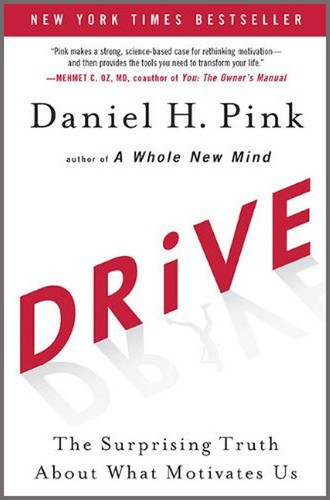
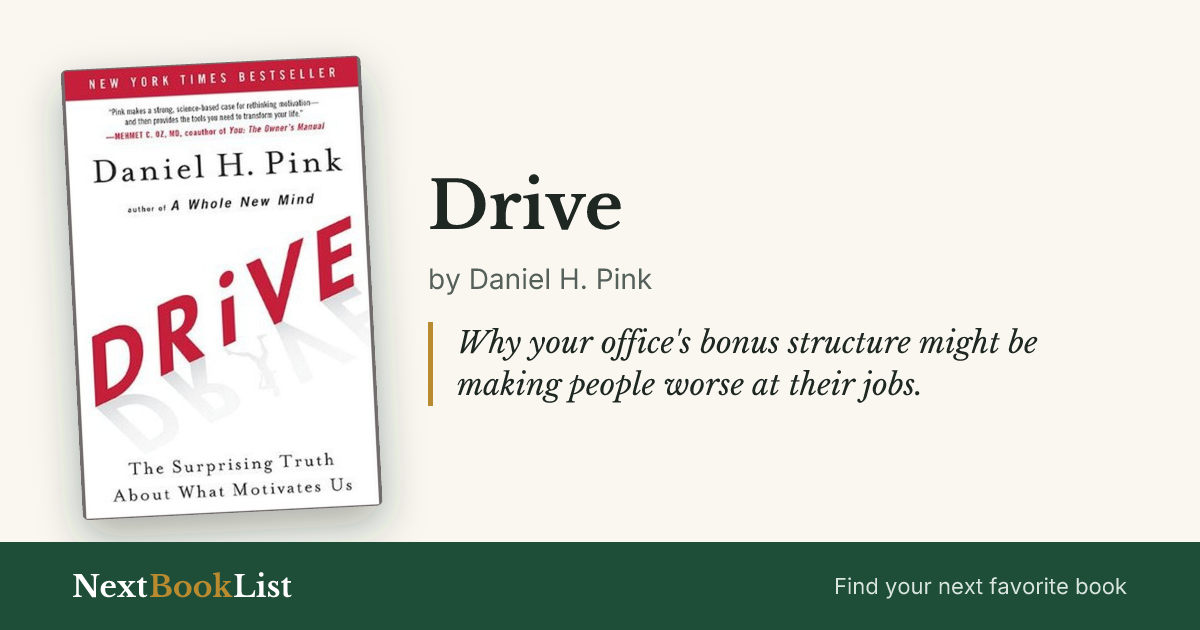
Drive
by Daniel H. Pink · 2009
Why your office's bonus structure might be making people worse at their jobs.
Worth reading? Drive and Angela Duckworth's Grit both explain why some people outperform more talented peers, but they're answering different questions. Grit is about sustained effort over years -- why some people don't quit. Drive is about the conditions that make effort feel worth sustaining in the first place: autonomy, mastery, and purpose, instead of a bonus dangling in front of you. Read Grit if your problem is persistence. Read Drive if your problem is that the incentive structure around you (or the one you built for your team) is quietly killing motivation for real work. Skip it if your team's work is genuinely mechanical and repetitive -- Pink is upfront that traditional if-then rewards still work fine for narrow, rule-based tasks. The book's real audience is anyone managing or doing creative, cognitive, judgment-heavy work, where the candle-problem research he leans on shows extrinsic rewards actively narrow thinking instead of sharpening it.
| Full Title | Drive: The Surprising Truth About What Motivates Us |
|---|---|
| Author | Daniel H. Pink |
| Published | 2009 |
| Publisher | Riverhead Books |
| Category | Business & Money |
| Favorite quote | “Carrots and sticks are so twentieth century.” |
The Verdict
Daniel Pink spent Drive dismantling a management assumption most companies never question: that bigger rewards produce better performance. The research says otherwise for anything beyond rote work, and Pink’s autonomy-mastery-purpose model is the most widely cited alternative. If you’ve ever watched a bonus scheme backfire, this book explains why.
you manage people, or manage yourself, and want to know why carrot-and-stick incentives keep backfiring
your team does manual, repetitive, low-skill work -- Pink himself says carrots and sticks still work fine there
Book Summary
Pink's argument starts with a body of research showing that "if-then" rewards -- do this, get that -- work fine for simple mechanical tasks but actively hurt performance on anything requiring creativity or problem-solving. The classic example is the candle problem: give people a cash reward for solving it fast, and they solve it slower, because the reward narrows focus exactly when the task needs open, associative thinking.
He calls the old model Motivation 2.0 -- carrots and sticks, upgraded slightly from Motivation 1.0's pure survival instinct, but still fundamentally about external control. Motivation 3.0 is his proposed upgrade: people are wired for autonomy (control over their own work), mastery (the urge to get better at something that matters), and purpose (connecting the work to something bigger than the paycheck). Where those three are present, people outperform what any bonus structure could buy.
Practically, this means rethinking how work gets structured, not just how it gets paid. Autonomy over task, time, technique, and team; deliberate practice aimed at mastery instead of hitting a quota; and a stated purpose beyond profit. Pink's case is that companies chasing performance through bigger bonuses are optimizing the wrong lever entirely.
Top 10 Lessons from Drive
- If-then rewards work for mechanical tasks and backfire on creative, judgment-heavy ones.
- The candle problem shows cash incentives can narrow thinking exactly when a task needs it open.
- Motivation 2.0 (carrots and sticks) is being replaced by Motivation 3.0 (autonomy, mastery, purpose).
- Autonomy means control over task, time, technique, and team -- not just 'do what you're told, when you're told.'
- Mastery is a mindset, not a destination -- the urge to keep getting better never fully resolves.
- Purpose (why the work matters) sustains effort longer than a bonus ever will.
- Bigger bonuses for creative work can shrink performance instead of growing it.
- People do their best work when they feel ownership over it, not surveillance of it.
- ROWE (results-only work environments) test the autonomy thesis directly -- judge output, not hours.
- Praise and rewards tied too tightly to outcomes teach people to chase the reward, not the mastery.
Top 4 Quotes from Drive
"Human beings have an innate inner drive to be autonomous, self-determined, and connected to one another."
Daniel H. Pink, Drive
"Control leads to compliance; autonomy leads to engagement."
Daniel H. Pink, Drive
"The secret to high performance and satisfaction... is the deeply human need to direct our own lives, to learn and create new things, and to do better by ourselves and our world."
Daniel H. Pink, Drive
"Carrots and sticks are so twentieth century."
Daniel H. Pink, Drive
Frequently Asked Questions
Is Drive worth reading?
Yes, if you manage people doing creative or judgment-heavy work -- the autonomy, mastery, purpose framework explains why bonuses often backfire. Skip it if your team's work is mechanical and repetitive; traditional incentives still work there.
What is the main idea of Drive?
Traditional carrot-and-stick incentives work for simple tasks but hurt performance on creative work. What actually drives high performance is autonomy, mastery, and purpose.
What is Motivation 3.0 in Drive?
Pink's term for intrinsic motivation built on autonomy (control over your work), mastery (getting better at something that matters), and purpose (connecting work to something bigger), replacing the old carrot-and-stick model.
Is Drive better than Grit?
They answer different questions. Grit explains why some people sustain effort over years; Drive explains what conditions make that effort feel worth sustaining. Read Drive first if your issue is a bad incentive structure, not a lack of persistence.
Ready to read it?
Get Drive on Amazon