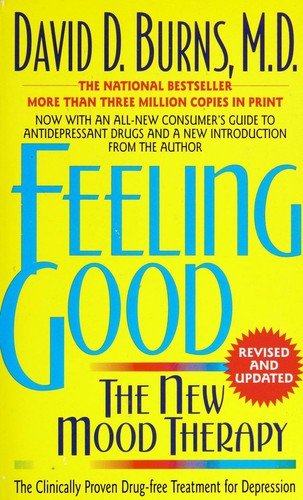
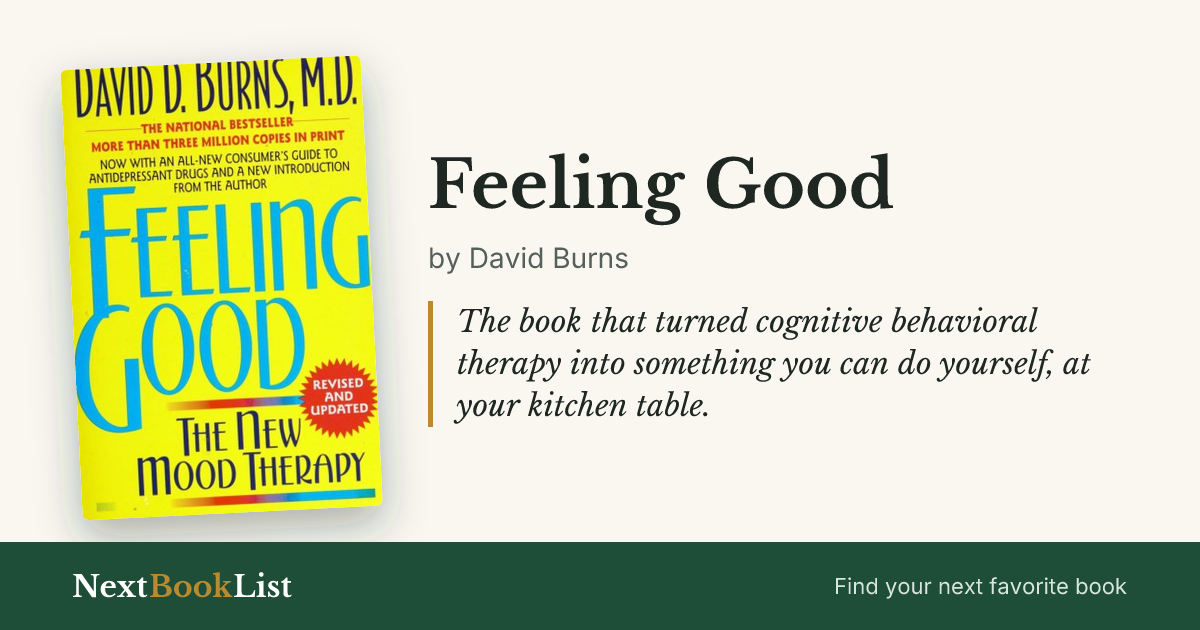
Feeling Good
by David Burns · 1980
The book that turned cognitive behavioral therapy into something you can do yourself, at your kitchen table.
Worth reading? Feeling Good is the most clinically-tested self-help book on this list -- studies have shown reading it alone measurably reduces depressive symptoms, which is more than can be said for most of the genre. It's dry and repetitive in the way a workbook is dry and repetitive, but the ten cognitive distortions Burns lays out (all-or-nothing thinking, catastrophizing, mind reading) are genuinely useful tools you'll start noticing in your own head within days. Pair it with Learned Optimism if you want the explanatory-style angle on top of the CBT one.
| Full Title | Feeling Good: The New Mood Therapy |
|---|---|
| Author | David Burns |
| Published | 1980 |
| Category | Self-Improvement & Psychology |
| Favorite quote | “You feel the way you think.” |
The Verdict
Burns writes like a doctor handing you a workbook, not a guru handing you a mantra, and that’s the point. The ten cognitive distortions alone are worth the price of the book – once you can name “catastrophizing” or “mind reading” in real time, you can’t unsee it in your own thinking. It’s long and can feel repetitive if you read it straight through, but it’s designed to be used, not just read.
you want a practical, worksheet-based way to catch and correct the distorted thoughts driving anxiety or low mood
you're dealing with a severe mood disorder, this supplements therapy, it doesn't replace it, and the book says so itself
Book Summary
Your emotions come from your thoughts, not from events themselves -- and those thoughts are frequently distorted in predictable, nameable ways. Burns catalogs ten cognitive distortions (all-or-nothing thinking, overgeneralization, mental filtering, jumping to conclusions, catastrophizing, and more), and just being able to name the distortion you're running takes a lot of its power away.
The fix is not positive thinking, it's accurate thinking. Burns has you write down the automatic negative thought, identify which distortion it fits, and then write a more realistic response -- a mechanical process that works precisely because it doesn't require you to feel better first, only to think more precisely.
Top 8 Lessons from Feeling Good
- Emotions follow thoughts, not events -- change the thought, change the feeling.
- Name the cognitive distortion (all-or-nothing thinking, catastrophizing, mind reading) to defang it.
- Write automatic negative thoughts down instead of just replaying them in your head.
- Replace 'should' statements with realistic ones -- 'should' thinking manufactures guilt.
- Don't confuse how you feel with what's actually true; feelings aren't evidence.
- Small, daily thought-record practice beats occasional deep introspection.
- Self-esteem built on achievement is fragile; build it on a stable sense of worth instead.
- Perfectionism isn't high standards -- it's a distortion that guarantees you'll always feel like you failed.
Top 4 Quotes from Feeling Good
"You feel the way you think."
David Burns, Feeling Good
"Your thoughts create your emotions; therefore your emotions cannot prove that your thoughts are accurate."
David Burns, Feeling Good
"Cognitions are not deep, dark, hidden entities. They are simply your ongoing thoughts, which occur just at, or slightly above, the level of awareness."
David Burns, Feeling Good
"There is no such thing as a 'hopeless case.'"
David Burns, Feeling Good
Frequently Asked Questions
Is Feeling Good worth reading?
Yes -- it's one of the few self-help books backed by clinical studies showing it measurably helps with mild-to-moderate depression and anxiety, not just anecdote.
What is the main idea of Feeling Good?
Your moods come from your thoughts, and many negative thoughts are distorted in specific, identifiable ways. Correcting the distortion corrects the mood.
Can Feeling Good replace therapy?
No. Burns designed it as a self-help supplement to CBT, and it works well alongside therapy or on its own for milder cases, but it isn't a substitute for treating serious depression.
How is Feeling Good different from The Road Less Traveled?
Feeling Good is clinical and secular -- worksheets and named cognitive distortions. The Road Less Traveled is more philosophical and explicitly spiritual. Different tools for a similar problem.
Ready to read it?
Get Feeling Good on Amazon