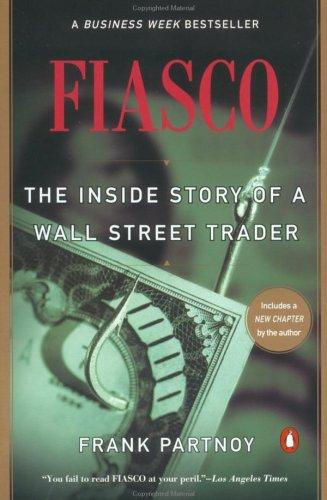
F.I.A.S.C.O.
by Frank Partnoy · 1997
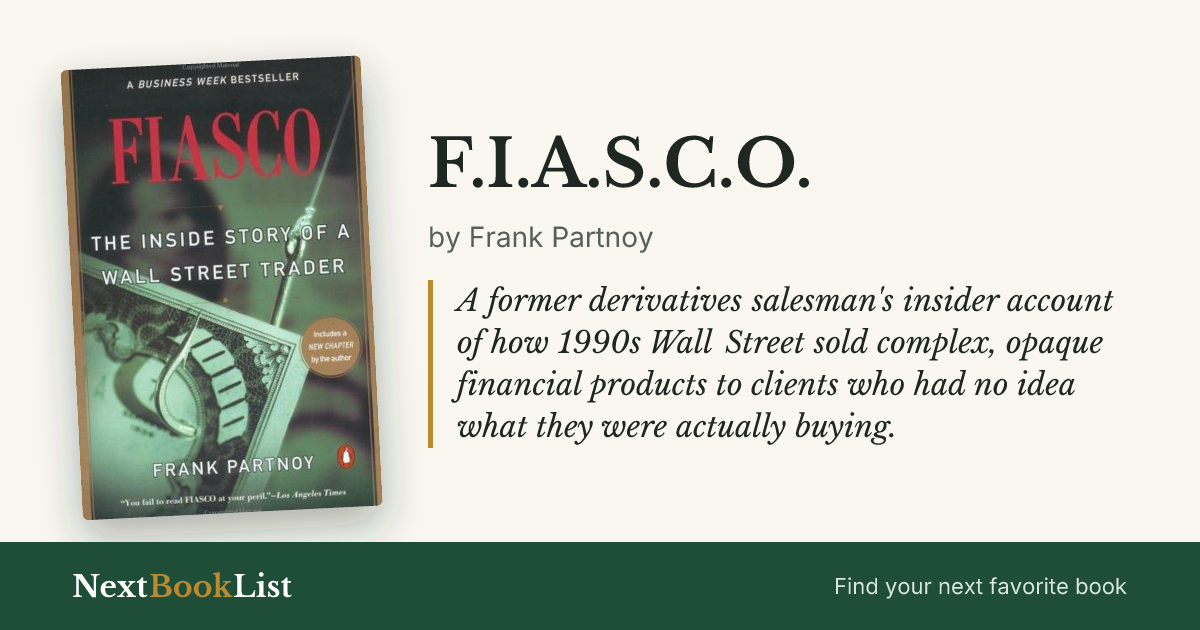
A former derivatives salesman's insider account of how 1990s Wall Street sold complex, opaque financial products to clients who had no idea what they were actually buying.
Worth reading? Partnoy worked as a derivatives salesman at Morgan Stanley before writing this, and the insider vantage gives F.I.A.S.C.O. real teeth -- he describes, specifically, how complex derivative products were engineered to be difficult for clients to understand and value, generating large fees while transferring risk that clients often didn't fully grasp they were taking on. It's the derivatives-specific companion to Liar's Poker's broader trading-culture memoir, and reads as an early, insider warning about dynamics that would recur, at greater scale, in 2008.
| Full Title | F.I.A.S.C.O.: Blood in the Water on Wall Street |
|---|---|
| Author | Frank Partnoy |
| Published | 1997 |
| Category | Business & Money |
| Favorite quote | “Derivatives are financial weapons of mass destruction... but I saw them differently: as tools for separating fools from their money.” |
The Verdict
Partnoy had a front-row seat to exactly the kind of incentive misalignment that would matter at a much bigger scale a decade later, and the book reads today as an early warning most of Wall Street didn’t heed. It’s a sharper, more specifically technical companion to Liar’s Poker – read both if you want the full trading-floor-to-derivatives-desk picture of the era.
you want a firsthand, insider account of how derivatives desks operated and misled clients in the 1990s, ahead of later crises the same dynamics contributed to
you want current, technical derivatives education, this is a memoir-style exposé of a specific era's sales culture, not a textbook on how derivatives actually work today
Book Summary
Complexity, in the derivatives business Partnoy describes, wasn't an unavoidable byproduct of sophisticated finance -- it was often a deliberate sales tool, engineered specifically to make a product's true risk and cost difficult for the client to independently evaluate, which let the selling firm extract larger fees than a transparent, easily-priced product would allow. Clients who should have known better, including sophisticated institutional buyers, repeatedly got burned by products they couldn't actually model themselves.
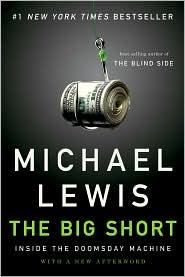
Partnoy also documents the intense, ethically loose sales culture on the derivatives desk itself, where compensation was tied directly to how much complexity (and margin) a salesperson could push through, creating individual incentives that ran directly counter to client interests -- a specific, insider-documented version of the incentive misalignment that Michael Lewis would later chronicle at broader scale in The Big Short.
Top 7 Lessons from F.I.A.S.C.O.
- Product complexity can be a deliberate sales tool, not just a technical byproduct, when it obscures true risk and cost from the buyer.
- Sophisticated institutional buyers can still get burned by products they can't independently model or price.
- Sales compensation tied to product complexity and margin creates incentives directly opposed to client interests.
- Ask whether you can independently verify a financial product's actual risk and value before buying it, however sophisticated the seller.
- Insider accounts (like this one) can expose systemic dynamics that external analysis alone often misses.
- Watch for the pattern of complexity used to justify high fees rather than to solve a genuine problem for the client.
- Individual moral discomfort within a corrosive incentive structure, as Partnoy describes his own experience, is worth taking seriously as a signal, not suppressing.
Top 1 Quotes from F.I.A.S.C.O.
"Derivatives are financial weapons of mass destruction... but I saw them differently: as tools for separating fools from their money."
Frank Partnoy, F.I.A.S.C.O.
Frequently Asked Questions
Is F.I.A.S.C.O. worth reading?
Yes, especially if you're interested in Wall Street culture and derivatives from an insider account. It's a memoir-style exposé rather than a technical guide, and reads as an early warning about incentive dynamics that recurred at larger scale later.
What is F.I.A.S.C.O. about?
Frank Partnoy's firsthand account of working as a derivatives salesman at Morgan Stanley in the 1990s, describing how complex derivative products were engineered to obscure risk and generate large fees, often at clients' expense.
Is F.I.A.S.C.O. similar to Liar's Poker?
Yes, both are insider Wall Street memoirs from former traders/salespeople turned writers, though F.I.A.S.C.O. focuses specifically on the derivatives business, while Liar's Poker covers broader bond-trading floor culture.
Does F.I.A.S.C.O. connect to the 2008 financial crisis?
Not directly (it predates 2008 by over a decade), but the incentive misalignment and product complexity it documents in 1990s derivatives sales foreshadow dynamics that contributed to the later crisis, which Michael Lewis covers directly in The Big Short.
Ready to read it?
Get F.I.A.S.C.O. on Amazon