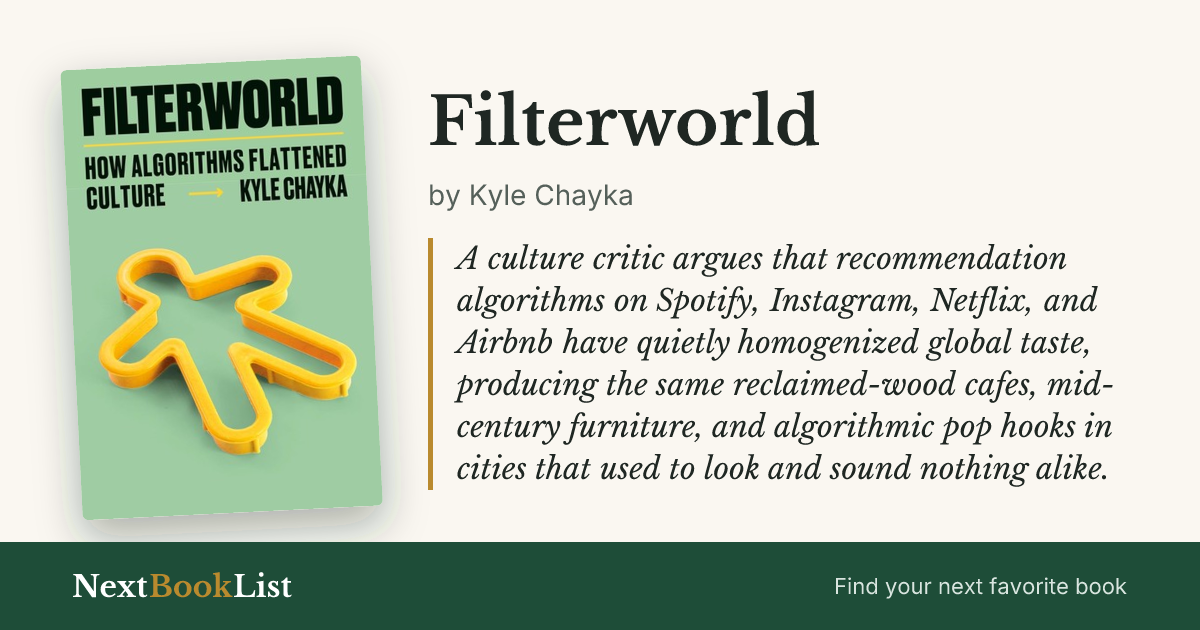
Filterworld
by Kyle Chayka · 2024
A culture critic argues that recommendation algorithms on Spotify, Instagram, Netflix, and Airbnb have quietly homogenized global taste, producing the same reclaimed-wood cafes, mid-century furniture, and algorithmic pop hooks in cities that used to look and sound nothing alike.
Worth reading? Chayka's central observation, that a cafe in Nairobi, Tokyo, and Portland increasingly look the same, all reclaimed wood, hanging plants, and minimalist signage, isn't new to anyone who travels, but he's the first to trace it convincingly to a specific mechanism: recommendation algorithms across platforms converge on the same 'legible,' algorithm-friendly aesthetic because that aesthetic photographs well, avoids controversy, and reliably triggers engagement, so it gets amplified everywhere at once, everywhere the same. It's sharply observed, well-reported cultural criticism, more essayistic argument than empirical study, but the concept of 'Filterworld,' a single flattened aesthetic layer sitting on top of what used to be distinct local cultures, is a genuinely useful new term for something a lot of readers will recognize immediately once it's named.
| Full Title | Filterworld: How Algorithms Flattened Culture |
|---|---|
| Author | Kyle Chayka |
| Published | 2024 |
| Publisher | Doubleday |
| Category | Sociology & Culture |
| Favorite quote | “Taste goes beyond superficial observation, beyond identifying something as 'cool.' Taste requires experiencing the creation in its entirety and evaluating one's own authentic emotional response to it, parsing its effect. Taste is not passive; it requires effort.” |
The Verdict
Chayka names something you’ve probably already half-noticed on your own: the coffee shop in Lisbon, the Airbnb in Austin, and the co-working space in Seoul have started to look suspiciously like the same room. Reclaimed wood, hanging plants, a specific font on the sign. He calls the phenomenon “Filterworld,” and the term is genuinely useful because it names a pattern most travelers have felt without being able to explain.
The explanation is the book’s real contribution. It’s not that everyone independently decided to like the same aesthetic. It’s that Instagram, Spotify, Airbnb, and Netflix are all, separately and without coordinating, optimizing for the same thing: content that reads clearly and pleasantly in a few seconds, avoids anything ambiguous or divisive, and therefore gets shared and re-recommended more. That selection pressure, applied across enough platforms for long enough, quietly produces one global aesthetic layer sitting on top of what used to be distinct local cultures.
The specific mechanisms are the most convincing part: Instagram rewarding photogenic spaces until cafe owners design for the photo first, Spotify rewarding songs with a hook in the first several seconds until songwriters write to that clock, Airbnb rewarding one replicable interior style until every listing converges on it. None of these are conspiracies. They’re independent optimization loops landing on the same answer.
Read it if you’ve felt this flattening firsthand while traveling or scrolling and want the mechanism named and explained by someone who’s thought about it seriously and reported it out across several industries.
Skip it if you need hard statistical measurement of cultural homogenization to find an argument credible. Chayka is a critic building a case from observation, travel, and interviews, not a sociologist running a quantitative study, and the book is stronger as a sharp, well-written essay-length argument than as rigorously proven empirical claim. For naming and explaining a real, widely felt phenomenon, it’s one of the better recent books on culture and technology.
you've noticed every trendy coffee shop, Airbnb, and Spotify playlist starting to feel interchangeable no matter what city you're in, and want a sharp cultural critic's explanation for why, and what specifically got lost
you want hard data and empirical measurement of cultural homogenization rather than a critic's argument built from travel, observation, and industry interviews -- this is cultural criticism in the tradition of a sharp essayist, not a quantitative sociology study
Book Summary
Chayka argues that recommendation algorithms across seemingly unrelated platforms, Spotify, Instagram, Netflix, Airbnb, Yelp, converge on rewarding the same kind of content: visually and sonically "legible" work that reads clearly and pleasantly within a few seconds, avoids ambiguity or controversy, and is therefore more likely to be shared, liked, and re-recommended.
This convergence, he argues, produces "Filterworld": a single homogenized global aesthetic layer, the same reclaimed-wood coffee shop, the same mid-century modern Airbnb interior, the same algorithmically optimized pop song structure, appearing in wildly different cities and cultures that previously had distinct local aesthetics.
He traces specific mechanisms behind the flattening: Instagram's engagement-optimized feed rewarding photogenic, easily-parsed spaces over idiosyncratic ones; Spotify's playlist algorithms rewarding songs with specific structural features (like quick hooks) that perform well in autoplay and recommendation contexts; and Airbnb's rating and search systems rewarding a specific, replicable interior design style.
Chayka argues the cost of this flattening isn't just aesthetic sameness but a genuine loss of local distinctiveness and cultural risk-taking, since algorithmically-favored content systematically underweights the ambiguous, challenging, or hyper-local work that doesn't translate well into a thumbnail or a 30-second preview.
Top 8 Lessons from Filterworld
- Recommendation algorithms across unrelated platforms (Spotify, Instagram, Airbnb, Netflix) converge on rewarding the same kind of 'legible' content -- visually or sonically clear, non-controversial, easily parsed in seconds.
- This convergence produces 'Filterworld,' Chayka's term for a single homogenized global aesthetic layer replacing what used to be distinct local design and cultural styles.
- Instagram's engagement-optimized feed specifically rewards photogenic, easily-parsed physical spaces, which has measurably influenced how cafes, restaurants, and retail spaces are actually designed worldwide.
- Spotify's algorithm rewards songs with specific structural features, like a hook arriving within the first several seconds, that perform well in autoplay and recommendation contexts, subtly shaping how songwriters actually write.
- Airbnb's search and rating systems reward a specific, replicable interior design style, which is why short-term rentals across very different cities have converged on similar mid-century-modern-adjacent interiors.
- Algorithmically-favored content systematically underweights ambiguous, challenging, or hyper-local work that doesn't translate well into a thumbnail, preview clip, or quick scroll, which represents a real cultural loss, not just an aesthetic one.
- The flattening effect isn't the result of a single company's deliberate design choice -- it emerges from many different platforms independently optimizing for engagement, converging on similar outcomes without coordination.
- Algorithmic recommendation replaced older cultural gatekeeping systems (critics, local scenes, word of mouth) with a system that optimizes for immediate legibility over long-term cultural value or distinctiveness.
Top 3 Quotes from Filterworld
"Frictionlessness is always the Filterworld ideal -- as soon as you slow down, you might just reconsider what you're clicking on and giving your data away."
Kyle Chayka, Filterworld
"Taste goes beyond superficial observation, beyond identifying something as 'cool.' Taste requires experiencing the creation in its entirety and evaluating one's own authentic emotional response to it, parsing its effect. Taste is not passive; it requires effort."
Kyle Chayka, Filterworld
"In passively consuming what I was interested in, had I given up my agency to figure out what was truly meaningful to me?"
Kyle Chayka, Filterworld
Frequently Asked Questions
Is Filterworld worth reading?
Yes, if you've noticed cafes, Airbnbs, and playlists starting to feel interchangeable across different cities and want a sharp critic's explanation of the specific algorithmic mechanism behind it, rather than a vague sense that 'everything looks the same now.'
What does 'Filterworld' mean?
Chayka's term for the single, homogenized global aesthetic layer produced when recommendation algorithms across unrelated platforms (Spotify, Instagram, Airbnb, Netflix) all converge on rewarding the same easily-parsed, non-controversial, engagement-friendly content.
Why do coffee shops look the same everywhere now, according to Filterworld?
Chayka argues Instagram's engagement-optimized feed specifically rewards photogenic, easily-parsed physical spaces, which has measurably shaped how cafes and retail spaces are actually designed worldwide, converging on reclaimed wood, hanging plants, and minimalist signage.
Is Filterworld based on data or opinion?
It's cultural criticism built from travel, observation, and industry interviews, in the tradition of a sharp essayist, not a quantitative empirical study -- read it for the argument and the newly useful vocabulary, not for statistical rigor.
Ready to read it?
Get Filterworld on Amazon