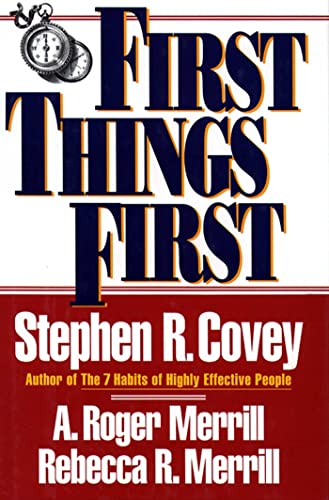
First Things First
by Stephen R. Covey, A. Roger Merrill & Rebecca R. Merrill · 1994
The Covey follow-up that ditched to-do lists for a time-management matrix built around what actually matters, not what's loudest.
Worth reading? First Things First takes Habit 3 from The 7 Habits of Highly Effective People and builds an entire book around it, centered on the four-quadrant matrix: urgent/important, important/not urgent, urgent/not important, and neither. Covey's real argument is that most people live reactively in quadrant one (urgent and important, i.e. crisis mode) when they should be investing in quadrant two (important, not urgent) before it becomes a crisis. It's a genuinely useful reframe, though if you've already read The 7 Habits closely, a lot of this will feel like a deep dive on material you've seen.
| Author | Stephen R. Covey, A. Roger Merrill & Rebecca R. Merrill |
|---|---|
| Published | 1994 |
| Category | Self-Improvement & Psychology |
| Favorite quote | “The key is not to prioritize what's on your schedule, but to schedule your priorities.” |
The Verdict
The four-quadrant matrix is the single idea worth extracting even if you never read the full book – most productivity problems really are a quadrant-two starvation problem, not a scheduling-software problem. If you’ve already absorbed The 7 Habits deeply, treat this as an optional deep-dive rather than a must-read.
you're constantly busy with urgent tasks but feel like your important goals never move, the Eisenhower/Covey matrix fixes exactly that gap
you've already internalized the 7 Habits' 'put first things first' habit deeply, this book is a full expansion of just that one habit, and can feel repetitive if you want new material
Book Summary
Time management, done well, isn't about scheduling more efficiently -- it's about correctly identifying what's actually important versus what's merely urgent, and protecting time for the important-but-not-urgent work (relationships, planning, prevention, growth) before it becomes an urgent crisis. Most people spend their days firefighting quadrant one (urgent and important) and quadrant three (urgent but not important, i.e. other people's priorities disguised as emergencies), while quadrant two -- where the highest-leverage work actually lives -- gets starved.
Covey also pushes back on efficiency as the goal, arguing instead for effectiveness rooted in personal mission and roles: before you optimize your calendar, you need clarity on your actual priorities (family, health, career, community) so your schedule reflects your values instead of just whoever shouted loudest that week.
Top 7 Lessons from First Things First
- Sort tasks into four quadrants by urgency and importance, not just urgency alone.
- Protect time for quadrant two: important, not-yet-urgent work like planning, relationships, and prevention.
- Urgent tasks crowd out important ones by default -- you have to deliberately defend quadrant two time.
- Define your roles (parent, professional, community member) and set weekly goals within each, not just one global to-do list.
- A packed calendar isn't the same as an effective one -- busy and important are different axes.
- Say no to urgent-but-unimportant requests (quadrant three) even when they feel pressing.
- Weekly planning around roles and goals beats daily reactive to-do lists.
Top 4 Quotes from First Things First
"The key is not to prioritize what's on your schedule, but to schedule your priorities."
Stephen R. Covey, A. Roger Merrill & Rebecca R. Merrill, First Things First
"Most of us spend too much time on what is urgent and not enough time on what is important."
Stephen R. Covey, A. Roger Merrill & Rebecca R. Merrill, First Things First
"Effective leadership is putting first things first. Effective management is discipline, carrying it out."
Stephen R. Covey, A. Roger Merrill & Rebecca R. Merrill, First Things First
"The main thing is to keep the main thing the main thing."
Stephen R. Covey, A. Roger Merrill & Rebecca R. Merrill, First Things First
Frequently Asked Questions
Is First Things First worth reading?
Yes, if time management (not just habit-building generally) is your specific problem. It's a deep, practical expansion of the urgent-vs-important matrix that The 7 Habits only introduces briefly.
What is the main idea of First Things First?
Sort tasks by importance and urgency using a four-quadrant matrix, and deliberately protect time for important-but-not-urgent work (quadrant two) before it becomes an urgent crisis.
Is First Things First a sequel to The 7 Habits?
It's a standalone book, but it expands specifically on Habit 3 ('Put First Things First') from The 7 Habits of Highly Effective People into a full time-management system.
How is this different from Getting Things Done?
First Things First focuses on prioritizing by importance versus urgency and aligning tasks to personal roles and values. Getting Things Done is more about capturing and organizing everything you have to do, regardless of priority.
Ready to read it?
Get First Things First on Amazon