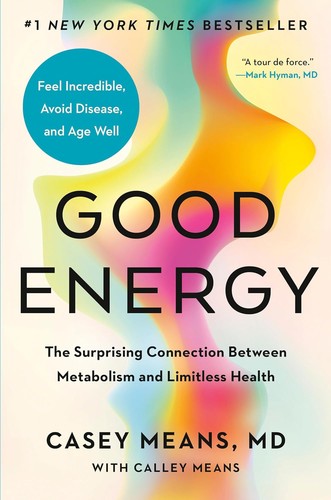
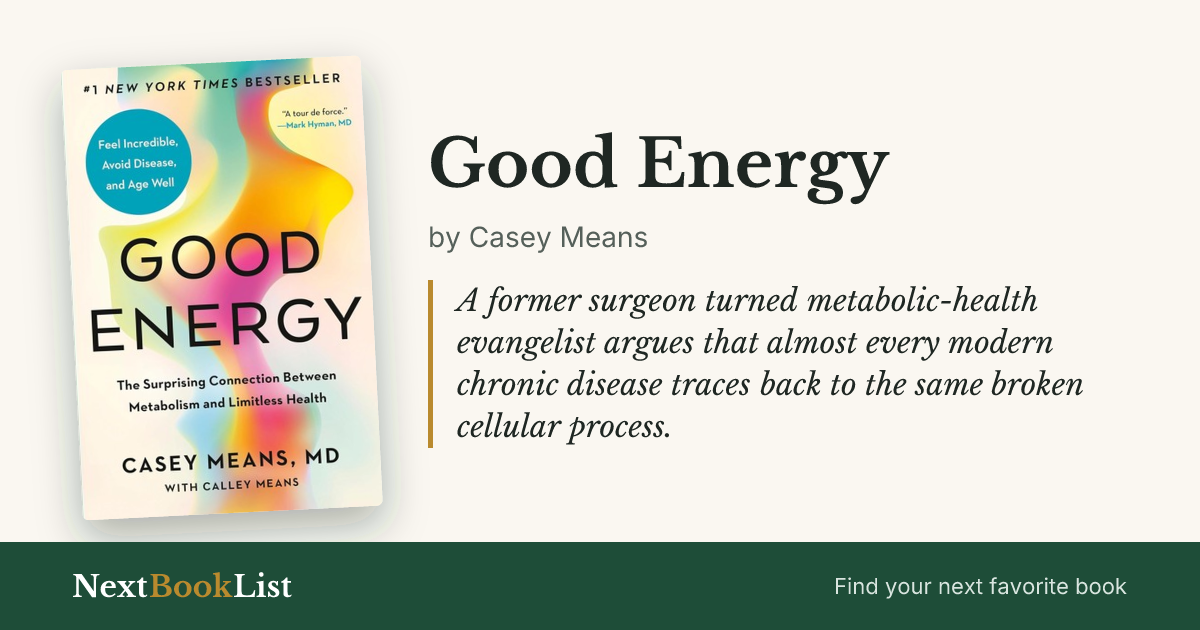
Good Energy
by Casey Means · 2024
A former surgeon turned metabolic-health evangelist argues that almost every modern chronic disease traces back to the same broken cellular process.
Worth reading? Good Energy is the most ambitious attempt yet to unify metabolic dysfunction as the shared root of obesity, diabetes, depression, and infertility -- more sweeping than The Glucose Revolution and angrier at the medical system than Ultra-Processed People. The science on insulin resistance and mitochondrial health is real; the leap to 'this explains almost everything' is where you should bring some skepticism. Read it for the framework, not as a substitute for your doctor.
| Full Title | Good Energy: The Surprising Connection Between Metabolism and Limitless Health |
|---|---|
| Author | Casey Means |
| Published | 2024 |
| Publisher | Avery |
| Category | Science & Nature |
| Favorite quote | “Muscle contraction is miraculous medicine.” |
The Verdict
Means’s diagnosis is stronger than her cure. The case that insulin resistance and mitochondrial dysfunction sit upstream of a huge share of modern disease is well-argued and backed by real research, and the book will change how you read a lab report. Where it overreaches is treating metabolic dysfunction as close to a unified theory of illness – some of the disease links (infertility, depression, certain cancers) lean on correlational or early-stage evidence stretched further than it can hold.
If you want the same core idea with a tighter evidence bar, Rob Lustig’s Metabolical or Jessie Inchauspé’s Glucose Revolution cover similar ground with less system-wide grievance. Read Good Energy for the framework and the practical levers (sleep, muscle, ultra-processed food), and treat the sweeping causal claims as a hypothesis to raise with your own doctor, not a verdict.
you want a root-cause framework connecting blood sugar, mitochondria, and chronic disease instead of a diagnosis-by-diagnosis approach to health
you want mainstream-consensus nutrition advice without the anti-establishment framing, or you're not going to track anything (glucose, sleep) to test the ideas yourself
Book Summary
Means's central claim is that "Good Energy" -- efficient, well-functioning metabolism at the cellular level -- is the missing root cause behind most of the diseases that dominate modern medicine: heart disease, type 2 diabetes, obesity, depression, infertility, even some cancers. The proposed mechanism is mitochondrial dysfunction and chronic low-grade inflammation, driven largely by ultra-processed food, sedentary living, poor sleep, and environmental toxins.
She argues the American medical system is built to manage symptoms with drugs and procedures rather than fix the metabolic dysfunction underneath, and frames this as misaligned incentives rather than incompetence -- doctors are trained, measured, and paid to treat downstream disease, not upstream metabolic health.
The practical throughline is that everyday habits -- what you eat, when you eat it, how you move, how you sleep, how much stress and toxin exposure you carry -- shift measurable biomarkers like blood glucose and insulin, and those markers are treated as more useful early-warning signals than waiting for a diagnosis.
Top 9 Lessons from Good Energy
- Metabolic dysfunction, not any single disease, is framed as the shared root cause behind most chronic illness.
- Continuous glucose monitors can reveal how specific foods and habits spike your blood sugar in ways standard annual labs miss.
- Ultra-processed food is positioned as the primary driver of population-wide metabolic damage, more than any single macronutrient.
- Muscle is treated as a metabolic organ, not just an aesthetic one -- resistance training improves insulin sensitivity directly.
- Sleep and circadian rhythm are framed as metabolic levers, not just recovery tools.
- Chronic stress and toxin exposure (plastics, certain food additives) are added to the causal chain alongside diet and exercise.
- The medical system's incentive structure is criticized for rewarding disease management over prevention.
- Standard lab ranges (like 'normal' fasting glucose) are argued to be too lenient to catch early metabolic decline.
- The book pushes self-tracking (glucose, sleep, HRV) as real-time feedback instead of waiting for an annual physical.
Top 5 Quotes from Good Energy
"We need to see refined added sugar for what it is: an addictive, dangerous drug that has been included in 74 percent of foods in the U.S. food system and for which the body needs zero grams in a lifetime."
Casey Means, Good Energy
"Muscle contraction is miraculous medicine."
Casey Means, Good Energy
"Good Energy is also known as metabolic health. Metabolism refers to the set of cellular mechanisms that transform food into energy that can power every single cell in the body."
Casey Means, Good Energy
"Eighty percent of American Farm Bill subsidies go to corn, grains, and soy oil."
Casey Means, Good Energy
"We can't have a healthy society without well-functioning humans. We can't have well-functioning humans without well-functioning cells."
Casey Means, Good Energy
Frequently Asked Questions
Is Good Energy worth reading?
Yes, for the root-cause framework connecting metabolism to chronic disease. Skip it if you want a narrower, more conservative evidence bar than Means uses.
What is the main idea of Good Energy?
That cellular metabolic dysfunction -- driven mainly by ultra-processed food, inactivity, poor sleep, and toxins -- underlies most modern chronic disease, and that the medical system is structured to treat symptoms rather than this root cause.
Do you need a continuous glucose monitor to use this book?
No, but Means recommends one as a feedback tool. The core habits (whole food, muscle-building movement, sleep, stress management) work without any device.
Who should read Good Energy?
Anyone who wants a unifying framework for chronic disease prevention. Skip it if you want mainstream-consensus advice without the anti-establishment framing.
Ready to read it?
Get Good Energy on Amazon