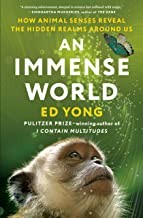
An Immense World
by Ed Yong · 2022
A Pulitzer-winning science journalist tours the sensory worlds other animals actually inhabit, the ones surrounding us constantly that human senses simply can't detect.
Worth reading? Yong's core concept, borrowed from biologist Jakob von Uexkull, is the umwelt -- the specific, limited slice of reality any given organism can actually perceive, shaped entirely by its sensory apparatus -- and the book is a tour through radically different umwelten: a crocodile's face as sensitive as fingertips, bees seeing ultraviolet patterns on flowers invisible to humans, songbirds hearing sound at speeds human ears can't resolve, dogs smelling a world of information humans walk past entirely unaware of. It's genuinely wonder-inducing science writing, built from extensive interviews with working sensory biologists, and it repeatedly forces the humbling realization that human perceived reality is just one narrow slice among countless others happening simultaneously around us.
| Full Title | An Immense World: How Animal Senses Reveal the Hidden Realms Around Us |
|---|---|
| Author | Ed Yong |
| Published | 2022 |
| Category | Science & Nature |
| Favorite quote | “To sense the world through another creature's Umwelt is a rare and disorienting privilege.” |
The Verdict
Yong’s reporting rigor (built from direct interviews with the actual researchers studying these senses, not secondhand summary) is what keeps the book’s genuine sense of wonder from tipping into vague mysticism. Each chapter systematically dismantles the assumption that human perception is a reasonable default against which other species should be measured.
you want rigorous, wonder-inducing science journalism about how radically different other animals' perceived reality actually is from ours
you want a book primarily about animal behavior or conservation -- this stays specifically focused on sensory biology, not broader ecology or animal welfare
Book Summary
Every organism perceives only a specific, limited slice of physical reality -- its "umwelt" -- determined entirely by which senses it has and how they're tuned, meaning the world any given animal actually experiences can be radically different from the world experienced by another species occupying the exact same physical space, a concept Yong uses to structure the entire book chapter by chapter across different senses (smell, vision, hearing, touch, electroreception, and more).
Human sensory experience, per Yong's repeated point, isn't a neutral, complete baseline against which other species' senses should be measured as more or less capable -- it's just one specific, limited umwelt among many, and animals routinely perceive entire dimensions of information (ultraviolet light, magnetic fields, ultrasonic sound, electrical fields in water) that humans have no direct access to at all, not a lesser version of human perception but a genuinely different one.
Top 7 Lessons from An Immense World
- Every organism perceives only a specific slice of reality (its 'umwelt'), determined by its particular sensory apparatus.
- Human sensory experience is not a neutral baseline -- it's one limited umwelt among countless radically different others.
- Many animals perceive entire dimensions of information (ultraviolet light, magnetic fields, electrical fields) humans have no direct access to at all.
- The same physical space can be experienced as radically different realities by different species occupying it simultaneously.
- Sensory biology reveals that 'more advanced' senses aren't a linear hierarchy -- different senses are adaptations to different ecological needs.
- Human-centric assumptions about what constitutes normal perception can blind us to entire categories of animal experience worth taking seriously.
- Rigorous science writing, grounded in direct researcher interviews, can produce genuine wonder without sacrificing accuracy.
Top 4 Quotes from An Immense World
"To sense the world through another creature's Umwelt is a rare and disorienting privilege."
Ed Yong, An Immense World
"Earth teems with sights and textures, sounds and vibrations, smells and tastes, electric and magnetic fields. But every animal can only tap into a small fraction of reality's fullness. Each is enclosed within its own unique sensory bubble, perceiving but a tiny sliver of an immense world."
Ed Yong, An Immense World
"By giving in to our preconceptions, we miss what might be right in front of us. And sometimes what we miss is breathtaking."
Ed Yong, An Immense World
"Jumping spiders remind us that we share a visual reality with other sighted creatures, but we experience it in utterly different ways."
Ed Yong, An Immense World
Frequently Asked Questions
Is An Immense World worth reading?
Yes -- it's rigorous, wonder-inducing science journalism that repeatedly reframes how radically different animal sensory experience actually is from human perception, built from extensive interviews with working sensory biologists.
What is the 'umwelt' concept in An Immense World?
A term borrowed from biologist Jakob von Uexkull for the specific, limited slice of physical reality any given organism can perceive, determined entirely by its sensory apparatus -- the book's organizing concept across chapters.
What senses does An Immense World cover?
Smell, vision (including ultraviolet perception), hearing, touch, electroreception, magnetoreception, and several other senses across a wide range of animal species, from insects to mammals to fish.
Who is Ed Yong?
A Pulitzer Prize-winning science journalist known for his COVID-19 reporting for The Atlantic and his earlier book I Contain Multitudes, about the human microbiome, published before An Immense World.
Ready to read it?
Get An Immense World on Amazon