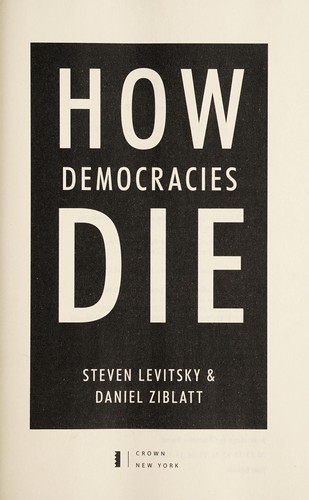
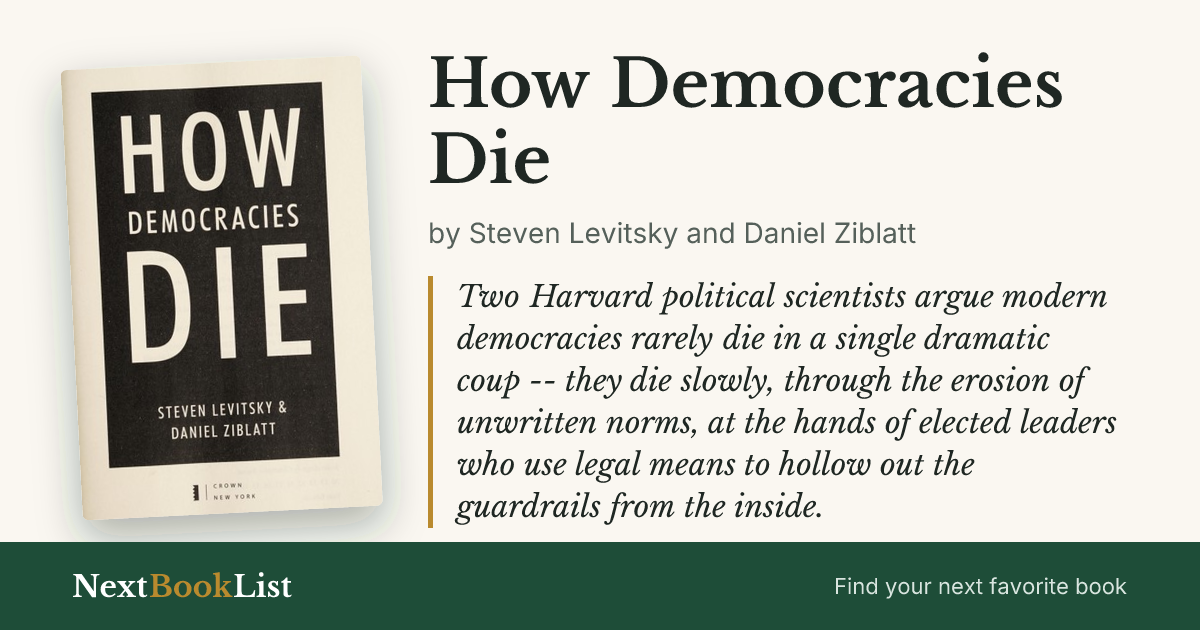
How Democracies Die
by Steven Levitsky and Daniel Ziblatt · 2018
Two Harvard political scientists argue modern democracies rarely die in a single dramatic coup -- they die slowly, through the erosion of unwritten norms, at the hands of elected leaders who use legal means to hollow out the guardrails from the inside.
Worth reading? The book's central, most useful idea is a four-part litmus test for spotting an authoritarian before they consolidate power: rejection of democratic rules of the game, denial of the legitimacy of political opponents, toleration or encouragement of violence, and readiness to curtail the civil liberties of opponents (including the press). Levitsky and Ziblatt, both career comparative-politics scholars, build the case almost entirely from historical and international examples -- Weimar Germany, Pinochet's Chile, Chavez's Venezuela, Erdogan's Turkey -- and their real contribution is showing how much democratic survival depends on unwritten norms (mutual toleration between parties, and forbearance in not using every legal power available) rather than the written constitution alone. It became a bestseller specifically because American readers applied its comparative framework to their own political moment, and the book invites that reading directly in its later chapters, but the analytical tools hold up as a general framework independent of any one country's headlines.
| Full Title | How Democracies Die: What History Reveals About Our Future |
|---|---|
| Author | Steven Levitsky and Daniel Ziblatt |
| Published | 2018 |
| Publisher | Crown |
| Category | Sociology & Culture |
| Favorite quote | “Would-be autocrats can use the letter of the law to kill democracy without violating a single constitutional provision.” |
The Verdict
The strength of this book is discipline: Levitsky and Ziblatt are comparative-politics scholars first, and they build their argument almost entirely from historical and international cases before turning it on the present. That gives the four-part test a durability that a book written purely as commentary on one election cycle wouldn’t have – it’s a framework you can actually apply going forward, to any country, not a snapshot of one moment’s anxieties.
Read it if you want a rigorous, historically grounded way to recognize democratic erosion in real time, wherever it’s happening. Skip it if you’re looking for a partisan takedown of one specific figure – the authors are explicit that the framework is meant to apply across the political spectrum, and readers hoping for a narrower target will find the comparative scope frustrating.
you want a comparative, historically grounded framework (Weimar Germany, 1970s Chile, Erdogan's Turkey, Hungary under Orban) for recognizing the warning signs of democratic backsliding, rather than a book focused on any single country's politics
you want a book making a narrow partisan argument about one specific leader or election -- Levitsky and Ziblatt build a comparative framework across many countries and historical periods, and explicitly apply their four-point test to figures across the political spectrum
Book Summary
Democracies today rarely die via a single coup or dramatic overthrow -- they die gradually, through the accumulation of legal, incremental actions by elected leaders (packing courts, weakening the press, changing electoral rules) that individually look defensible but collectively hollow out democratic checks, a process Levitsky and Ziblatt argue is harder to recognize in real time than an outright coup because each individual step can be justified.
A simple four-part test can help identify authoritarian behavior before it consolidates: does a political figure reject the legitimacy of the democratic rules of the game, deny the legitimacy of political opponents, tolerate or encourage violence, and show readiness to curtail opponents' civil liberties (including a free press)? Any one factor alone might be normal political hardball; the pattern of several together is the warning sign.
Democratic institutions survive not just on written constitutional rules but on two unwritten norms: mutual toleration (accepting your opponents as legitimate rivals, not enemies to be destroyed) and institutional forbearance (not using every technically legal power available just because you can). When party leaders abandon these norms -- even while staying technically within the law -- constitutional systems that look identical on paper can produce very different outcomes for democracy.
Top 9 Lessons from How Democracies Die
- Modern democracies typically die through gradual, legal erosion by elected leaders, not sudden coups -- which makes the process much harder to recognize while it's happening.
- A four-part test for spotting authoritarian tendencies: rejecting democratic rules of the game, denying opponents' legitimacy, tolerating or encouraging violence, and readiness to curtail civil liberties including press freedom.
- Written constitutions alone don't protect democracy -- two unwritten norms, mutual toleration and institutional forbearance, do much of the actual protective work.
- Mutual toleration means treating political opponents as legitimate rivals rather than enemies or traitors to be eliminated from public life.
- Institutional forbearance means not using every technically legal power available -- restraint in wielding legal authority is itself a democratic norm, not weakness.
- Court-packing, gerrymandering, and other technically legal maneuvers can be used to permanently entrench power even while the constitution remains formally unchanged.
- Historical case studies (Weimar Germany, Pinochet's Chile, Chavez's Venezuela, Erdogan's Turkey) show the same underlying pattern of gradual norm erosion despite very different ideologies and contexts.
- Political gatekeepers within a party (not just voters) historically played a key role in filtering out extremist or authoritarian figures before they could win a nomination -- and the weakening of that gatekeeping function is itself a warning sign.
- A leader's rise through fully legal, constitutional means doesn't guarantee a commitment to democratic norms once in power -- legality and democratic legitimacy are related but separate things.
Top 2 Quotes from How Democracies Die
"Would-be autocrats can use the letter of the law to kill democracy without violating a single constitutional provision."
Steven Levitsky and Daniel Ziblatt, How Democracies Die
"Democracies work best -- and survive longer -- where constitutions are reinforced by strong unwritten democratic norms."
Steven Levitsky and Daniel Ziblatt, How Democracies Die
Frequently Asked Questions
Is How Democracies Die worth reading?
Yes -- it's a comparative, historically grounded framework for recognizing democratic backsliding, built by two career political scientists rather than around a single country's headlines.
What is How Democracies Die about?
Steven Levitsky and Daniel Ziblatt argue that modern democracies typically die gradually, through legal erosion of unwritten norms by elected leaders, rather than through sudden coups, and offer a four-part test for recognizing authoritarian tendencies early.
Is How Democracies Die about any one specific country?
The framework is comparative, built from historical cases across many countries (Weimar Germany, Chile, Venezuela, Turkey, Hungary), though later chapters apply the framework directly to the authors' reading of contemporary American politics.
What is the four-part test in How Democracies Die?
Whether a political figure rejects democratic rules of the game, denies opponents' legitimacy, tolerates or encourages violence, and shows readiness to curtail civil liberties including press freedom -- the pattern across several factors is the warning sign, not any single one alone.
What are the two unwritten norms Levitsky and Ziblatt say protect democracy?
Mutual toleration (treating political opponents as legitimate rivals, not enemies) and institutional forbearance (not using every legally available power just because you can).
Ready to read it?
Get How Democracies Die on Amazon