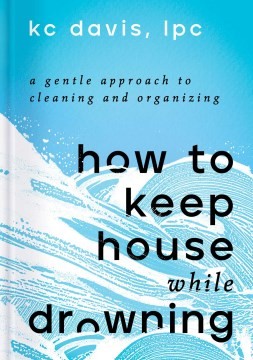
How to Keep House While Drowning
by KC Davis · 2022
The cleaning book for people who don't have a mess problem, they have a shame problem.
Worth reading? How to Keep House While Drowning is the best answer yet to the person standing in a messy apartment feeling like a failure. Davis's core move, calling chores 'care tasks' and stripping the morality out of them, does more for actually getting things done than any productivity system, because it removes the shame that was stalling you in the first place. Skip it if you don't struggle with the shame spiral around mess; you probably just need a cleaning schedule, not this book.
| Full Title | How to Keep House While Drowning: A Gentle Approach to Cleaning and Organizing |
|---|---|
| Author | KC Davis |
| Published | 2022 |
| Publisher | Simon Element |
| Category | Self-Improvement & Psychology |
| Favorite quote | “You are not a failure because you can't keep up with laundry. Laundry is morally neutral.” |
The Verdict
Davis is a licensed therapist, and it shows: this isn’t a cleaning book dressed up with feelings, it’s a mental-health book that happens to use chores as the case study. The “care tasks” reframe alone is worth the price. Once dishes stop being a referendum on your character, you can actually look at why they’re not getting done.
What separates this from the productivity shelf is the refusal to moralize. There’s no gold star for a spotless kitchen and no shame for a sink full of dishes, just a functional question: does this task serve you right now, and what’s the smallest version of it you can do at 5% effort. That’s more useful to someone in a depressive episode than any 30-day challenge.
Skip it if you already have a working system and just want new organizing tricks, this isn’t that book. But if the real obstacle between you and a livable home is shame, not knowledge, start here.
you're depressed, overwhelmed, or neurodivergent and standard cleaning advice makes you feel worse, not better
you already have a working system and just want new organizing hacks -- this is about mindset, not storage bins
Book Summary
Cleaning isn't a moral test. Davis renames chores "care tasks" on purpose: the point of a task like doing dishes isn't virtue, it's making your space functional enough that you can actually live and feel okay in it. A messy house doesn't mean you're lazy or broken.
You don't have to earn rest by finishing everything first. Care tasks are never fully "done," they regenerate daily, so waiting until the list is clear before you let yourself relax means you never relax. Rest and unfinished chores can coexist.
Perfect motivation isn't required to start. Davis's "closing task" and 5-things tidying method let you do a task at 5% effort instead of waiting for 100% motivation that may never show up. Partial completion still counts, and "good enough" is a legitimate finish line, not a failure to try harder.
Top 8 Lessons from How to Keep House While Drowning
- Rename chores 'care tasks' in your head -- it strips out the shame and reframes them as basic self-care, not a moral test.
- Care tasks are functional, not moral: a messy kitchen doesn't mean you're lazy or bad, it means the task didn't get done yet.
- You don't have to earn rest by finishing everything first -- care tasks never fully end, so wait-until-done means never resting.
- Use the 'five things tidying' method: pick five categories (trash, dishes, laundry, surfaces, out-of-place items) instead of trying to deep clean.
- Do the task at 5% effort if that's all you have -- partial completion is still real progress, not failure.
- Build a 'closing task' routine (one small reset before bed) instead of aiming for a fully clean house every day.
- Executive dysfunction, not laziness, is usually the real reason a task isn't getting done -- name the actual barrier.
- Ask 'does this task functionally serve me' before adopting someone else's cleaning standard as your own.
Top 5 Quotes from How to Keep House While Drowning
"You are not a failure because you can't keep up with laundry. Laundry is morally neutral."
KC Davis, How to Keep House While Drowning
"Care tasks exist for one reason only... to make your body and space functional enough for you to easily experience the joy this world has to offer."
KC Davis, How to Keep House While Drowning
"You do not have to earn the right to rest, connect, or recreate. Unlearn the idea that care tasks must be totally complete before you can sit down."
KC Davis, How to Keep House While Drowning
"It's stressful to try to summon up 100% motivation sitting on the couch. Let yourself use 5% motivation to do 5% of the task... Anything worth doing is worth doing partially."
KC Davis, How to Keep House While Drowning
"I do not think laziness exists. You know what does exist? Executive dysfunction, procrastination, feeling overwhelmed, perfectionism, trauma, amotivation, chronic pain, energy fatigue, depression, lack of skills, lack of support, and differing priorities."
KC Davis, How to Keep House While Drowning
Frequently Asked Questions
Is How to Keep House While Drowning worth reading?
Yes, especially if a messy home makes you feel like a personal failure. It treats the shame, not just the mess, which is why it works when other cleaning advice hasn't.
What is the main idea of How to Keep House While Drowning?
Chores are 'care tasks,' not a moral test. Reframing them that way, and accepting partial effort as real progress, gets more done than shame ever does.
Is this book only for depressed or neurodivergent readers?
It's aimed at people for whom standard cleaning advice hasn't worked, often due to depression, ADHD, or overwhelm, but the shame-removal framing helps almost anyone stuck in a mess-guilt cycle.
Who should read How to Keep House While Drowning?
Anyone who feels like a failure over an untidy home. Skip it if you just want new storage or organizing hacks -- your barrier isn't mindset, it's logistics.
Ready to read it?
Get How to Keep House While Drowning on Amazon