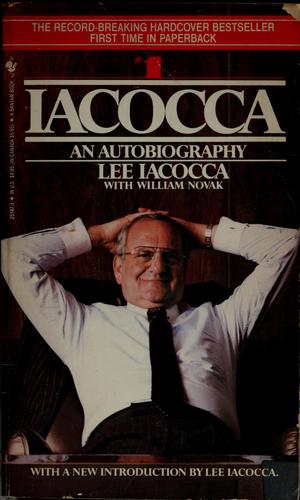
Iacocca
by Lee Iacocca with William Novak · 1984
The Chrysler turnaround, told by the executive who got fired from Ford and then talked the U.S. government into a loan guarantee to save Chrysler from bankruptcy.
Worth reading? Iacocca is one of the best-selling business autobiographies ever published, and it earns that reputation through sheer narrative drama: fired from Ford by Henry Ford II after building the Mustang, Iacocca took over a nearly bankrupt Chrysler, secured a controversial federal loan guarantee, and turned the company around within a few years. It's a memoir, not an analytical business book, so read it for the story and the era it captures -- pair it with a more structured turnaround or leadership book if you want frameworks rather than narrative.
| Full Title | Iacocca: An Autobiography |
|---|---|
| Author | Lee Iacocca with William Novak |
| Published | 1984 |
| Category | Business & Money |
| Favorite quote | “In the end, all business operations can be reduced to three words: people, product, and profits.” |
The Verdict
Iacocca tells this story as its central character, and the self-mythologizing is part of what made the book a phenomenon in the 1980s – the $1 salary, the ad campaigns, the government showdown all read like a script because Iacocca understood narrative as well as he understood cars. Read it for the drama and the era; look elsewhere for objective turnaround analysis.
you want a firsthand, opinionated account of one of the most dramatic corporate turnarounds in American business history
you want objective, third-party business analysis, this is a memoir, told from Iacocca's own perspective, with all the self-serving framing that implies
Book Summary
Iacocca's account centers on a turnaround built through blunt communication, aggressive cost-cutting, and his own willingness to take a symbolic $1 salary to demonstrate shared sacrifice while asking employees, suppliers, and the government for concessions to save Chrysler from collapse. The K-car and minivan bets that followed the immediate crisis show a second theme: correctly reading what the market actually wanted (smaller, more efficient vehicles) after years of Detroit assuming bigger was always better.
The book is also a case study in personal reputation as a business asset -- Iacocca leveraged his own public credibility, built through the Mustang's success at Ford and reinforced through his own television ad appearances for Chrysler, to rally political, financial, and public support for the loan guarantee that most analysts assumed was politically impossible to secure.
Top 7 Lessons from Iacocca
- Symbolic shared sacrifice (Iacocca's $1 salary) can rally stakeholders more effectively than a spreadsheet argument alone.
- Correctly reading a shifting market (Chrysler's move to smaller, efficient vehicles) matters as much as operational turnaround discipline.
- Personal credibility, built over a career, is a real asset you can leverage in a genuine crisis.
- Blunt, direct communication during a crisis builds more trust than reassuring vagueness.
- A turnaround requires aligning multiple stakeholders (government, unions, suppliers, employees) simultaneously, not just internal operations.
- Being fired or sidelined doesn't end a career -- Iacocca's Chrysler chapter came after being pushed out of Ford.
- Public-facing leadership (Iacocca's own ad campaigns) can rebuild brand trust faster than product improvements alone.
Top 4 Quotes from Iacocca
"In the end, all business operations can be reduced to three words: people, product, and profits."
Lee Iacocca with William Novak, Iacocca
"The ability to concentrate and to use time well is everything."
Lee Iacocca with William Novak, Iacocca
"I have found that the best way to give advice to your children is to find out what they want and then advise them to do it."
Lee Iacocca with William Novak, Iacocca
"In a truly rational society, the best of us would be teachers and the rest of us would have to settle for something less."
Lee Iacocca with William Novak, Iacocca
Frequently Asked Questions
Is Iacocca worth reading?
Yes, as a dramatic, firsthand account of one of the most famous corporate turnarounds in American business history. Read it as memoir and narrative, not as an objective analytical case study.
What is Iacocca about?
Lee Iacocca's autobiography, covering his career at Ford (including the Mustang's success and his firing by Henry Ford II) and his subsequent turnaround of a nearly bankrupt Chrysler in the early 1980s, including a controversial federal loan guarantee.
Is Iacocca a business strategy book?
Not in a structured, framework-driven sense -- it's a personal memoir. Readers looking for analytical turnaround frameworks should pair it with a more structured business book.
Why is Iacocca considered a classic business memoir?
It captures a specific dramatic moment in American industrial history -- a near-bankrupt Chrysler saved through government intervention and aggressive leadership -- narrated firsthand by the executive who led it, at a scale few other business memoirs match.
Ready to read it?
Get Iacocca on Amazon