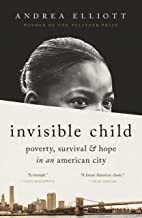
Invisible Child
by Andrea Elliott · 2021
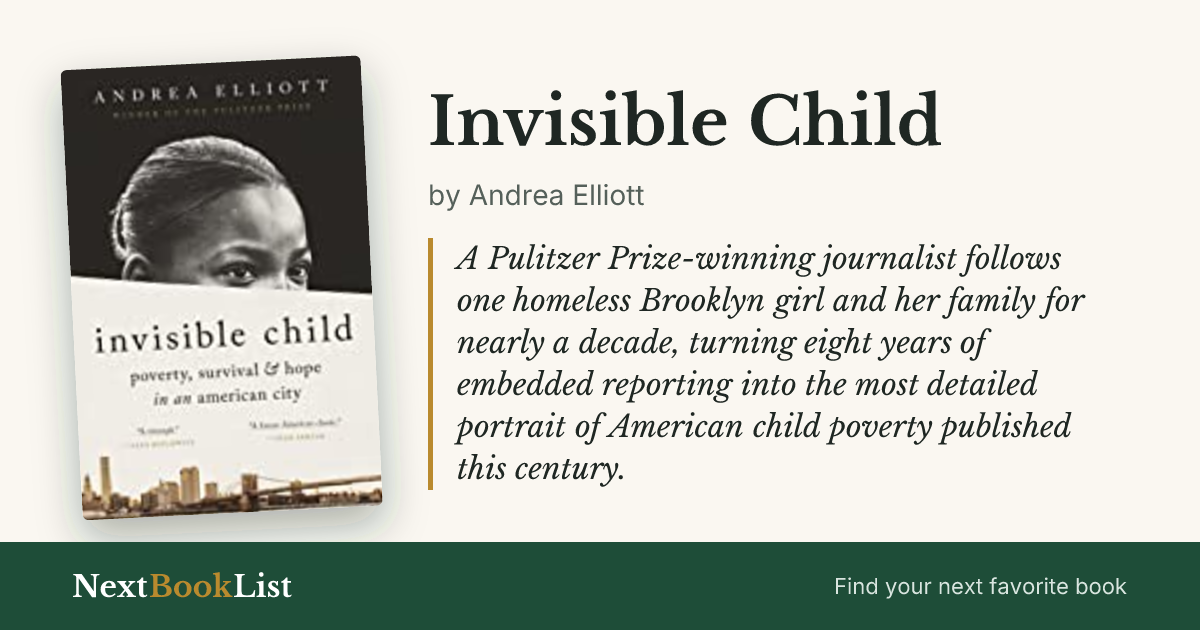
A Pulitzer Prize-winning journalist follows one homeless Brooklyn girl and her family for nearly a decade, turning eight years of embedded reporting into the most detailed portrait of American child poverty published this century.
Worth reading? Elliott spent close to a decade following Dasani Coates and her family through New York City's shelter system, its schools, and eventually foster care, expanding an 2013 New York Times series into a book that reads like a novel but is reported like an investigation. What makes it land is the refusal to simplify -- Dasani's parents are neither saints nor villains, the systems meant to help her (shelters, schools, child services) are neither wholly broken nor wholly functional, and Dasani herself is smart, resilient, and still ground down by circumstances no eleven-year-old should have to navigate. The book doesn't argue a policy position so much as force you to sit with how many separate systems a poor family has to survive at once, and how each one's failures compound the others'. It's long, and it's not efficient nonfiction the way a business book is -- but the length is the point. You don't get the accumulation of small institutional failures Elliott is documenting from a shorter book.
| Full Title | Invisible Child: Poverty, Survival, and Hope in an American City |
|---|---|
| Author | Andrea Elliott |
| Published | 2021 |
| Publisher | Random House |
| Category | Sociology & Culture |
| Favorite quote | “Almost nothing counts more than the person who shows up.” |
The Verdict
Elliott doesn’t editorialize much, and she doesn’t need to – the reporting does the work. You watch Dasani navigate shelter transfers, school changes, and a family reshaped by addiction and the child welfare system, and the cumulative effect is more persuasive than any policy argument could be. This isn’t a quick read, and it isn’t trying to hand you a five-point plan. It’s trying to make sure you actually understand what surviving poverty in an American city costs, in granular, specific, human detail.
Read it if you want the most thoroughly reported account of American child poverty available and you’re willing to sit with a long, dense narrative to get it. Skip it if you’re looking for a policy brief or a fast read – this is 600-plus pages of accumulated detail, and the length is doing real work.
you want deeply reported, character-driven narrative nonfiction that shows what poverty actually does to a family over years -- shelters, schools, foster care, addiction -- rather than a policy paper about it
you want statistics, policy prescriptions, or a fast read -- this is a 600-plus-page immersive narrative built from years of embedded reporting, not a briefing document, and it doesn't end with a tidy list of fixes
Book Summary
Poverty in America isn't a single condition -- it's the simultaneous, compounding failure of multiple systems (housing, schooling, child welfare, the criminal justice system, addiction treatment) that a family has to navigate at once, and each system's dysfunction makes the others harder to survive. A family that's homeless struggles to keep kids in one school; a family struggling with school attendance draws child-welfare scrutiny; scrutiny and instability make housing harder to secure.
Institutions built to help poor families often demand the most from the people least equipped to supply it -- shelter rules, school attendance policies, and child-welfare requirements assume a level of stability, paperwork, and free time that a family in crisis frequently doesn't have, so the "help" itself becomes another obstacle to clear.
Individual resilience and talent (Dasani's own intelligence, drive, and care for her siblings) are real but not sufficient on their own -- Elliott's reporting shows a genuinely exceptional kid still getting pulled down by structural forces, which undercuts the comfortable idea that poverty is mainly a story of individual choices.
Top 9 Lessons from Invisible Child
- Homelessness rarely shows up as a single crisis -- it's usually the visible symptom of several compounding failures (housing cost, job instability, health, family breakdown) that arrived together.
- Shelter and school systems are frequently in tension rather than aligned -- shelter placements move families across the city, which then breaks school attendance and continuity, which then triggers new institutional scrutiny.
- Child welfare intervention can stabilize a family or shatter it further, and Elliott's reporting shows both outcomes are live possibilities depending on circumstances that have little to do with how much a parent loves their kids.
- Older siblings in large, struggling families frequently take on parentified caretaking roles for younger children, absorbing responsibilities no child should carry and often at real cost to their own development.
- Addiction inside a family doesn't stay contained to the person using -- it reorganizes the entire household's stability, finances, and relationship to institutions like schools and shelters.
- Being identified as a 'gifted' or promising kid inside a broken system can open real doors (scholarships, attention, opportunity) but doesn't undo the structural disadvantages still working against that same kid every other hour of the day.
- Long-term embedded journalism reveals patterns that snapshot reporting misses -- Elliott's decade of access shows how a single policy change or personnel decision can ripple through a family's life for years.
- Geographic instability (repeated moves between shelters, schools, and relatives) has costs beyond the obvious -- lost friendships, disrupted routines, and an inability to build the kind of stable relationships that help kids cope with hardship.
- The systems meant to serve poor families are typically run by well-intentioned people working inside genuinely under-resourced institutions -- Elliott's account resists the easy villain narrative in favor of showing how good intentions and bad outcomes coexist.
Top 2 Quotes from Invisible Child
"Almost nothing counts more than the person who shows up."
Andrea Elliott, Invisible Child
"The bottled water had come to Brooklyn's bodegas just before she was born, catching the fancy of her mother, who could not afford such indulgences. Who paid for water in a bottle? Just the sound of it- Dasani- conjured another life."
Andrea Elliott, Invisible Child
Frequently Asked Questions
Is Invisible Child worth reading?
Yes -- it's one of the most detailed, honestly reported portraits of American child poverty available, built from nearly a decade of embedded journalism, and it won the Pulitzer Prize for the reporting it grew out of.
What is Invisible Child about?
Andrea Elliott follows Dasani Coates, a homeless girl in Brooklyn, and her family across nearly ten years, showing how shelter, school, child welfare, and addiction systems compound to keep a family trapped in poverty.
Is Invisible Child based on a true story?
Yes. It's narrative nonfiction built from years of direct reporting and an original 2013 New York Times series that Elliott expanded into this book.
How long is Invisible Child?
It's a substantial book at over 600 pages -- long by design, since the accumulation of small institutional failures over years is central to what Elliott is documenting.
Does Invisible Child offer policy solutions?
Not directly. It's built as immersive narrative journalism rather than a policy brief, though the systemic failures it documents make an implicit case for where reform is needed.
Ready to read it?
Get Invisible Child on Amazon