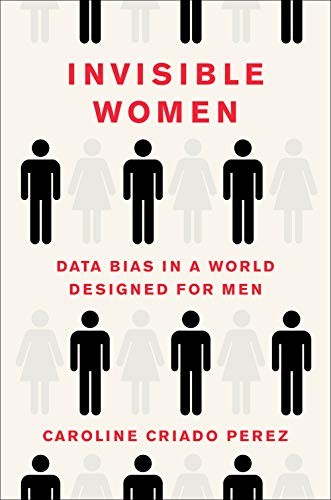
Invisible Women
by Caroline Criado Perez · 2019
From car crash test dummies to phone sizes to snow-plowing routes, Criado Perez documents case after case of design built around male-default data, with women paying the safety and convenience cost.
Worth reading? Criado Perez's method is relentless and specific: crash test dummies modeled on the average male body mean women are statistically more likely to be seriously injured in car crashes even at equal safety ratings; snow-plowing schedules optimized for commuter (often male) traffic patterns rather than the walking-and-public-transit patterns (often female) that clear first in some cities; medical research historically excluding women from drug trials, meaning dosages and side-effect profiles are less understood for female bodies. Each chapter is its own case study, backed by real data, and the sheer accumulation of examples is what makes the book's argument land -- this isn't one anecdote, it's a pattern across transportation, medicine, workplace design, and disaster relief. It beats a single-issue book on any one of these topics by making clear how consistent and structural the pattern is.
| Full Title | Invisible Women: Data Bias in a World Designed for Men |
|---|---|
| Author | Caroline Criado Perez |
| Published | 2019 |
| Publisher | Abrams Press |
| Category | Sociology & Culture |
| Favorite quote | “There is no such thing as a woman who doesn't work. There is only a woman who isn't paid for her work.” |
The Verdict
Criado Perez’s real skill is refusing to let any single example carry the whole argument – it’s the accumulation, chapter after chapter, sector after sector, that makes the pattern impossible to write off as coincidence. If you want the data-backed version of “the default isn’t neutral,” this is the book.
you want a data-dense, case-by-case argument for how 'gender-neutral' design defaults quietly assume a male body and male schedule, with real safety consequences
you want a narrative-driven or personal-story book -- this is closer to a rigorously sourced catalog of case studies than a single flowing argument
Book Summary
Across transportation, medicine, technology, and workplace design, systems built on supposedly neutral or "average" data are frequently modeled on male bodies, male schedules, or male-dominated research samples by default, producing real safety and convenience costs for women that go largely undocumented and unaddressed.
Car crash test dummies were historically modeled on an average male body, and Criado Perez documents that women are statistically more likely to be seriously injured in equivalent crashes as a direct result, a gap only recently starting to be addressed with female-body test dummies in some markets.
Medical research has historically underrepresented women in clinical drug trials, meaning dosage guidelines and side-effect profiles for many medications are better understood for male physiology than female physiology, with documented real-world consequences for treatment efficacy and safety.
Public infrastructure decisions -- like the order cities clear snow from streets -- often prioritize commuter traffic patterns (historically more male) over the trip-chaining, multi-stop patterns common among caregivers (historically more female), even when policymakers have no explicit intent to disadvantage anyone; the bias is baked into which data gets collected and prioritized in the first place.
Top 8 Lessons from Invisible Women
- Car crash test dummies historically modeled on an average male body correlate with women being more likely to be seriously injured in equivalent crashes.
- Medical research has historically underrepresented women in clinical drug trials, leaving dosage and side-effect data less reliable for female physiology.
- Snow-plowing and infrastructure scheduling in some cities has prioritized commuter traffic patterns over the multi-stop 'trip-chaining' patterns more common among caregivers.
- Data gaps, not necessarily explicit intent, are frequently the root cause of design defaults that disadvantage women.
- The pattern of male-default data spans transportation, medicine, technology, workplace design, and disaster relief -- it isn't limited to one sector.
- Products and standards described as 'gender-neutral' often quietly encode a male-body or male-schedule default.
- Collecting sex-disaggregated data specifically is presented as a practical, evidence-based fix across the case studies covered.
- The accumulated weight of many separate, well-documented case studies is what makes the book's structural argument persuasive, more than any single example alone.
Top 5 Quotes from Invisible Women
"There is no such thing as a woman who doesn't work. There is only a woman who isn't paid for her work."
Caroline Criado Perez, Invisible Women
"The result of this deeply male-dominated culture is that the male experience, the male perspective, has come to be seen as universal, while the female experience -- that of half the global population, after all -- is seen as, well, niche."
Caroline Criado Perez, Invisible Women
"It's time to start designing women in."
Caroline Criado Perez, Invisible Women
"When we exclude half of humanity from the production of knowledge we lose out on potentially transformative insights."
Caroline Criado Perez, Invisible Women
"But when your big data is corrupted by big silences, the truths you get are half-truths, at best."
Caroline Criado Perez, Invisible Women
Frequently Asked Questions
Is Invisible Women worth reading?
Yes -- it's a rigorously sourced, case-by-case argument for how 'neutral' design defaults across transportation, medicine, and technology quietly assume a male body or male schedule, with real safety consequences documented in each chapter.
What is Invisible Women about?
Caroline Criado Perez's catalog of case studies -- crash test dummies, medical trials, snow-plowing schedules, workplace design -- showing how supposedly gender-neutral data and design defaults are frequently modeled on male bodies or male routines.
Is Invisible Women a narrative book or a data book?
It's closer to a rigorously sourced catalog of case studies than a single flowing narrative -- each chapter functions as its own data-backed example within the larger structural argument.
Does Invisible Women only cover one topic, like medicine or transportation?
No -- it spans multiple sectors including transportation, medicine, technology, workplace design, and disaster relief, which is part of what makes its 'pattern, not anecdote' argument land.
Ready to read it?
Get Invisible Women on Amazon