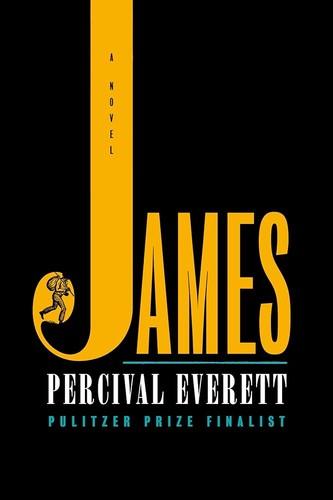
James
by Percival Everett · 2024
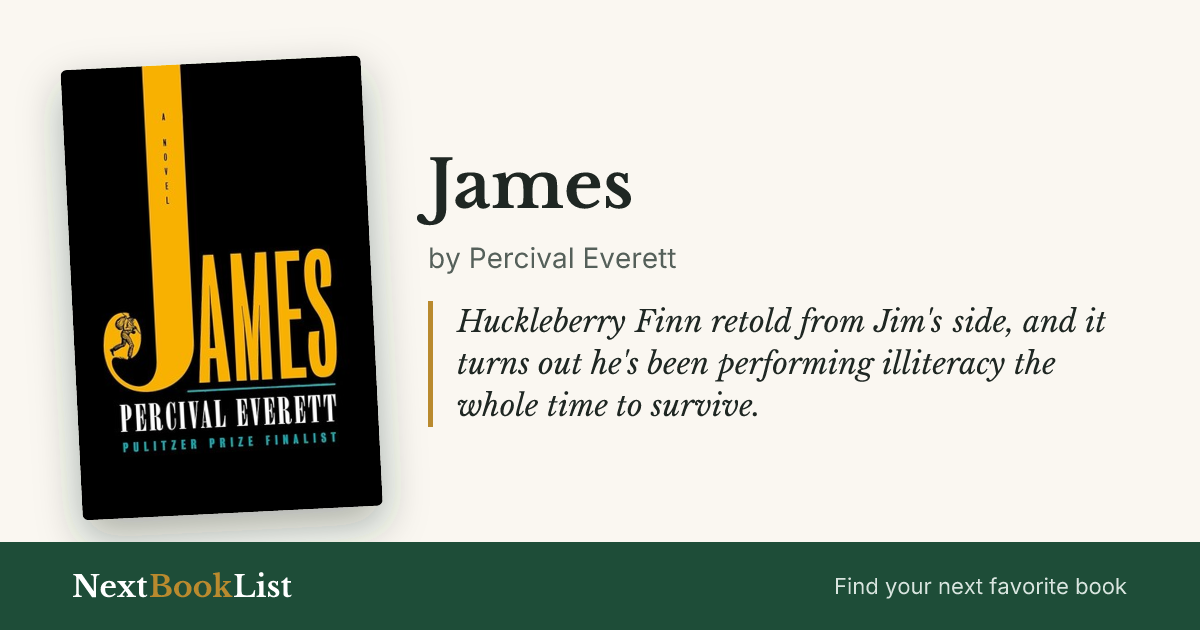
Huckleberry Finn retold from Jim's side, and it turns out he's been performing illiteracy the whole time to survive.
Worth reading? James is the best American novel published in 2024, and it's not close. Everett takes a book everyone thinks they already know and shows you how much of it depended on ignoring its Black narrator's interiority. Read it whether or not you remember Huckleberry Finn -- it stands entirely on its own, and it's funnier and angrier than the premise suggests.
| Author | Percival Everett |
|---|---|
| Published | 2024 |
| Publisher | Doubleday |
| Category | Fiction |
| Favorite quote | “With my pencil, I wrote myself into being. I wrote myself to here.” |
The Verdict
Everett’s central move is simple to describe and hard to pull off: James speaks two languages, and only one of them is the one white people hear. Once you see the gap between those two voices, you can’t unsee how much of the original Huckleberry Finn depended on you not noticing it.
It’s also just a better-plotted book than the premise suggests, with real stakes around James’s escape and his family that Twain’s version never gave him. This isn’t a duty-read retelling – it’s a novel that would be great with or without the Twain connection, and the connection just makes it sharper.
you want one of the best American novels of the decade -- a Pulitzer and National Book Award winner that reframes a classic without needing you to have read it recently
you're not interested in a book in direct conversation with Twain's Huckleberry Finn -- the retelling structure is central to how it works
Book Summary
The novel retells Adventures of Huckleberry Finn entirely from the enslaved character Jim's point of view, renaming him James, and reveals that James is secretly literate and philosophically sharp -- deliberately performing a simpler dialect around white characters as a calculated survival strategy, not because he actually thinks or speaks that way. Code-switching is the book's central device: James speaks one way to protect himself in front of white characters, and a fully articulate, interior way in his own narration and in private moments. Everett uses this device, along with dark satire, to expose the absurd internal logic white supremacy required to sustain itself. The Mississippi River journey becomes a story of Black interiority and resistance rather than just Huck's coming-of-age, as James risks everything to escape and reunite with his enslaved wife and daughter. Everett revises several of Twain's plot beats to give James an agency the original novel denied him, interrogating who gets to "own" language and literacy and how withholding both was itself a tool of control.
Top 9 Lessons from James
- The novel retells Adventures of Huckleberry Finn entirely from the enslaved character Jim's point of view, renaming him James.
- James is secretly literate and philosophically sharp, deliberately performing a simpler dialect around white characters as a survival strategy.
- Code-switching is the book's central device -- one voice for protection, one voice (the narration) for his actual interior life.
- The novel reframes the river journey as a story of Black interiority and resistance rather than Huck's coming-of-age alone.
- Everett uses satire and dark comedy to expose the absurd logic that slavery and white supremacy required to sustain themselves.
- James risks everything to escape and reunite with his enslaved wife and daughter, reframing the plot's stakes around his family.
- The novel interrogates who gets to 'own' language and literacy, and how withholding both functioned as a tool of control.
- Everett revises several of Twain's original plot beats to give James an agency the source novel denied him.
- The book won the 2024 National Book Award for Fiction and the Pulitzer Prize for Fiction.
Top 4 Quotes from James
"At that moment the power of reading made itself clear and real to me. If I could see the words, then no one could control them or what I got from them... It was a completely private affair and completely free and, therefore, completely subversive."
Percival Everett, James
"I had never seen a white man filled with such fear. The remarkable truth, however, was that it was not the pistol, but my language, the fact that I didn't conform to his expectations, that I could read, that had so disturbed and frightened him."
Percival Everett, James
"With my pencil, I wrote myself into being. I wrote myself to here."
Percival Everett, James
"That is what equality is, Jim. It's the capacity for becoming equal."
Percival Everett, James
Frequently Asked Questions
Is James worth reading?
Yes -- it won the Pulitzer Prize and the National Book Award for good reason. It's one of the sharpest American novels published in the last several years.
Do you need to have read Huckleberry Finn to read James?
It helps but isn't required. Everett gives you enough of the original's plot beats that the retelling stands on its own even if your memory of Twain is fuzzy.
What is the main theme of James?
That literacy and language were tools of control under slavery, and that James's performed illiteracy around white characters was a calculated survival strategy, not a reflection of who he actually was.
Who should read James?
Anyone interested in literary fiction, American history, or Twain's original novel seen from the perspective it always denied its most important character.
Ready to read it?
Get James on Amazon