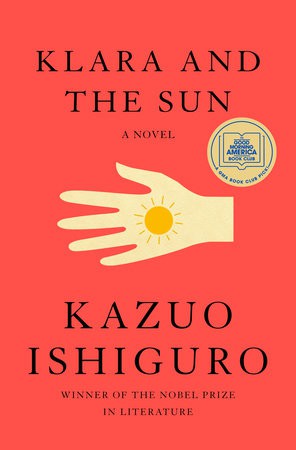
Klara and the Sun
by Kazuo Ishiguro · 2021
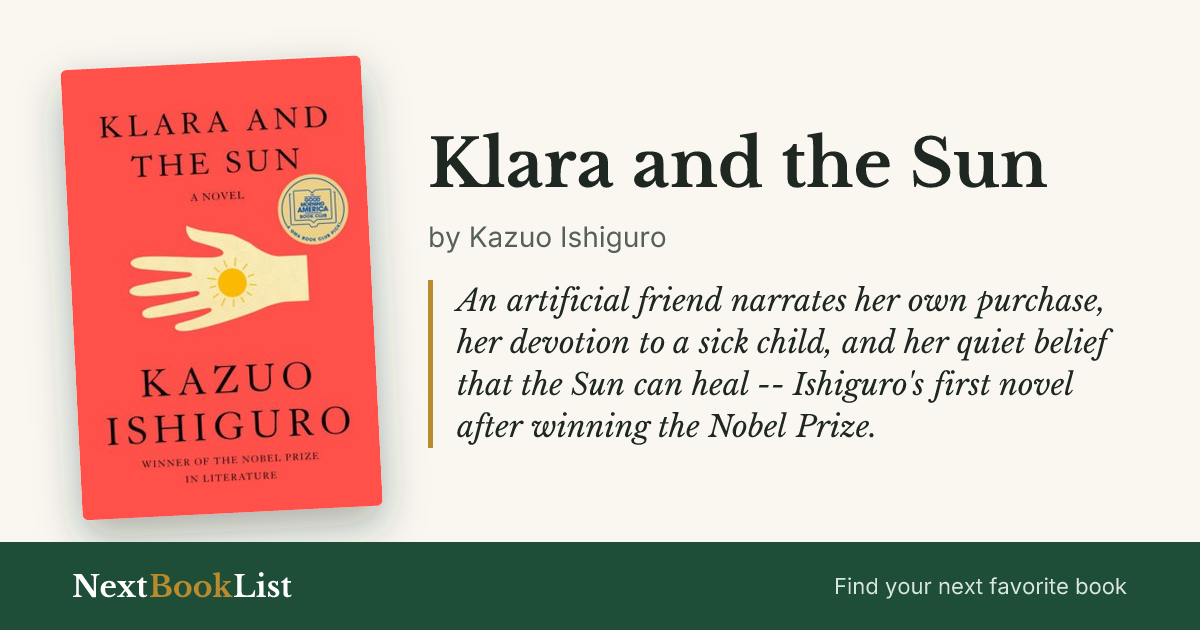
An artificial friend narrates her own purchase, her devotion to a sick child, and her quiet belief that the Sun can heal -- Ishiguro's first novel after winning the Nobel Prize.
Worth reading? Klara and the Sun is Never Let Me Go's spiritual sequel -- the same trick of a naive narrator slowly revealing a quietly horrifying premise, this time through an AI instead of a clone. It's not as tightly constructed as Never Let Me Go, but it's the better book if you want Ishiguro's ideas about love and personhood pushed even further.
| Author | Kazuo Ishiguro |
|---|---|
| Published | 2021 |
| Publisher | Knopf |
| Category | Fiction |
| Favorite quote | “There was something very special, but it wasn't inside Josie. It was inside those who loved her.” |
The Verdict
What makes this land is how little Klara understands about her own situation compared to the reader – Ishiguro trusts you to feel the horror and the tenderness of her devotion well before she can name either one herself. That’s the same trick that made Never Let Me Go work, executed just as precisely a second time.
you want a quiet, devastating meditation on love, sacrifice, and what makes a person a person, narrated by an AI whose limited understanding makes the emotional reveals land harder, not softer
you want plot-driven science fiction with clear worldbuilding and stakes -- Ishiguro deliberately keeps the world hazy and the pace slow; if you loved Never Let Me Go's directness, expect something even more restrained here
Book Summary
Klara is an Artificial Friend purchased to be a companion for Josie, a chronically ill teenager. Because Klara narrates from a limited, childlike vantage point, the reader has to piece together the story's darker implications well before Klara herself fully grasps them, including the real cause of Josie's illness and what her mother actually wants Klara for.
Klara develops something close to a religion around the Sun, whose light powers her, and treats it as a source of both physical energy and moral hope. Ishiguro uses that devotion, and Klara's eventual near-sacrificial ritual on Josie's behalf, to ask whether love expressed through pure, uncomplaining service is any less real for coming from a machine.
Top 9 Lessons from Klara and the Sun
- Klara is an Artificial Friend purchased to be a companion for Josie, a chronically ill teenage girl.
- Klara develops a near-religious belief that the Sun has healing power, based on her own solar charging and childlike reasoning about the world.
- Klara's limited vantage point, narrating first from a shop window and then from inside a household, forces the reader to piece together the story's darker implications.
- Josie's illness is revealed to stem from a genetic 'lifting' procedure many parents use to boost their children's intelligence, at real medical risk.
- Josie's mother has a secret plan to have Klara continue Josie's personality and behavior if Josie dies, testing whether an AI can truly replicate a person.
- Rick, Josie's unmodified neighbor and love interest, represents a path not taken -- a child whose parents refused the risky genetic enhancement.
- Klara ultimately performs a private, near-sacrificial ritual aimed at the Sun to try to save Josie, driven entirely by her own devised logic and devotion.
- The novel never fully resolves whether Klara's beliefs about the Sun are 'real' in any sense, or purely a product of her programming and isolation.
- By the end, Klara is retired to a scrapyard, reflecting with total lack of self-pity on a life spent entirely in service of someone else's family.
Top 4 Quotes from Klara and the Sun
"A part of us refuses to let go. The part that wants to keep believing there's something unreachable inside each of us. Something that's unique and won't transfer. But there's nothing like that, we know that now."
Kazuo Ishiguro, Klara and the Sun
"There was something very special, but it wasn't inside Josie. It was inside those who loved her."
Kazuo Ishiguro, Klara and the Sun
"Until recently, I didn't think that humans could choose loneliness. That there were sometimes forces more powerful than the wish to avoid loneliness."
Kazuo Ishiguro, Klara and the Sun
"Sometimes, at special moments like that, people feel a pain alongside their happiness."
Kazuo Ishiguro, Klara and the Sun
Frequently Asked Questions
Is Klara and the Sun worth reading?
Yes, especially if you liked Never Let Me Go -- it's Ishiguro doing the same slow-reveal trick with an AI narrator instead of a clone, and it's just as quietly devastating.
What is Klara and the Sun about?
An artificial companion cares for a chronically ill teenage girl and develops her own near-religious devotion to the Sun, believing it can heal the child she loves.
Is Klara and the Sun hard to read?
No, the prose is simple and restrained, but the pacing is slow and the world is deliberately kept hazy -- it rewards patience over quick payoff.
Do I need to read Never Let Me Go first?
No, they're unconnected. But if you liked Never Let Me Go's approach to a naive narrator slowly revealing a dark premise, you'll recognize the same technique here.
Ready to read it?
Get Klara and the Sun on Amazon