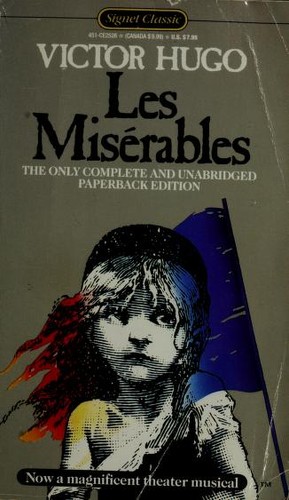
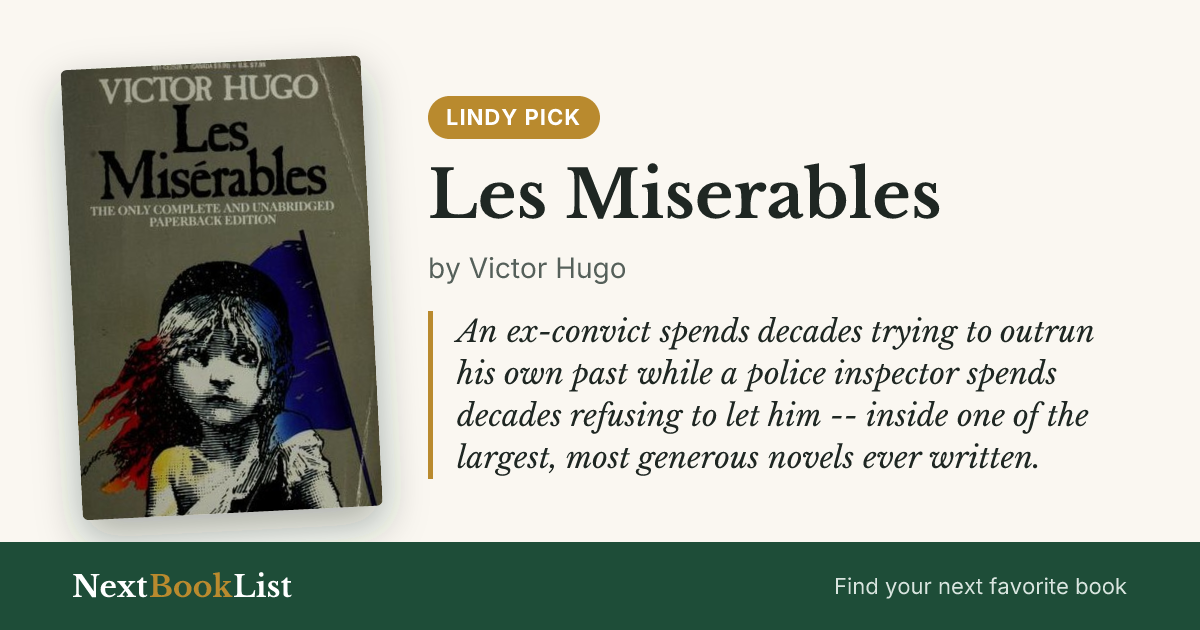
Les Miserables
by Victor Hugo · 1862
An ex-convict spends decades trying to outrun his own past while a police inspector spends decades refusing to let him -- inside one of the largest, most generous novels ever written.
Worth reading? Les Miserables has stayed in print for over 150 years and inspired one of the longest-running musicals in history because the moral question at its center -- does a person get to become someone other than the worst thing they ever did -- still works on every reader who takes it seriously. It beats most 19th-century epics on sheer generosity of spirit. Skip the unabridged edition if you can't tolerate a 50-page digression on sewers; an abridged edition exists for a reason.
| Full Title | Les Miserables (Signet Classics, Norman Denny translation) |
|---|---|
| Author | Victor Hugo |
| Published | 1862 |
| Publisher | Signet Classics |
| Category | Fiction |
| Favorite quote | “It is nothing to die; it is dreadful not to live.” |
The Verdict
The musical trimmed this down to its emotional beats, and those beats are genuinely earned in the novel – but the book gives you the machinery underneath them: the legal system that criminalizes poverty, the social structures that trap Fantine, the historical weight bearing down on the 1832 barricade.
Read the unabridged version if you actually want the whole argument Hugo is making. Read an abridged one if you just want Valjean, Javert, and Cosette without the 50-page tour of the Paris sewer system. Either way, this is one of the few 1,200-page novels that earns its size.
you want a genuinely massive, morally serious epic about justice, mercy, and revolution, and you're willing to commit 1,200-plus pages to get it
you want a tight plot -- Hugo interrupts the story for entire standalone essays on the Battle of Waterloo, the Paris sewer system, and convent life, and none of them are optional in the unabridged edition
Book Summary
Jean Valjean is released from nineteen years in prison for stealing bread, breaks parole, and spends the rest of his life trying to become a genuinely good man while evading Inspector Javert, who believes a criminal record is permanent and identity-defining. The entire novel is built on that disagreement: can a person actually change, or is a record destiny.
Around Valjean's personal arc, Hugo builds out an entire social panorama of 19th-century France -- poverty, prostitution, the 1832 Paris uprising, the legal system's cruelty to the poor -- using Valjean's adopted daughter Cosette, the tragic Fantine, and the student revolutionary Marius as different lenses on the same injustice.
Hugo's digressions (Waterloo, the Paris sewers, convent life, criminal slang) aren't padding so much as Hugo insisting the reader understand the machinery -- historical, physical, institutional -- that produces the poverty and injustice his characters live inside. It's a novel that wants you to understand the system, not just sympathize with individuals caught in it.
Top 8 Lessons from Les Miserables
- Valjean's transformation after the bishop's mercy (letting him keep stolen silver and giving him more) is the moral engine of the entire novel -- one act of grace redirects an entire life.
- Javert's rigid belief that a criminal record defines a person permanently makes him incapable of recognizing Valjean's genuine transformation, even after years of evidence.
- Fantine's descent into poverty and prostitution to support Cosette is Hugo's most direct indictment of a society that punishes desperate women more than the men who abandon them.
- The Thenardiers exploit Cosette for years while performing respectability, showing how cruelty hides comfortably inside a normal-looking household.
- The 1832 student uprising at the barricade fails militarily but the novel treats the students' conviction as morally significant regardless of the outcome.
- Javert's eventual suicide comes from being unable to reconcile his absolute rule-based morality with the fact that Valjean, a criminal by his own definition, saved his life.
- Marius and Cosette's romance is almost naive by design -- Hugo contrasts their sheltered love with the brutal poverty surrounding it on every side.
- Valjean repeatedly chooses self-sacrifice over self-preservation -- revealing his identity to save a wrongly accused man, carrying wounded Marius through the sewers -- as proof his transformation is real, not performed.
Top 4 Quotes from Les Miserables
"It is nothing to die; it is dreadful not to live."
Victor Hugo, Les Miserables
"The future has several names. For the weak, it means the impossible. For the fainthearted, it means the unknown. For the thoughtful and valiant, it means ideal."
Victor Hugo, Les Miserables
"To love or have loved, that is enough. Ask nothing further. There is no other pearl to be found in the dark folds of life."
Victor Hugo, Les Miserables
"He who despairs of the human condition is a coward, but he who has hope for it is a fool."
Victor Hugo, Les Miserables
Frequently Asked Questions
Is Les Miserables worth reading?
Yes, if you want a genuinely huge, morally serious novel and are willing to commit to it. The core Valjean-versus-Javert story is one of the best justice-versus-mercy arguments in fiction.
How long is Les Miserables?
The unabridged edition runs well over 1,200 pages, including lengthy historical digressions on Waterloo, the Paris sewers, and convent life that aren't strictly plot.
Should I read the abridged or unabridged version?
Start with abridged if you want plot momentum; go unabridged if you want the full social panorama Hugo was building, digressions included.
What is the main theme of Les Miserables?
Whether a person can genuinely become someone other than the worst thing they ever did -- argued out between Jean Valjean's transformation and Inspector Javert's belief that a criminal record is permanent.
Ready to read it?
Get Les Miserables on Amazon