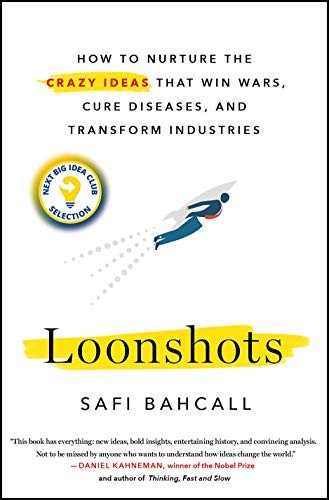
Loonshots
by Safi Bahcall · 2019
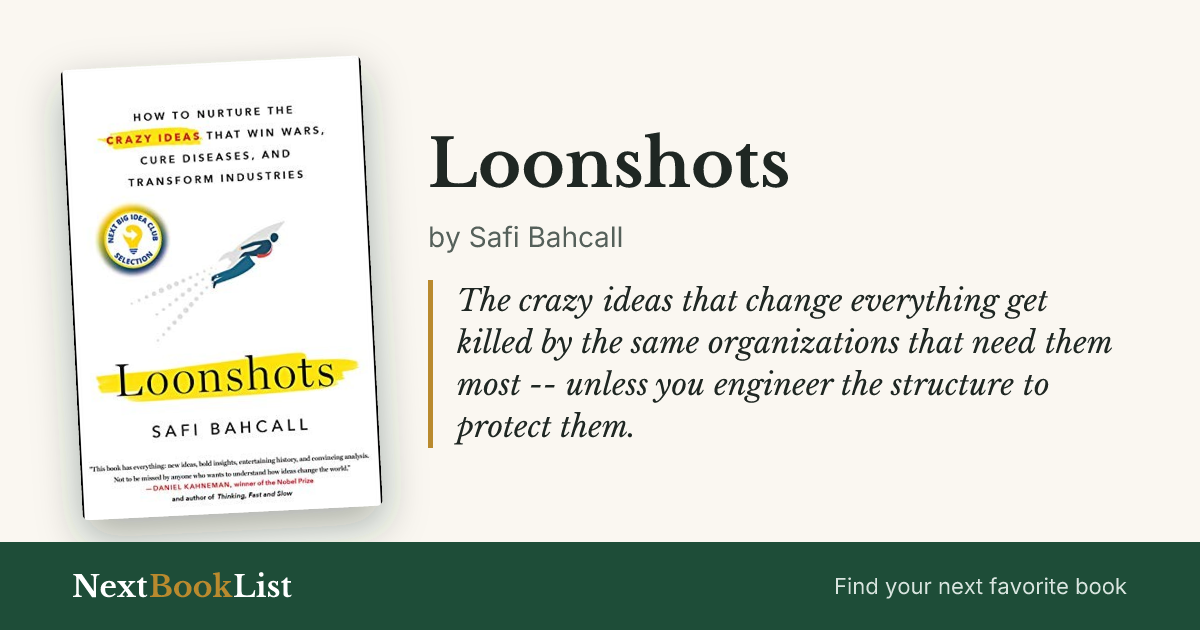
The crazy ideas that change everything get killed by the same organizations that need them most -- unless you engineer the structure to protect them.
Worth reading? Loonshots and Blue Ocean Strategy both promise a way out of "compete on the same terms as everyone else," but they solve different halves of the problem. Blue Ocean Strategy tells you where to point the company -- toward uncontested market space instead of a crowded one. Loonshots tells you how to structure the company so the radical idea that finds that space survives contact with its own organization instead of getting killed by the people optimizing the current business. Read Blue Ocean for strategy, read Loonshots for the internal physics of why good strategies still die inside real companies. Worth reading if you've watched a genuinely good idea get killed inside your own company and want to understand why that keeps happening structurally, not just blame the person who killed it. Skip it if you're after simple innovation slogans -- Bahcall's argument leans on physics analogies (phase transitions, structure over culture) that some readers find illuminating and others find like unnecessary scaffolding around a simpler point.
| Full Title | Loonshots: How to Nurture the Crazy Ideas That Win Wars, Cure Diseases, and Transform Industries |
|---|---|
| Author | Safi Bahcall |
| Published | 2019 |
| Category | Business & Money |
| Favorite quote | “A loonshot is a neglected project, widely dismissed, its champion written off as unhinged.” |
The Verdict
Bahcall ran a biotech company before he wrote this, and the physics background isn’t a gimmick – he’s genuinely trying to find the equations behind why the same “innovative” company kills its best ideas at scale when it didn’t at a smaller size. The framework is more useful than the metaphor is memorable, which is the honest tradeoff of this book.
you run or work inside a company that keeps talking about innovation while quietly crushing every weird idea that shows up
you want a book of case studies with no organizational framework -- Bahcall's whole pitch is the structure, not the anecdotes alone
Book Summary
Bahcall's central claim, borrowed from physics, is that organizations undergo phase transitions the same way water turns to ice: past a certain size, the same people, same values, same "innovative culture" slogans suddenly produce completely different behavior, because structure -- not culture -- determines whether radical ideas survive. Two companies with identical values can behave completely differently depending on how they're structured to handle risk and reward.
He splits people inside any organization into "artists" (who generate loonshots -- ideas that look crazy and get dismissed) and "soldiers" (who execute and defend the proven, franchise business). Both types are necessary, and the mistake most companies make is either favoring soldiers so completely that artists get crushed, or romanticizing artists so much that nothing ships. The fix isn't picking a side -- it's structurally separating the two groups while keeping them in constant, respectful communication, a balance Bahcall calls "dynamic equilibrium."
Loonshots die inside organizations for predictable, structural reasons: the moment a radical idea threatens to disrupt the franchise that pays everyone's salary, the incentives of the people running the franchise turn against it, regardless of how much the company's mission statement praises innovation. Bahcall's prescription -- borrowed partly from Vannevar Bush's WWII research organization and partly from Alfred Sloan's General Motors -- is to build separate structures and processes for loonshot nurseries versus franchise execution, so the loonshot doesn't have to win a popularity contest against the business that's currently making money.
Top 10 Lessons from Loonshots
- Organizations undergo phase transitions -- past a certain size, structure beats culture.
- Split people into 'artists' who generate radical ideas and 'soldiers' who execute the proven business.
- Both artists and soldiers are necessary -- favoring either one kills the company differently.
- Structurally separate loonshot nurseries from franchise execution, don't just hope culture protects them.
- Keep the separated groups in constant, respectful communication -- isolation kills loonshots too.
- A radical idea threatens the incentives of whoever runs the current profitable business.
- Mission statements praising innovation don't protect loonshots -- incentive structures do.
- Bush's WWII research organization and Sloan's GM both separated invention from execution deliberately.
- A loonshot looks like a bad idea right up until the moment it isn't.
- 'Dynamic equilibrium' between artists and soldiers has to be actively managed, not assumed.
Top 1 Quotes from Loonshots
"A loonshot is a neglected project, widely dismissed, its champion written off as unhinged."
Safi Bahcall, Loonshots
Frequently Asked Questions
Is Loonshots worth reading?
Yes if you want a structural explanation for why good ideas die inside real companies, backed by history and physics analogies rather than generic innovation advice.
What is the main idea of Loonshots?
Structure, not culture, determines whether radical ideas survive inside an organization -- separate the people generating loonshots from the people executing the current business, but keep them talking.
What's the difference between Loonshots and Blue Ocean Strategy?
Blue Ocean Strategy is about where to compete -- uncontested market space. Loonshots is about how to structure a company so the idea that finds that space actually survives internally.
Who should read Loonshots?
Founders, executives, and product leaders who've watched a genuinely good idea get killed inside their own organization and want the structural reason why.
Ready to read it?
Get Loonshots on Amazon