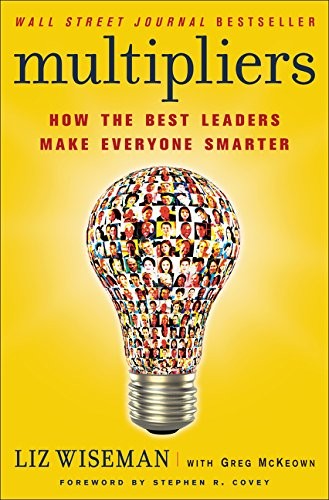
Multipliers
by Liz Wiseman · 2010
Some bosses double everyone's brainpower. Most just want credit for their own.
Worth reading? The best leadership book about getting more out of a team without turning into a control freak is Multipliers, and it earns the spot against Turn the Ship Around! by L. David Marquet, which tells the same story through one submarine captain's turnaround. Marquet's book is the specific case study; Wiseman's is the general framework, with five disciplines you can actually run a diagnostic against. Read Multipliers first for the model, then Turn the Ship Around for what it looks like on the ground. Skip Multipliers if you don't manage anyone yet -- it's aimed squarely at people with direct reports, and the frameworks don't do much for an individual contributor.
| Full Title | Multipliers: How the Best Leaders Make Everyone Smarter |
|---|---|
| Author | Liz Wiseman |
| Published | 2010 |
| Publisher | HarperBusiness |
| Category | Business & Money |
| Favorite quote | “Leadership isn't about being the smartest person in the room. It's about recognizing the genius in others and creating an environment where that genius can flourish.” |
The Verdict
Wiseman spent years interviewing executives and found a pattern nobody was measuring: two leaders with identical teams can get wildly different results, and the difference isn’t talent or budget. It’s whether the leader makes people feel smarter or smaller in the room. That’s a system you can actually build, and this book hands you the blueprint.
you manage people and want to know if you're multiplying their intelligence or diminishing it
you're an individual contributor with no direct reports and no plans to get any
Book Summary
Wiseman studied executives and split them into two types: Multipliers, who make the people around them smarter and more capable, and Diminishers, who drain intelligence out of a room without meaning to. The gap in output between the two types managing the same team runs close to 2x -- not from working harder, but from how much of everyone else's brain actually gets used.
Diminishers aren't villains. Most think they're helping: the "idea guy" who always has the answer, the rescuer who jumps in before someone can fail, the always-on boss who fills every silence in a meeting. Each of those moves shuts down other people's thinking, even when the intent behind it is generous.
Multipliers run on five disciplines: they attract and use talent instead of hoarding it, create an environment that demands people's best thinking, extend challenges rather than hand out assignments, debate decisions in the open rather than dictate them, and instill ownership rather than control. None of it requires more charisma. It requires stepping back.
Top 11 Lessons from Multipliers
- Diminishers shrink the room's intelligence; Multipliers double it.
- Being the smartest person in the room is a liability if you act on it.
- The 'idea guy' boss trains the team to stop generating ideas of its own.
- Rescuing someone before they fail also rescues them from learning.
- Extend a challenge instead of assigning a task -- let people stretch into it.
- Debate the decision out loud, then commit to it as a team.
- Give people ownership of outcomes, not just a list of tasks.
- Attracting and using talent beats hoarding it for your own projects.
- Silence from a leader creates space; talking fills it up.
- Most Diminishers genuinely think they're being helpful, not harmful.
- Ask questions you don't already know the answer to.
Top 3 Quotes from Multipliers
"Leadership isn't about being the smartest person in the room. It's about recognizing the genius in others and creating an environment where that genius can flourish."
Liz Wiseman, Multipliers
"Multipliers aren't genius, they're genius makers."
Liz Wiseman, Multipliers
"The most valuable and yet under-leveraged resource in most companies is the collective, cumulative intelligence of the people within it."
Liz Wiseman, Multipliers
Frequently Asked Questions
Is Multipliers worth reading?
Yes, if you manage anyone at all. It's the clearest explanation of why some leaders get roughly double the output from the same team, and it comes with five disciplines you can actually check yourself against. Skip it if you have no direct reports -- the frameworks don't transfer to individual work.
What is the main idea of Multipliers?
Leaders fall into two camps: Multipliers, who amplify the intelligence of the people around them, and Diminishers, who shrink it, usually without realizing it. The gap in team output between the two styles is roughly 2x, using the exact same people.
What's the difference between a Multiplier and a Diminisher?
A Diminisher jumps in with the answer, rescues people before they fail, and fills every silence -- often with good intentions. A Multiplier extends a challenge, lets people struggle productively, and creates space for other people's best thinking instead of showing off their own.
Is Multipliers useful if I'm not a manager yet?
Less so. The five disciplines assume you have people whose thinking you can either amplify or shut down. Read it once you're leading a team; it won't do much for you as an individual contributor.
Ready to read it?
Get Multipliers on Amazon