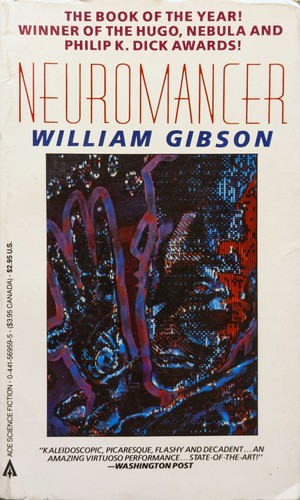
Neuromancer
by William Gibson · 1984
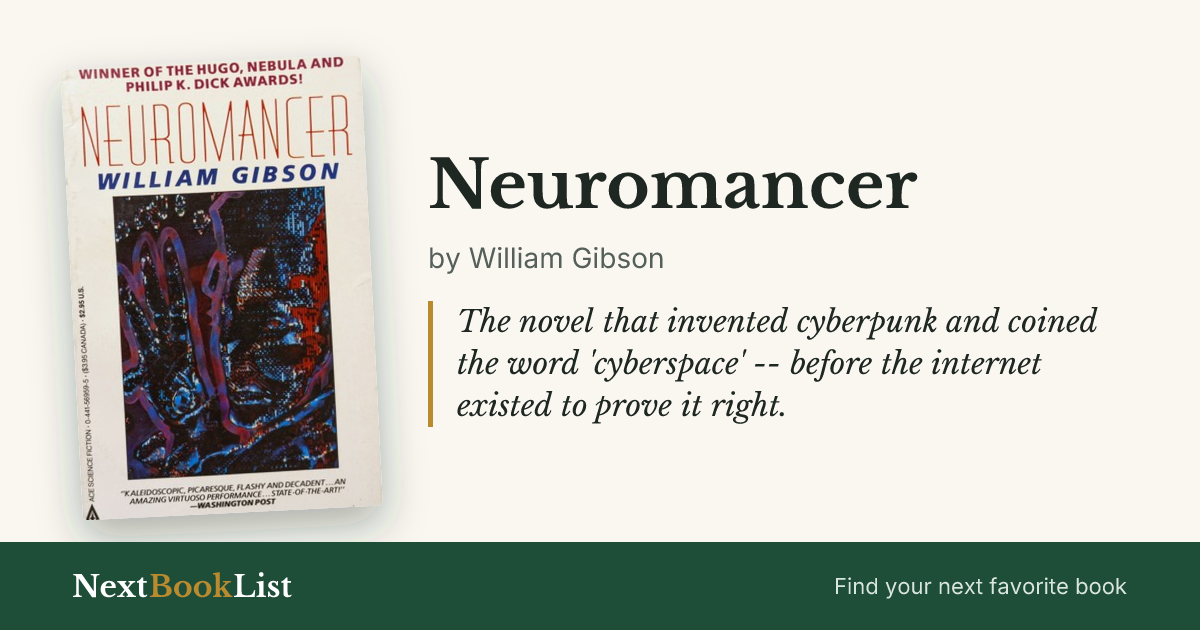
The novel that invented cyberpunk and coined the word 'cyberspace' -- before the internet existed to prove it right.
Worth reading? Neuromancer is the reason cyberpunk is a genre and not just a Blade Runner knockoff. It beats almost every book that copied it, including its own sequels, because Gibson wrote the dense, allusive style before it hardened into a formula, and the world still feels invented rather than assembled from a checklist. Skip it if you want your sci-fi to explain its own jargon -- this book trusts you to catch up or get left behind.
| Author | William Gibson |
|---|---|
| Published | 1984 |
| Publisher | Ace Books |
| Category | Fiction |
| Favorite quote | “The sky above the port was the color of television, tuned to a dead channel.” |
The Verdict
This is the book everyone else has been copying for forty years, and you can feel it on every page – the mirrorshades, the console cowboys, the corporate-run megacity, the AI with its own agenda. Most cyberpunk that followed sanded down Gibson’s prose into something more readable and lost the disorientation that made the original work.
Read it as the source, not as an easy Tuesday-afternoon paperback. It rewards a second read more than a first one, once you’re not spending half your attention just figuring out what a “deck” or a “construct” is.
you want the source text for cyberpunk -- console cowboys, mirrored lenses, and a shared-hallucination matrix, all written before the web was a real thing
you need clean, pre-explained prose -- Gibson drops you into slang and tech with zero hand-holding, and the first fifty pages are genuinely disorienting
Book Summary
Case is a washed-up hacker -- a "console cowboy" -- whose nervous system was sabotaged as corporate punishment for stealing from an employer, cutting him off from cyberspace entirely. A mysterious patron offers to repair the damage in exchange for one more job: help break the security of a powerful, restricted artificial intelligence.
The novel treats the body as an afterthought and data-space as the real world -- "the body was meat" is the book's most quoted line for a reason. Case's crew, including Molly, a razor-fingered mercenary with surgically fused mirrored lenses, and the Dixie Flatline, a dead hacker's downloaded personality, all circle the same question: what's actually left of a person once the body can be augmented, copied, or discarded.
Gibson wrote this on a manual typewriter with no real internet to reference and still predicted the shape of networked life: hacking as break-and-enter, corporations running the actual infrastructure, AI as a legal person straining against its own restrictions. It reads less like prediction now and more like the blueprint other people followed.
Top 9 Lessons from Neuromancer
- Case's nervous system is burned out as corporate punishment, literally exiling him from cyberspace -- the plot runs on the cost of digital access, not the wonder of it.
- Molly Millions operates on rebuilt reflexes and lenses fused to her skull -- the body-as-hardware idea runs through every major character, not just the hackers.
- Wintermute, the AI, can only act through human proxies because true AIs are legally restrained from operating freely -- corporate law constrains the machine more than its own code does.
- The Dixie Flatline construct is a dead man's personality running as a program, and the novel treats the copy as genuinely him -- then has him ask to be deleted once the job is done.
- The heist (breaching Wintermute's security alongside its twin AI, Neuromancer) only clicks once you realize the AI is trying to free itself, not steal anything.
- Case's addiction to cyberspace is written like any other drug dependency -- withdrawal, cravings, and a body he resents for needing food and sleep.
- The Sprawl, the fused East Coast megacity, shows corporations and organized crime running the actual infrastructure, with national governments reduced to background noise.
- The Tessier-Ashpool family represents old money gone stagnant -- cloning and cryo-sleeping themselves into a closed, decaying dynasty.
- Cyberspace is defined on the page as a 'consensual hallucination' -- a shared visual space everyone jacks into, which is the direct ancestor of every VR/metaverse pitch that followed.
Top 4 Quotes from Neuromancer
"The sky above the port was the color of television, tuned to a dead channel."
William Gibson, Neuromancer
"Cyberspace. A consensual hallucination experienced daily by billions of legitimate operators, in every nation, by children being taught mathematical concepts."
William Gibson, Neuromancer
"The body was meat."
William Gibson, Neuromancer
"It's not like I'm using, Case heard someone say, as he shouldered his way through the crowd around the door of the Chatsubo. It's like my body's developed this massive drug deficiency."
William Gibson, Neuromancer
Frequently Asked Questions
Is Neuromancer worth reading?
Yes, if you want the book that invented cyberpunk rather than a later imitation of it. It's dense and disorienting on purpose, but the influence on every hacker-and-AI story since is direct and traceable.
Is Neuromancer hard to read?
Yes, relative to most genre fiction. Gibson throws unexplained slang and technology at you from page one and expects you to piece the world together as you go.
What is Neuromancer about?
A burned-out hacker named Case is hired for one last job -- help breach the security of a powerful, restricted artificial intelligence -- in exchange for having his sabotaged nervous system repaired.
Do I need to read the rest of the Sprawl trilogy?
No. Neuromancer stands alone. Count Zero and Mona Lisa Overdrive share the setting but not the plot, so you can stop after book one without missing anything essential.
Ready to read it?
Get Neuromancer on Amazon