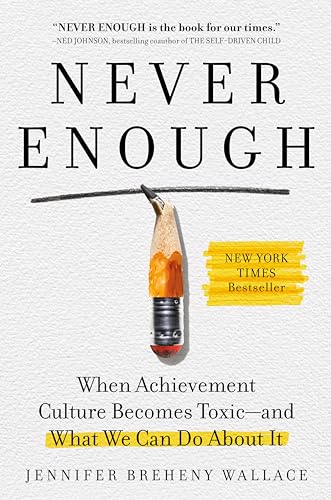
Never Enough
by Jennifer Breheny Wallace · 2023
The book that names what's actually wrong with grind culture: kids and adults alike have started to believe they only matter when they perform.
Worth reading? Never Enough is the clearest explanation yet of why high-achieving teens (and the adults who raise them) are burning out at record rates: they've absorbed that love is conditional on performance. Wallace's concept of 'mattering', feeling valued for who you are, not what you produce, is the single most useful idea in the book. Skip it if you're looking for a step-by-step parenting manual instead of a mindset shift, though the mattering framework alone is worth the read.
| Full Title | Never Enough: When Achievement Culture Becomes Toxic and What We Can Do About It |
|---|---|
| Author | Jennifer Breheny Wallace |
| Published | 2023 |
| Publisher | Portfolio |
| Category | Self-Improvement & Psychology |
| Favorite quote | “Our kids are absorbing the idea that their worth is contingent on their performance -- their GPA, the number of social media followers they have, their college brands -- not for who they are deep at their core.” |
The Verdict
Wallace spent years reporting in the country’s most competitive school districts, the ones where teens are cracking under pressure that looks, from the outside, like privilege. Her finding: the workload isn’t the whole story. Kids in these communities have absorbed that being loved and being high-performing are the same thing, and that belief is what’s actually breaking them.
The “mattering” framework is the book’s real contribution. It’s not resilience training, grit, or more praise, it’s the felt sense that you’re valued for who you are and that you’re needed, not just talented. That reframing applies past parenting too: plenty of adults are running the same conditional-worth software from their own childhoods.
Skip it if you want a chore chart or a 10-step program. This is a mindset book with research receipts, not a manual, and it works best if you’re willing to sit with the diagnosis before looking for the fix.
parents raising achievement-obsessed kids, or adults who quietly tie their worth to output
you want a parenting how-to with a chore chart -- this is a research-driven diagnosis, not a checklist
Book Summary
Achievement culture has quietly taught kids (and the adults modeling it) that their worth is conditional on performance -- grades, college brand, follower count, income. That conditional-worth message, even when unintentional, is what's driving the spike in teen anxiety and depression in high-achieving communities, not the workload itself.
The antidote is "mattering": the felt sense that you're valued for who you are and that you add value to others, independent of your resume. Kids (and adults) who feel like they matter to their family and community are more resilient under pressure than kids who are simply told they're talented.
Parents and workplaces build mattering through small, repeatable signals, not grand gestures: noticing effort over outcome, assigning real responsibility, modeling self-compassion out loud when you fail. Praise tied only to results erodes exactly the security it's meant to build.
Top 8 Lessons from Never Enough
- Achievement culture teaches kids their worth is conditional on performance -- that message does the damage, not the workload.
- 'Mattering' (feeling valued for who you are, not what you produce) is the real buffer against burnout, more than raw resilience training.
- Praise tied only to outcomes (grades, wins, followers) quietly signals that failure means you matter less.
- Giving kids real responsibility, chores, caregiving, community roles, builds mattering faster than compliments do.
- Model self-compassion out loud when you fail; kids copy how you talk to yourself more than what you tell them to do.
- Community and neighborhood ties matter as much as family ties for a kid's sense that they're needed, not just loved.
- Extrinsic goals (status, income, prestige) sustain motivation worse than intrinsic ones (relationships, contribution).
- Adults carry the same conditional-worth wiring from childhood into their careers -- this isn't only a parenting book.
Top 4 Quotes from Never Enough
"Our kids are absorbing the idea that their worth is contingent on their performance -- their GPA, the number of social media followers they have, their college brands -- not for who they are deep at their core. They feel they only matter to the adults in their lives, their peers, the larger community, if they are successful."
Jennifer Breheny Wallace, Never Enough
"Choosing intrinsic values -- like investing in friendships, neighbors, or volunteer groups -- has been found to sustain our happiness and well-being in a way that pursuing extrinsic goals, like higher income or higher status in a career, doesn't."
Jennifer Breheny Wallace, Never Enough
"When you make a mistake, consider modeling self-compassion out loud: Okay, I made a mistake and here's what I learned. Now I must stop being so hard on myself."
Jennifer Breheny Wallace, Never Enough
"When we put every family member's needs above ours because that's what 'good' parents do, we are showing that we don't think we matter -- even if we think we're showing our love."
Jennifer Breheny Wallace, Never Enough
Frequently Asked Questions
Is Never Enough worth reading?
Yes, especially for parents in competitive schools or high-pressure communities. It names the mechanism behind teen burnout, conditional self-worth, better than most parenting books.
What is the main idea of Never Enough?
Kids and adults burn out not from workload alone but from believing they only matter when they perform. 'Mattering', feeling valued independent of achievement, is the real protective factor.
Is this a parenting how-to book?
Not really. It's closer to a research-backed diagnosis with practical mattering-building habits woven in, not a step-by-step manual.
Who should read Never Enough?
Parents of achievement-focused kids, and any adult who notices they only feel okay about themselves after a win. Skip it if you want a rigid checklist rather than a mindset shift.
Ready to read it?
Get Never Enough on Amazon