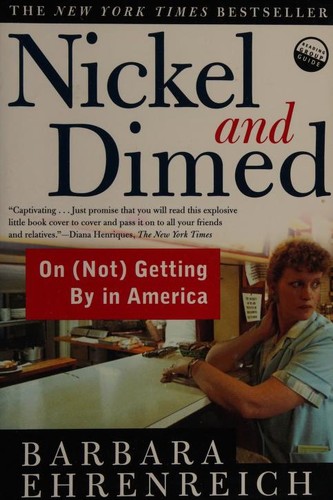
Nickel and Dimed
by Barbara Ehrenreich · 2001
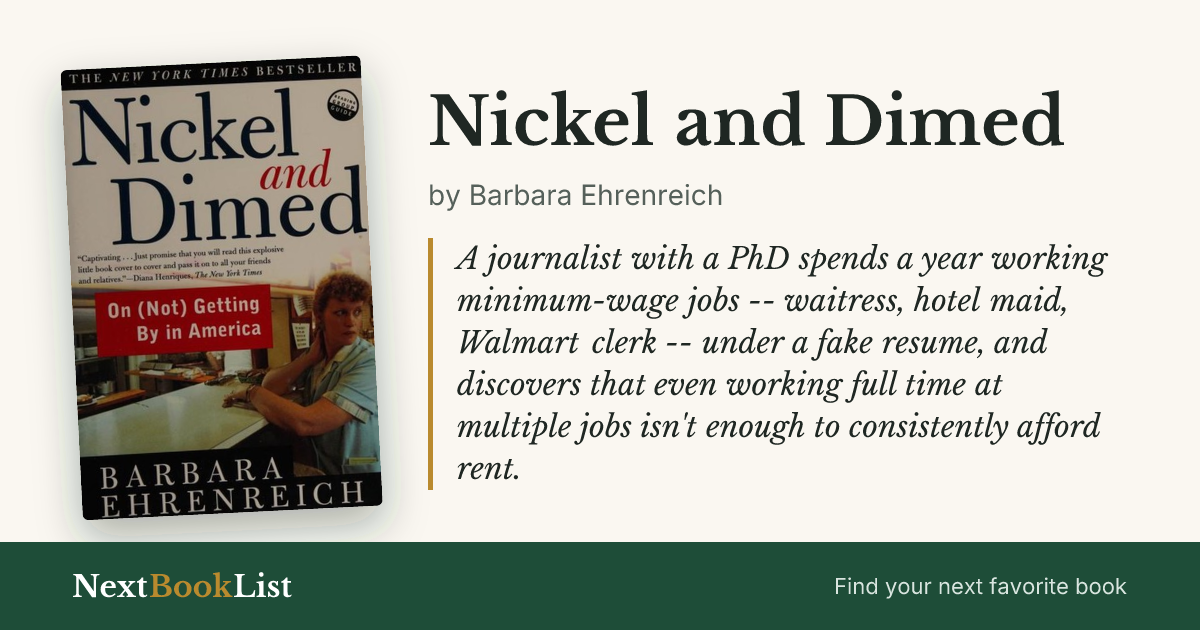
A journalist with a PhD spends a year working minimum-wage jobs -- waitress, hotel maid, Walmart clerk -- under a fake resume, and discovers that even working full time at multiple jobs isn't enough to consistently afford rent.
Worth reading? Nickel and Dimed works because Ehrenreich doesn't pretend her experiment is equivalent to actually being poor -- she's upfront that she had savings, no dependents, and an exit date her coworkers didn't have. That honesty is what makes the book's central finding land: even with those advantages stripped down to a minimum-wage budget, the math still doesn't work.
| Full Title | Nickel and Dimed: On (Not) Getting By in America |
|---|---|
| Author | Barbara Ehrenreich |
| Published | 2001 |
| Publisher | Picador |
| Category | Sociology & Culture |
| Favorite quote | “When someone works for less pay than she can live on -- when, for example, she goes hungry so that you can eat more cheaply and conveniently -- then she has made a great sacrifice for you.” |
The Verdict
Ehrenreich’s decision to name her own advantages up front is what keeps the book from being either exploitative or naive – she’s not claiming to know what it’s like to be poor, she’s testing whether the wages alone could support a person even under close-to-best-case conditions. They can’t, consistently, and that’s the finding that still gets cited two decades later.
The house-cleaning and nursing-home chapters are the most physically grueling parts of the book, and Ehrenreich doesn’t gloss over how much the work itself costs a body, separate from what it costs in hours.
Read it if you want honest, firsthand reporting on the gap between minimum wage and actual living costs. Skip it if you’re looking for a book that claims to speak for every low-wage worker’s exact experience – Ehrenreich is careful not to make that claim herself.
you want firsthand, undercover reporting on low-wage work in America rather than statistics alone -- Ehrenreich lived the budget constraints she's writing about
you want the book to represent every low-wage worker's experience -- Ehrenreich is explicit that she went in with safety nets (savings, no dependents, good health) that most of her coworkers didn't have
Book Summary
Ehrenreich took on a series of low-wage jobs -- waitressing in Florida, house cleaning and nursing-home work in Maine, retail at Walmart in Minnesota -- under an assumed identity, living only on what each job paid, to test whether full-time minimum-wage work could actually cover basic living costs.
Across all three locations, she found that even working close to full time, and often taking on a second job, the wages barely covered rent, food, and transportation, with almost no margin for emergencies, illness, or unexpected expenses.
The book is explicit about the limits of its own methodology -- Ehrenreich retained savings, health insurance backup, and an exit date her actual coworkers didn't have -- and uses that honesty to argue her experience likely understated, not overstated, the real difficulty of living on minimum wage.
Top 7 Lessons from Nickel and Dimed
- Ehrenreich worked as a waitress in Florida, a house cleaner and nursing-home aide in Maine, and a retail associate at Walmart in Minnesota, testing three different low-wage jobs across three different cost-of-living regions.
- In multiple locations, she had to take on a second job or seek cheaper, less stable housing (a motel room instead of an apartment) just to make rent, illustrating how tight the margin is on minimum-wage income.
- The book documents workplace practices -- mandatory drug testing, personality tests, tight scheduling with little notice -- that added real friction and cost to low-wage workers' lives beyond the wage itself.
- Ehrenreich is explicit that she retained a financial safety net (savings, a car, no dependents, good health) throughout the experiment, and argues her actual coworkers facing the same wages without those advantages had it measurably harder.
- Housing costs, more than food, emerged repeatedly as the hardest expense to cover on minimum wage across all three locations she worked.
- The book documents the physical toll of jobs like house cleaning and nursing-home care, treating the physical exhaustion of low-wage work as a cost the wage itself doesn't account for.
- Ehrenreich argues that low-wage employers' scheduling and management practices, not just the wage rate itself, actively make it harder for workers to hold a second job or pursue additional training to escape the wage bracket.
Top 1 Quotes from Nickel and Dimed
"When someone works for less pay than she can live on -- when, for example, she goes hungry so that you can eat more cheaply and conveniently -- then she has made a great sacrifice for you."
Barbara Ehrenreich, Nickel and Dimed
Frequently Asked Questions
Is Nickel and Dimed worth reading?
Yes -- it's honest, firsthand reporting on low-wage work in America that's upfront about the limits of its own experiment, which makes its findings more credible, not less.
What is Nickel and Dimed about?
Barbara Ehrenreich spends a year working minimum-wage jobs -- waitressing, house cleaning, retail -- under an assumed identity to test whether full-time low-wage work can cover basic living costs.
Is Nickel and Dimed still relevant today?
The specific wages and rents are dated to the early 2000s, but the book's core finding -- that minimum-wage work leaves little to no margin for emergencies -- is still widely cited in discussions of the minimum wage.
Does Nickel and Dimed claim to represent every low-wage worker's experience?
No -- Ehrenreich is explicit that she retained savings, health, and an exit date her actual coworkers didn't have, and argues her experience likely understated the real difficulty most low-wage workers face.
What jobs did Barbara Ehrenreich work for the book?
She worked as a waitress in Florida, a house cleaner and nursing-home aide in Maine, and a retail associate at Walmart in Minnesota.
Ready to read it?
Get Nickel and Dimed on Amazon