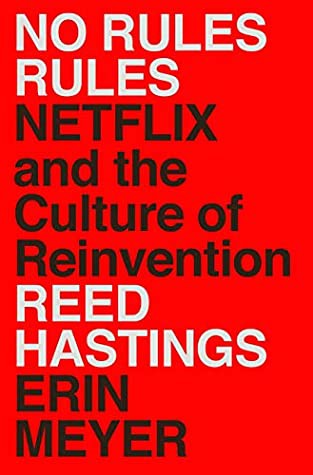
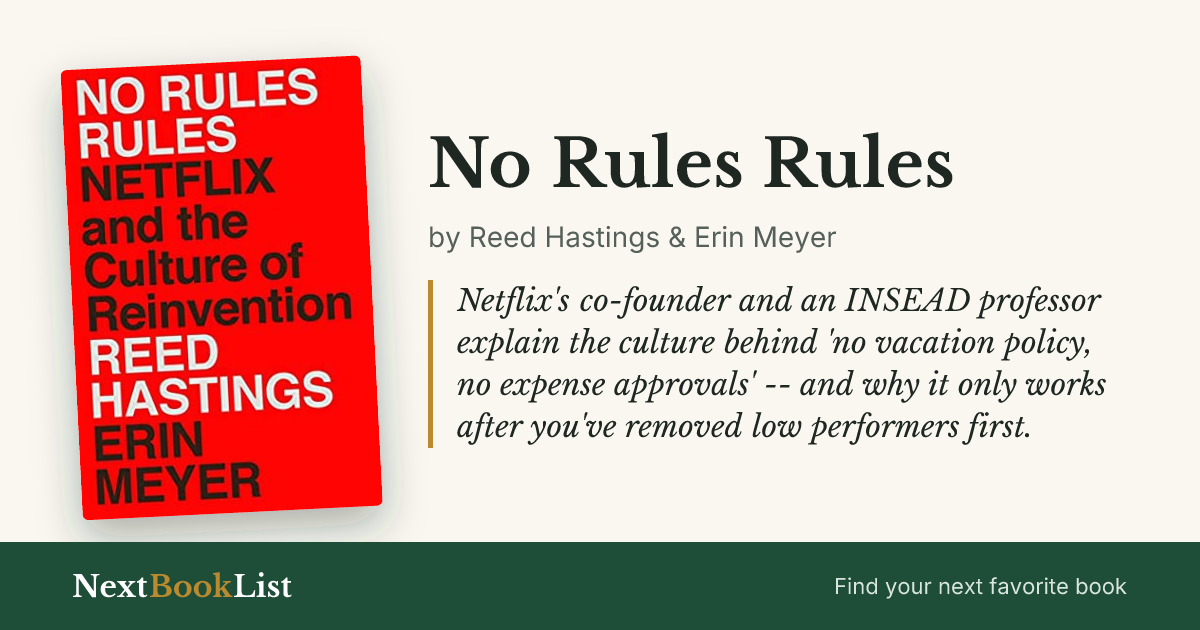
No Rules Rules
by Reed Hastings & Erin Meyer · 2020
Netflix's co-founder and an INSEAD professor explain the culture behind 'no vacation policy, no expense approvals' -- and why it only works after you've removed low performers first.
Worth reading? No Rules Rules is co-written with an outside academic (Erin Meyer), which keeps it from being pure Silicon Valley mythology, she pushes back on Hastings throughout, and includes where the culture failed abroad. Compared to Powell's Netflix folk-legend deck this book expands on, the sequencing point is the most important: freedom and informality only work after you've built talent density and radical candor, not before. It's candid about failure modes, especially cultural friction expanding Netflix outside the U.S. Skip it if you're going to cherry-pick "no vacation policy" without the talent density and candor prerequisites, that's the version that breaks.
| Full Title | No Rules Rules: Netflix and the Culture of Reinvention |
|---|---|
| Author | Reed Hastings & Erin Meyer |
| Published | 2020 |
| Publisher | Penguin Press |
| Category | Business & Money |
| Favorite quote | “Adequate performance gets a generous severance package.” |
The Verdict
The sequencing is the whole book: talent density and radical candor come first, and only then do the famous freedoms (no vacation policy, no expense approvals) actually work instead of causing chaos. Copy the freedoms without the prerequisites and you get the failure mode, not the culture.
you run or work inside a company and want to understand talent density before copying any of Netflix's famous freedoms
you're a small team without the budget to pay top-of-market -- several of these freedoms assume high talent density you may not have yet
Book Summary
Freedom and responsibility only work as a culture after you've built talent density, removing average performers and paying top-of-market for the ones who remain. Freedom applied to an average team just produces chaos; applied to an all-star team it produces speed.
Radical candor has to be a practiced, structural habit (starting meetings with critique, 360 feedback processes) not a personality trait some managers happen to have. Without a deliberate system for it, "no rules" culture drifts into avoidance instead of honesty.
Removing rules (expense policies, vacation policies, approval chains) works as a byproduct of hiring right and building candor, not as the starting intervention. Meyer's chapters flag where this exported poorly to more hierarchical cultures internationally, the book doesn't pretend it's universal.
Top 7 Lessons from No Rules Rules
- Talent density (removing average performers, paying top-of-market) has to come before removing rules, or freedom just produces chaos.
- Radical candor must be a structural habit (built into meetings, feedback cycles), not left to individual managers' personalities.
- Removing vacation and expense policies is a downstream effect of trust, not a starting culture hack to copy directly.
- The 'keeper test' (would you fight to keep this person if they quit tomorrow) is a blunt but useful filter for who stays.
- Context, not control: give talented people the full context for a decision and let them make the call, rather than approving every step.
- Culture that works in San Francisco doesn't automatically transplant, several of Netflix's international offices needed adapted versions.
- Sunlighting (informing peers before acting, rather than asking permission) replaces approval chains once trust is established.
Top 4 Quotes from No Rules Rules
"Adequate performance gets a generous severance package."
Reed Hastings & Erin Meyer, No Rules Rules
"The best thing you can do for employees is hire only 'A' players to work alongside them."
Reed Hastings & Erin Meyer, No Rules Rules
"Lead with context, not control."
Reed Hastings & Erin Meyer, No Rules Rules
"Talent density beats process."
Reed Hastings & Erin Meyer, No Rules Rules
Frequently Asked Questions
Is No Rules Rules worth reading?
Yes, for anyone building or working in a company culture, but read the sequencing carefully. The famous freedoms (no vacation policy, no expense approval) only work after talent density and radical candor are in place, not before.
What is the 'keeper test'?
A manager's gut check: would you fight to keep this person if they told you they were quitting tomorrow? If not, Netflix's culture argues you should let them go rather than manage them out slowly.
Does Netflix's culture work everywhere?
Co-author Erin Meyer specifically documents where it didn't transplant cleanly, more hierarchical cultures needed adapted versions of the candor and freedom principles.
Ready to read it?
Get No Rules Rules on Amazon