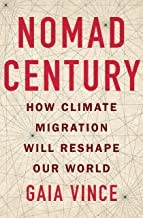
Nomad Century
by Gaia Vince · 2022
A Royal Society Prize-winning science writer argues that mass climate migration isn't a hypothetical future risk but an already-underway reordering of where humans will be able to live -- and makes the case for planning it rather than fighting it.
Worth reading? Vince's argument starts from a premise a lot of climate writing avoids stating this bluntly: enough warming is already locked in that large parts of the currently habitable world (equatorial regions, low-lying coasts, areas dependent on vanishing water sources) will become difficult or impossible to live in within decades, and hundreds of millions of people will need to move. Rather than treating that as a catastrophe to prevent, she treats it as a logistics and governance problem to plan for -- proposing new cities and expanded infrastructure in northern latitudes (Canada, Scandinavia, Siberia, the UK) that could absorb displaced populations, and arguing that managed, welcomed migration produces far better outcomes than the chaotic, resisted migration current border politics are set up to produce. It's a genuinely provocative reframe, and Vince backs it with real demographic and climate modeling, though the political feasibility of the specific proposals (new mega-cities in the Arctic, open border policies) is the part readers will find hardest to accept regardless of how sound the underlying climate case is.
| Full Title | Nomad Century: How Climate Migration Will Reshape Our World |
|---|---|
| Author | Gaia Vince |
| Published | 2022 |
| Publisher | Flatiron Books |
| Category | Sociology & Culture |
The Verdict
What makes Vince’s argument land is that she doesn’t treat migration as the crisis – she treats resisting migration as the crisis. Once you accept her premise that large-scale displacement is coming regardless of emissions policy, the book’s proposals stop sounding like sci-fi and start sounding like the more rational alternative to the chaotic version currently on offer. Whether the specific solutions (new Arctic cities, dramatically open borders) are politically achievable is a fair question the book doesn’t fully resolve.
Read it if you want a science-grounded case for treating climate migration as inevitable and planning for it deliberately, rather than fighting a losing battle against it. Skip it if you’re looking for a book centered on cutting emissions – Vince’s focus is adaptation and migration, not mitigation policy.
you want a science writer's forward-looking case for treating climate migration as inevitable and planning for it deliberately, including new northern cities and managed relocation, rather than a book focused on emissions reduction
you want a book primarily about mitigating climate change (cutting emissions, renewable energy policy) -- Vince's focus is adaptation and migration, largely accepting significant warming as already locked in rather than centering prevention
Book Summary
Significant climate-driven migration is already underway and effectively locked in regardless of future emissions cuts, because warming already committed by past and current emissions will make parts of the equatorial belt, low-lying coastal regions, and water-stressed areas substantially harder to inhabit within decades -- Vince argues the relevant policy question is no longer whether mass migration happens, but whether it's planned or chaotic.
Northern latitude countries (Canada, the Nordic states, parts of Russia, the UK) have both the land and, as warming continues, potentially the climate to absorb large new populations, and Vince argues these regions should proactively build infrastructure and new cities designed for climate migrants rather than waiting for crisis-driven, informal migration to arrive unplanned.
Framing migration as a threat to be resisted (through border enforcement, nationalist politics) produces worse humanitarian and economic outcomes than framing it as a resource to be managed -- Vince points to historical and economic evidence that migrants tend to be net contributors to receiving economies, arguing the "invasion" framing common in current border politics is both empirically wrong and strategically counterproductive as climate pressure intensifies.
Top 9 Lessons from Nomad Century
- Vince argues that enough warming is already locked in from past emissions that large-scale climate migration is now a near-certainty regardless of future mitigation efforts -- the open question is whether it's planned or chaotic, not whether it happens.
- Equatorial regions, low-lying coastal areas, and water-stressed zones are identified as the areas most likely to become difficult to inhabit within decades, driving the bulk of projected climate displacement.
- Northern latitude countries (Canada, Nordic nations, parts of Russia, the UK) are proposed as prime candidates for large-scale new city development specifically designed to receive climate migrants, given their land availability and improving climates as warming continues.
- Managed, welcomed migration produces measurably better economic and humanitarian outcomes than resisted, chaotic migration -- Vince argues the difference is largely a policy choice, not an inevitability.
- Historical and economic evidence generally shows migrants as net economic contributors to receiving countries, which Vince uses to challenge the "burden" framing common in anti-immigration political rhetoric.
- Current international border and asylum systems were designed for much smaller and more sporadic migration flows than climate change is expected to produce, and Vince argues they need fundamental redesign rather than incremental patching.
- Vince treats climate adaptation and migration policy as inseparable -- adaptation planning that ignores where large populations will actually need to relocate is, in her view, planning for a world that won't exist.
- Aging populations and shrinking workforces in many wealthy northern countries create a demographic argument for welcoming climate migrants that runs parallel to the humanitarian one -- Vince frames migration as potentially solving two crises at once.
- The book challenges the idea that national borders should be treated as fixed and permanent given the scale of environmental change underway -- Vince argues for institutions and agreements built around expected mass movement rather than around maintaining current borders unchanged.
Frequently Asked Questions
Is Nomad Century worth reading?
Yes, if you want a provocative, well-researched case for planning climate migration rather than resisting it -- Vince backs the argument with real demographic and climate modeling, even where the specific proposals are ambitious.
What is Nomad Century about?
Gaia Vince argues that climate-driven mass migration is already locked in by past emissions and makes the case for managing it deliberately, including building new cities in northern latitudes to absorb displaced populations.
Does Nomad Century focus on reducing emissions?
Not primarily. Vince largely treats significant warming as already committed and focuses on adaptation and migration planning rather than emissions-reduction policy.
Are Nomad Century's proposals realistic?
The climate and demographic case is well supported, but proposals like new Arctic mega-cities and dramatically more open borders are the most speculative and politically difficult parts of the book -- readers should expect a provocative argument, not a near-term policy roadmap.
Who is Gaia Vince?
She's a science writer and broadcaster who won the Royal Society Science Book Prize for a previous book, and writes from a background covering climate science and its human consequences.
Ready to read it?
Get Nomad Century on Amazon