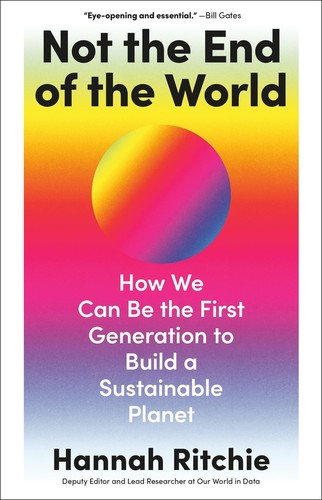
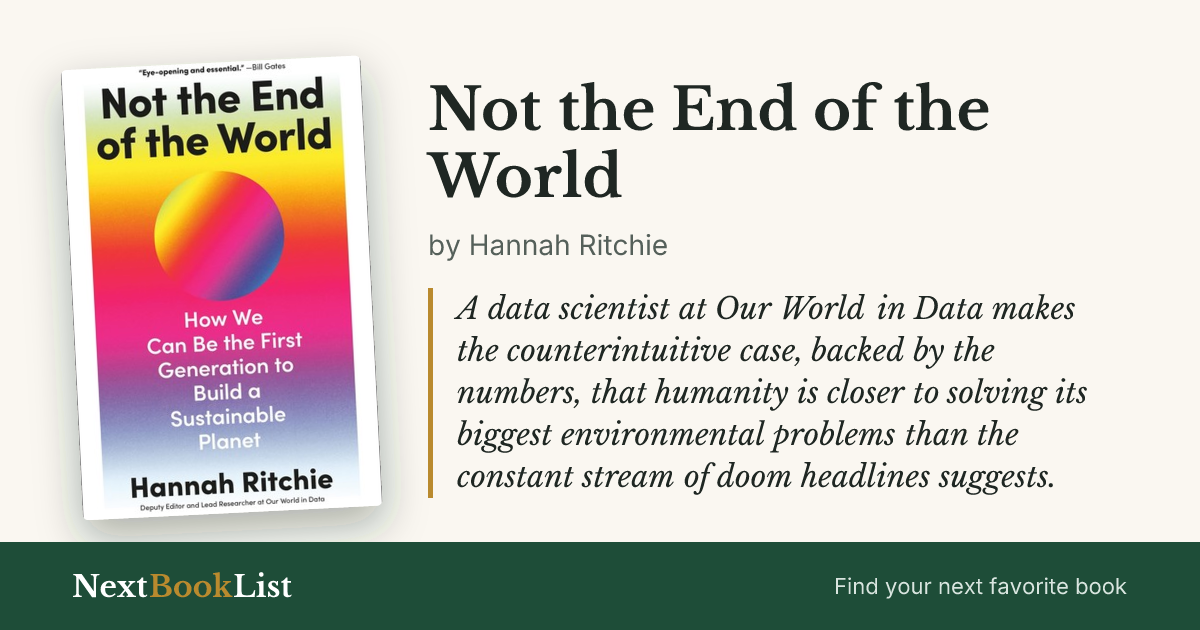
Not the End of the World
by Hannah Ritchie · 2024
A data scientist at Our World in Data makes the counterintuitive case, backed by the numbers, that humanity is closer to solving its biggest environmental problems than the constant stream of doom headlines suggests.
Worth reading? Ritchie's job at Our World in Data means she spends her career in the actual numbers behind climate, pollution, deforestation, and biodiversity loss, and the book's core move is holding two things true at once: environmental problems are real and serious, and the data shows more measurable progress than the doom-saturated news cycle usually reports. Chapter by chapter -- air pollution, climate, deforestation, food, biodiversity, plastic, overfishing -- she walks through where things have actually gotten better (often dramatically), where they haven't, and why constant doom framing can backfire by making people feel either hopeless or like nothing they do matters. It's not a naive 'everything's fine' book; she's explicit that current trajectories are still not good enough on several fronts. But if your model of the planet's environmental trend lines comes mostly from headlines, this book will genuinely update several of them with real data rather than vibes.
| Full Title | Not the End of the World: How We Can Be the First Generation to Build a Sustainable Planet |
|---|---|
| Author | Hannah Ritchie |
| Published | 2024 |
| Publisher | Little, Brown Spark |
| Category | Sociology & Culture |
The Verdict
Ritchie’s advantage over most climate writers is that she’s not primarily an advocate or a journalist – she’s the person who actually maintains the datasets everyone else cites. That gives the book a different texture: less “we must act now or else,” more “here’s what the last thirty years of data actually shows, and here’s what it implies for the next thirty.” It won’t satisfy readers who want maximum urgency, but it’s hard to argue with the numbers she’s citing.
Read it if you want a data-first, cautiously optimistic corrective to environmental doom coverage, written by someone who works in the actual global datasets every day. Skip it if you’re looking for urgency-first climate advocacy – Ritchie’s whole argument is that calm, accurate data beats panic, so don’t expect a call to immediate radical action.
you want a rigorously data-driven counterweight to environmental doomism -- someone who takes climate change and biodiversity loss seriously but argues the actual data shows real, measurable progress most coverage ignores
you're looking for urgency-first climate advocacy or a call to immediate radical action -- Ritchie's whole argument is that panic and doom framing are themselves counterproductive, so this reads calmer and more optimistic than most books in the genre
Book Summary
Doom-framed environmental coverage, even when well-intentioned, can be counterproductive: Ritchie argues that constant "we're all doomed" messaging tends to produce paralysis or fatalism rather than action, and that showing measurable progress alongside remaining problems is a more accurate and more motivating picture.
Several major environmental indicators (outdoor air pollution deaths per capita in many regions, deforestation rates in specific countries, the rate of growth in greenhouse gas emissions, extreme poverty) have genuinely improved over recent decades even as absolute totals or headlines suggest otherwise -- the distinction between "getting worse" and "still bad but improving" matters enormously for both accurate understanding and effective action.
Ritchie frames sustainability as an achievable goal within this generation's reach specifically because humanity now has better technology, more data, and more institutional capacity to address these problems than any previous generation -- the book's title is a direct rebuttal to the idea that meaningful environmental progress is either impossible or already too late.
Top 9 Lessons from Not the End of the World
- Doom-framed environmental messaging can backfire, producing paralysis or apathy rather than the urgency it's meant to inspire -- accurate data on progress alongside remaining problems tends to motivate action more effectively.
- Outdoor air pollution deaths per capita have fallen substantially in many parts of the world over recent decades, even though absolute pollution and headline coverage often suggest the opposite trend.
- Global deforestation rates have slowed and, in specific countries, reversed into net reforestation -- the picture varies enormously by region, and lumping all forest loss together obscures real, localized progress.
- The rate of growth in global greenhouse gas emissions has slowed measurably compared to past decades, even though total emissions are still rising -- distinguishing 'still rising' from 'rising at the same explosive rate' matters for accurately tracking progress.
- Renewable energy costs have fallen faster than most projections anticipated, changing the economics of the energy transition in ways that make ambitious climate targets more technically achievable than pessimistic narratives assume.
- Overfishing and ocean plastic pollution are real, serious problems, but Ritchie argues specific, targeted interventions (fishing quotas, waste management infrastructure) have shown measurable success where implemented, rather than the problems being unsolvable at any scale.
- Global extreme poverty has fallen dramatically over the past several decades, which matters to environmental discussion because poverty reduction and environmental sustainability are frequently treated as opposed goals when the data suggests they can move together.
- 'Sustainable' in Ritchie's framing means each generation leaving the environment no worse off than it found it while also meeting its own needs -- a definition that requires both continued economic development and genuine environmental protection, not a tradeoff between them.
- Individual countries have already 'decoupled' economic growth from rising emissions -- GDP increasing while a country's total emissions fall -- which Ritchie treats as evidence the growth-versus-planet tradeoff isn't fixed or universal.
Frequently Asked Questions
Is Not the End of the World worth reading?
Yes, especially if your sense of environmental trends comes mainly from news headlines -- Ritchie backs every claim with actual data from Our World in Data and offers a more accurate, and more actionable, picture than pure doom coverage.
What is Not the End of the World about?
Hannah Ritchie uses data on air pollution, climate change, deforestation, food, biodiversity, and ocean health to argue humanity has made real measurable progress on environmental problems and could become the first generation to achieve true sustainability.
Is Not the End of the World climate change denial?
No. Ritchie treats climate change and other environmental problems as real and serious; her argument is about accurately representing progress alongside remaining problems, not denying the problems exist.
Is Not the End of the World too optimistic?
It's data-grounded optimism rather than blind optimism -- Ritchie is explicit that several trends are still not good enough, but argues accurate data shows more progress than doom framing typically allows.
Who is Hannah Ritchie?
She's Deputy Editor and lead researcher at Our World in Data, based at the University of Oxford, and writes from inside the actual global datasets on environmental and development trends.
Ready to read it?
Get Not the End of the World on Amazon