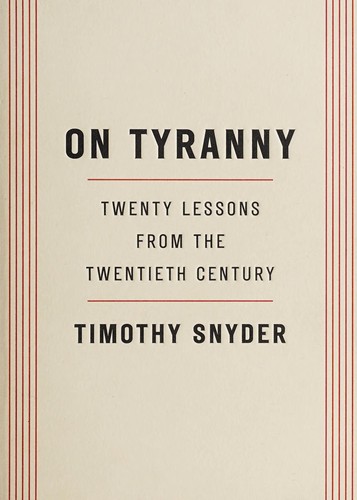
On Tyranny
by Timothy Snyder · 2017
A Yale historian of 20th-century fascism and totalitarianism condenses the lessons of how democracies collapsed into Hitler's Germany and Stalin's USSR into twenty short, actionable warnings for recognizing and resisting the same patterns today.
Worth reading? Snyder wrote this fast, in the weeks after the 2016 US election, distilling decades of his own scholarship on the collapse of interwar democracies into twenty short, imperative-mood lessons -- 'Do not obey in advance,' 'Defend institutions,' 'Believe in truth' -- each just a few pages long. It became a surprise bestseller precisely because of that compression: it reads less like an academic book and more like a pocket manual, meant to be read in one sitting and returned to. The tradeoff is depth -- if you want the actual historical detail behind lesson six ('be wary of paramilitaries') you need to go to Snyder's longer academic work, not this book, which deliberately strips away the footnotes and case-study nuance in favor of speed and memorability. Read as what it is -- a distilled warning pamphlet from someone who has spent a career studying how the twentieth century's worst regimes actually took power -- it succeeds completely at what it sets out to do.
| Full Title | On Tyranny: Twenty Lessons from the Twentieth Century |
|---|---|
| Author | Timothy Snyder |
| Published | 2017 |
| Publisher | Tim Duggan Books |
| Category | Sociology & Culture |
| Favorite quote | “Post-truth is pre-fascism.” |
The Verdict
What makes this land differently than most political pamphlets is Snyder’s actual scholarship behind it – he’s spent his career on exactly the historical collapses he’s compressing here, and it shows in how specific and non-hysterical the twenty lessons are. This isn’t a book of vague dread. It’s a list of concrete behaviors, drawn from documented history, that you can actually act on today.
Read it if you want the fastest, most historically grounded entry point into recognizing authoritarian patterns – it’s built to be read in one sitting and kept nearby. Skip it if you already want the deep historical case studies behind each lesson; go to Snyder’s longer academic work for that, because this one deliberately strips the detail out in favor of speed.
you want a short, urgent, historically grounded field guide to recognizing authoritarian tactics, written by a scholar of the actual historical collapses (Nazi Germany, the Soviet Union) rather than a pundit
you want deep historical narrative and detailed case studies -- this is a compressed pamphlet of twenty short lessons, each just a few pages, meant to be read fast and acted on, not a comprehensive history like Snyder's longer academic books (Bloodlands, Black Earth)
Book Summary
Authoritarian consolidation follows recognizable patterns across very different 20th-century contexts (Nazi Germany, the Soviet Union, other interwar collapses), and Snyder argues those patterns are recognizable and resistible in advance if citizens know what to watch for -- the book's premise is that history doesn't just repeat, but it rhymes closely enough to be genuinely useful as an early-warning system.
"Anticipatory obedience" -- people and institutions voluntarily complying with an anticipated demand before it's even made, in order to stay ahead of trouble -- is, in Snyder's account, one of the most powerful tools an aspiring authoritarian has, because it does the work of repression without the regime having to spend any actual coercive capital; refusing to comply in advance removes that free tool.
Institutions (courts, unions, professional associations, local government, a free press) don't defend themselves automatically -- they survive only when individuals inside them actively choose, case by case, to defend their independence, and Snyder argues the small, unglamorous choices of professionals (a judge, a civil servant, a journalist) in the early stages of authoritarian consolidation matter disproportionately, because by the time institutional collapse is obvious, individual resistance has become far more costly and dangerous.
Top 10 Lessons from On Tyranny
- 'Do not obey in advance' -- much of the power an authoritarian gains comes from people and institutions voluntarily complying with an anticipated demand before it's actually made.
- 'Defend institutions' -- courts, unions, and professional bodies don't protect themselves automatically; they survive only through individuals actively choosing to defend their independence, case by case.
- 'Beware the one-party state' -- watch for the elimination of competitive elections and the merging of party and state power, historically an early and identifiable step toward consolidation.
- 'Take responsibility for the face of the world' -- symbols matter, and removing or resisting symbols of hate (Snyder cites reactions to swastikas) is a small but meaningful act of resistance.
- 'Remember professional ethics' -- Snyder argues that professionals (lawyers, doctors, civil servants) who continued to follow their field's ethical codes rather than a regime's demands provided some of history's most effective resistance.
- 'Be wary of paramilitaries' -- armed groups operating outside normal state authority but tacitly tolerated by it were a recurring feature of 20th-century authoritarian consolidation.
- 'Believe in truth' -- abandoning a shared factual reality (accepting that some claims are just true regardless of who benefits) is, in Snyder's account, a precondition for the kind of large-scale manipulation that preceded past authoritarian takeovers.
- 'Investigate' -- do your own research rather than relying only on headlines, because Snyder argues state and non-state actors have historically exploited an under-informed public.
- 'Make eye contact and small talk' -- maintaining ordinary social bonds across political lines is, per Snyder, a small but real defense against the atomization that authoritarian movements exploit.
- 'Be as courageous as you can' -- Snyder closes on the idea that if none of the previous, safer lessons apply, physical courage may eventually be required, as it was for people who resisted at real personal risk in the historical cases he studies.
Top 6 Quotes from On Tyranny
"Post-truth is pre-fascism."
Timothy Snyder, On Tyranny
"Do not obey in advance."
Timothy Snyder, On Tyranny
"Institutions do not protect themselves. They fall one after the other unless each is defended from the beginning."
Timothy Snyder, On Tyranny
"Believe in truth."
Timothy Snyder, On Tyranny
"Make eye contact and small talk."
Timothy Snyder, On Tyranny
"Be as courageous as you can."
Timothy Snyder, On Tyranny
Frequently Asked Questions
Is On Tyranny worth reading?
Yes, if you want a fast, historically grounded pocket guide to recognizing authoritarian tactics -- it's short by design, written by a scholar of Nazi Germany and the Soviet Union rather than a pundit, and meant to be read in one sitting.
What is On Tyranny about?
Timothy Snyder distills twenty short lessons from the collapse of 20th-century democracies into fascism and communism into an urgent, actionable field guide for recognizing and resisting the same patterns today.
How long is On Tyranny?
It's a short book -- around 128 pages, split into twenty brief lessons of just a few pages each, deliberately compressed rather than a full historical narrative.
Is On Tyranny based on real historical research?
Yes. Snyder is a Yale historian specializing in 20th-century Eastern Europe, Nazi Germany, and the Holocaust (Bloodlands, Black Earth), and this book condenses lessons from that scholarship rather than presenting new speculation.
Should I read On Tyranny or Snyder's longer books first?
On Tyranny is the fast, actionable entry point. If you want the full historical detail and case studies behind the lessons, Snyder's longer academic works like Bloodlands go much deeper -- but On Tyranny works fine as a standalone.
Ready to read it?
Get On Tyranny on Amazon