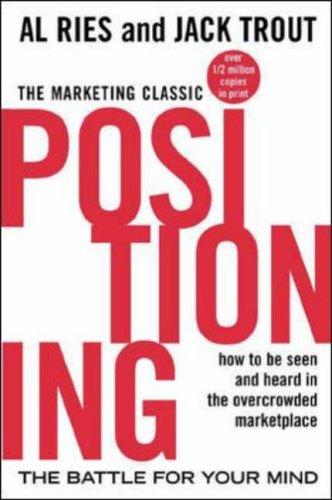
Positioning
by Al Ries and Jack Trout · 1981
The easiest way to win in a crowded market is to own a word in someone's head.
Worth reading? Positioning is the 1981 book that still explains why most marketing fails: the prospect's mind is full, so you don't 'communicate,' you find an empty slot and crawl into it. Ries and Trout's examples are decades old (Coca-Cola, Avis, Volkswagen), but the mechanism is more true now than then. Read it before any modern 'growth' book, most of those are just this idea with a dashboard. It beats Building a StoryBrand for actual strategic clarity.
| Full Title | Positioning: The Battle for Your Mind |
|---|---|
| Author | Al Ries and Jack Trout |
| Published | 1981 |
| Category | Business & Money |
| Favorite quote | “The basic approach of positioning is not to create something new and different, but to manipulate what's already up there in the mind, to retie the connections that already exist.” |
The Verdict
Ries and Trout wrote this when there were three TV networks and a handful of car brands. The mind has only gotten fuller since. The lesson that survived: you don’t out-feature the leader, you out-position them. Find the hole, name it, and stop screaming the same thing everyone else is screaming.
marketers, founders, and anyone launching something into a noisy category
you already run paid ads daily and want a tactics book, not a strategy one
Book Summary
The mind is a limited slot machine. It accepts only what fits an open category hole, and it remembers the first brand, not the best. Being first beats being better, that's why you fight for a position, not for quality.
Positioning is not what you do to the product, it's what you do to the prospect's mind. You can't change minds that are already made up, so you work with what's there: reposition a competitor ('Avis: we try harder' because Hertz is #1) or claim a hole ('the un-cola').
Names, categories, and the 'leader' frame do most of the work. A confused name or a me-too category dooms you before the ad spend starts. The classic line holds: it's easier to win a new category than to be the tenth brand in an old one.
Top 8 Lessons from Positioning
- The mind accepts only what fits an empty slot, fill one, don't fight a full one.
- Being first in a category beats being better in a crowd.
- You can't change a mind already made up; work with what's there.
- Reposition a stronger competitor to make room for yourself.
- A confused product name loses before the marketing starts.
- Lead with the leadership claim , 'we're #1' is the strongest position.
- Pick a narrow category you can own rather than a broad one you share.
- In a commodity fight, price cuts are a losing position; differentiation is the only defensible one.
Top 4 Quotes from Positioning
"The basic approach of positioning is not to create something new and different, but to manipulate what's already up there in the mind, to retie the connections that already exist."
Al Ries and Jack Trout, Positioning
"The mind is a slot machine with a limited number of slots."
Al Ries and Jack Trout, Positioning
"Marketing is a battle of perceptions, not products."
Al Ries and Jack Trout, Positioning
"The easiest way to get into a mind is to be first."
Al Ries and Jack Trout, Positioning
Frequently Asked Questions
Is Positioning worth reading?
Yes, especially before any modern marketing book. Its 1980s examples are dated, but the core insight, own an empty slot in a crowded mind, is more true in a noisy market than ever. It's the strategic foundation most 'growth hacks' borrow without credit.
What is the main idea of Positioning?
You don't win by being better; you win by being first into an open category in the customer's mind. The prospect's mind is full, so your job is to find or create an empty slot and claim it.
Is Positioning still relevant today?
More than ever. The internet multiplied the noise Ries and Trout warned about. The brands that win (and stay won) are the ones that own a word , 'search,' 'electric,' 'cloud', not the ones with the best product.
Should I read this or Building a StoryBrand?
Read Positioning first. StoryBrand is a useful framework for messaging once you've picked a position; Ries and Trout explain how to pick the position in the first place.
Ready to read it?
Get Positioning on Amazon