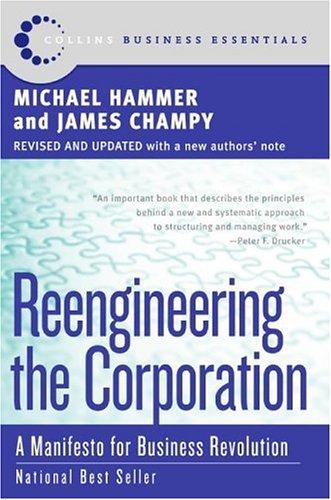
Reengineering the Corporation
by Michael Hammer & James Champy · 1993
The book that made 'reengineering' a 1990s corporate buzzword, and a cautionary tale about how a genuinely useful idea got hijacked into a euphemism for layoffs.
Worth reading? Hammer and Champy's actual argument is more thoughtful than the word 'reengineering' came to mean in practice: don't automate or streamline existing broken processes, redesign them from scratch around the outcome the customer actually needs, ignoring the org chart and legacy workflow entirely. The idea was sound; the 1990s corporate execution of it, widely used to justify mass layoffs under a rebranded name, gave the whole concept a reputation it never fully recovered from. Read it for the process-redesign thinking, understand the history for why the term itself became radioactive.
| Full Title | Reengineering the Corporation: A Manifesto for Business Revolution |
|---|---|
| Author | Michael Hammer & James Champy |
| Published | 1993 |
| Category | Business & Money |
| Favorite quote | “Don't automate, obliterate.” |
The Verdict
This is a book worth reading partly as a warning: a genuinely useful idea (redesign processes around outcomes, not legacy structure) got hijacked into corporate-speak for layoffs within a few years of publication, and Hammer later spoke publicly about how far the practice had drifted from the argument. Read the actual thesis with fresh eyes, separate from the baggage the word picked up.
you want the historical source of process-redesign thinking and a case study in how a legitimate management idea gets distorted in corporate practice
you want a book untainted by baggage , 'reengineering' became so associated with downsizing in the 1990s that many practitioners avoid the term entirely today, even while still using its underlying ideas
Book Summary
Most corporate inefficiency, per Hammer and Champy, comes from processes that evolved incrementally around old organizational structures and technology limitations rather than being designed intentionally around what the customer actually needs -- automating or optimizing a fundamentally broken process just makes the broken process faster, it doesn't fix it. Reengineering means starting from a blank page: define the desired outcome, then design the process to deliver it, ignoring existing departmental boundaries and job descriptions entirely.
The book's most consequential real-world legacy is a cautionary one: many companies in the 1990s used "reengineering" as a euphemism for aggressive layoffs and cost-cutting, stripped of the actual process-redesign discipline the authors intended, which produced short-term cost savings but often long-term damage to capability and morale -- a gap between the book's argument and its corporate application that Hammer himself later publicly acknowledged and pushed back against.
Top 7 Lessons from Reengineering the Corporation
- Don't automate a broken process -- redesign it around the actual outcome the customer needs, from scratch.
- Organizational and departmental boundaries often exist for historical reasons unrelated to what currently serves the customer best.
- Process redesign requires ignoring existing job descriptions and org charts as a starting constraint, not honoring them.
- Watch for a legitimate management idea being reduced, in practice, to a euphemism for cost-cutting or layoffs.
- Technology should follow process redesign, not be bolted onto an unexamined broken process.
- Cross-functional process ownership often beats siloed departmental ownership for end-to-end outcomes.
- Radical redesign carries real organizational risk -- Hammer and Champy underestimated how often it would be executed poorly or in bad faith.
Top 3 Quotes from Reengineering the Corporation
"Don't automate, obliterate."
Michael Hammer & James Champy, Reengineering the Corporation
"Reengineering is the fundamental rethinking and radical redesign of business processes to achieve dramatic improvements."
Michael Hammer & James Champy, Reengineering the Corporation
"It's time to stop paving the cow paths."
Michael Hammer & James Champy, Reengineering the Corporation
Frequently Asked Questions
Is Reengineering the Corporation worth reading?
Worth reading for historical context and the underlying process-redesign logic, but read it critically -- the term 'reengineering' became widely associated with layoff-driven cost-cutting in corporate practice, a distortion of the authors' actual argument.
What is business process reengineering?
A management approach from this book arguing companies should redesign core processes from scratch around customer outcomes, rather than automating or streamlining existing processes built around outdated organizational structures.
Why did 'reengineering' become a controversial term?
Many companies in the 1990s used it as cover for aggressive layoffs and cost-cutting without the actual process-redesign discipline the book intended, giving the term a lasting negative association that outlasted its original meaning.
Is Reengineering the Corporation still relevant today?
The underlying idea -- design processes around customer outcomes rather than legacy structure -- still shows up in modern business process management and operations consulting, even where the specific 'reengineering' label has fallen out of favor.
Ready to read it?
Get Reengineering the Corporation on Amazon