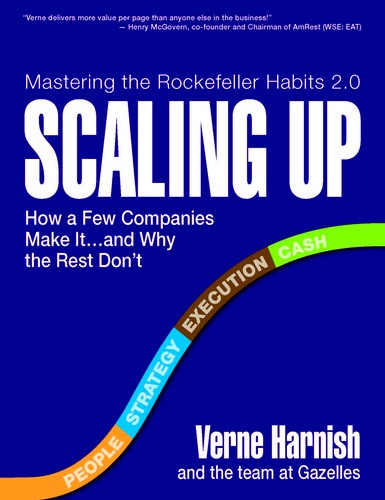
Scaling Up
by Verne Harnish · 2014
Most companies don't die from a bad idea. They die from trying to scale a good one with no operating system.
Worth reading? Scaling Up is Verne Harnish's operating system for mid-market companies, and it sits right next to Traction by Gino Wickman on the same shelf -- both give you a full stack of meeting rhythms, planning tools, and accountability structures instead of another growth story. Traction (EOS) is simpler and easier for a small team to adopt in a week; Scaling Up is denser, with more tools, and scales further up the size curve, since Harnish's case studies skew toward $10M-$250M companies. Read Scaling Up once you've outgrown Traction's simplicity. Skip both if you're pre-product-market-fit -- neither book will help you find what works, only scale what already does.
| Full Title | Scaling Up: How a Few Companies Make It...and Why the Rest Don't |
|---|---|
| Author | Verne Harnish |
| Published | 2014 |
| Publisher | Gazelles, Inc. |
| Category | Business & Money |
| Favorite quote | “Growth sucks cash.” |
The Verdict
Harnish has been coaching fast-growing companies since the 1990s, and this book is basically his consulting playbook made public – less inspiring than most business bestsellers, but built to actually be run by a leadership team on Monday morning, not just discussed at an offsite.
you're past startup chaos and need a repeatable system for people, strategy, execution, and cash
you're pre product-market fit -- this is for scaling something that already works, not finding it
Book Summary
Harnish's Scaling Up, an update of his earlier Mastering the Rockefeller Habits, organizes growth around four decisions every company has to get right: People, Strategy, Execution, and Cash, the "4 Decisions" framework. Most growing companies eventually hit a wall not because the market disappeared, but because none of these four decisions had a real system behind them.
The book is dense with specific tools rather than theory: the One-Page Strategic Plan, daily/weekly/monthly/quarterly/annual meeting rhythms, the Rockefeller Habits Checklist of ten disciplines healthy scale-ups share, and a cash conversion cycle framework built on the observation that growth without cash discipline kills companies just as fast as no growth at all.
It reads like a toolkit meant to be implemented with a leadership team, not read once and shelved, closer in spirit to Traction's EOS system than to a narrative business book. Harnish draws most of his case studies from mid-market companies in the $10M-$250M range, exactly the gap most startup advice ignores.
Top 10 Lessons from Scaling Up
- Most scaling failures are a systems problem, not a market problem.
- The 4 Decisions -- People, Strategy, Execution, Cash -- have to all be right, or the wall finds you.
- A one-page strategic plan forces clarity a 40-slide deck never will.
- Meeting rhythms, from daily huddle to annual planning, keep everyone aligned.
- Cash discipline matters as much as growth -- fast growth without cash kills you too.
- Hire and keep only people who fit both the seat and the company's core values.
- A company's real priorities should fit on an index card, not a binder.
- Systematic customer feedback beats guessing at what customers actually want.
- Growth exposes every weak process you were able to ignore at a smaller size.
- Set one Big Hairy Audacious Goal the whole company can actually rally behind.
Top 1 Quotes from Scaling Up
"Growth sucks cash."
Verne Harnish, Scaling Up
Frequently Asked Questions
Is Scaling Up worth reading?
Yes, once you're past the startup-chaos phase and need repeatable systems for people, strategy, execution, and cash. It's dense and tool-heavy rather than narrative, so treat it as a workbook, not a page-turner.
What are the 4 Decisions in Scaling Up?
People, Strategy, Execution, and Cash. Harnish's argument is that companies stall not from a bad market but from never building a real system behind one or more of these four.
Is Scaling Up the same as Traction or EOS?
They're close cousins. Traction (EOS) is simpler and faster to implement for a small team; Scaling Up has more tools and scales further up the size curve, aimed more at $10M-$250M companies than very early-stage teams.
Do I need Scaling Up if I'm pre-revenue?
Probably not yet. The book assumes you already have a working business model and are trying to scale it -- it won't help you find product-market fit in the first place.
Ready to read it?
Get Scaling Up on Amazon