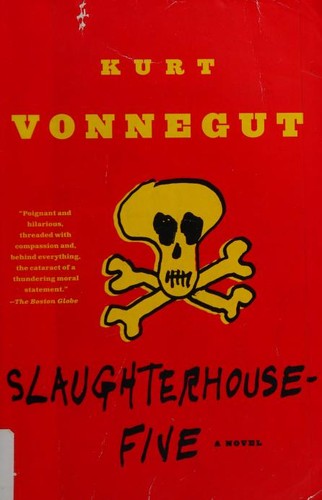
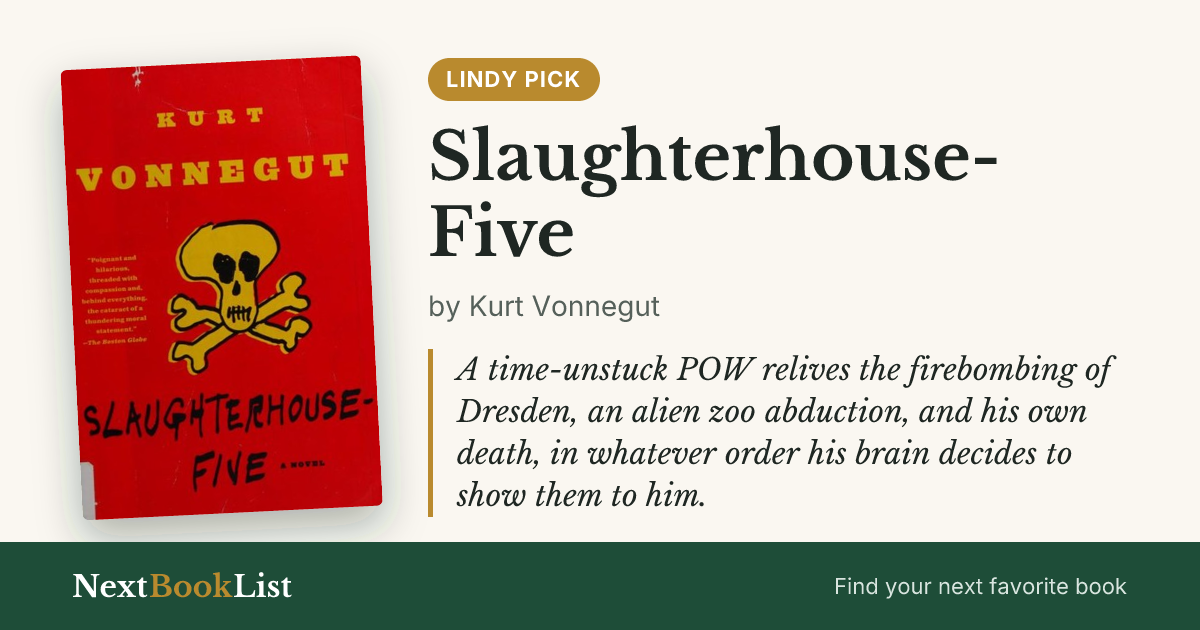
Slaughterhouse-Five
by Kurt Vonnegut · 1969
A time-unstuck POW relives the firebombing of Dresden, an alien zoo abduction, and his own death, in whatever order his brain decides to show them to him.
Worth reading? Slaughterhouse-Five is the best anti-war novel in print because it never tries to be one in the usual sense -- no battle heroics, no redemptive arc, just a man bouncing helplessly through his own timeline. It beats Catch-22 for readers who want something shorter and stranger, and it beats straight war memoir for readers who want the psychological damage on the page, not just the events. Skip it if you need cause-and-effect storytelling; Vonnegut deliberately won't give you that.
| Author | Kurt Vonnegut |
|---|---|
| Published | 1969 |
| Publisher | Dial Press Trade Paperback |
| Category | Fiction |
| Favorite quote | “So it goes.” |
The Verdict
Vonnegut spent over twenty years trying to write about Dresden and finally admitted, in the book’s own opening chapter, that a straight account wasn’t possible. So he wrote the alternative: fragmented, funny, sci-fi-inflected, and honest about its own failure to make sense of a massacre. That honesty is what separates it from every “important” war novel that pretends it has closure to offer.
It’s short enough to read in an afternoon and will sit with you a lot longer than that. If you’ve read Catch-22 and want something in the same anti-heroic register but stranger and sadder, this is the next stop.
you want the sharpest, funniest, saddest anti-war novel ever written, one that refuses to make combat look noble
you need a linear plot -- the whole point of the structure is that trauma doesn't unfold chronologically, and if that annoys you rather than moves you, this isn't your book
Book Summary
Billy Pilgrim has 'come unstuck in time' -- he lives his life out of order, flashing between his childhood, his capture as a POW, the Dresden firebombing, a fake marriage, and a supposed alien abduction, with no control over which moment he's in next. The structure isn't a gimmick. It's Vonnegut's way of representing trauma: horrific events don't stay in the past, they keep recurring, unannounced, out of sequence.
The novel's answer to mass death is the refrain 'so it goes,' repeated after every mention of dying, human or otherwise. It's not indifference -- it's exhaustion. After you've survived the actual firebombing of Dresden, as Vonnegut did, treating every death (a person, a bottle of champagne going flat, a whole city) with the same flat acknowledgment is the only way to keep narrating without either breaking down or pretending it makes sense.
The alien Tralfamadorians, who see all of time at once and shrug off death because the dead are 'simply in bad condition in that particular moment,' offer Billy a philosophy of acceptance. Vonnegut doesn't fully endorse it -- the book is too angry about Dresden for that -- but he lets Billy borrow it as a survival mechanism, and lets the reader decide if it's wisdom or a coping delusion.
Top 9 Lessons from Slaughterhouse-Five
- War narratives that glorify combat lie by omission -- Vonnegut structures the book to refuse that lie entirely.
- Trauma doesn't respect chronology; it resurfaces uninvited, which is why the book jumps in time instead of moving forward.
- 'So it goes' turns every death, big or small, into the same flat sentence -- a coping mechanism, not callousness.
- The firebombing of Dresden killed more civilians than the book ever dramatizes directly, because Vonnegut trusts restraint over spectacle.
- Billy Pilgrim is a passive protagonist on purpose -- he doesn't act on the world, the world acts on him, mirroring what it feels like to survive something enormous.
- The Tralfamadorian view of time (all moments exist permanently, nothing is ever truly lost) is offered as comfort, not as the book's final verdict.
- Fiction that claims to have 'answers' about mass violence is treated with suspicion -- the book keeps interrupting itself to admit its own limits as a war story.
- Kilgore Trout's pulpy, throwaway novels are woven in as a commentary on how badly science fiction (and fiction generally) usually handles real suffering.
- The famous line 'Poo-tee-weet?' -- a bird's nonsense call -- is the only sound Vonnegut lets stand for the aftermath of a massacre, because there's nothing coherent left to say.
Top 5 Quotes from Slaughterhouse-Five
"All this happened, more or less."
Kurt Vonnegut, Slaughterhouse-Five
"Billy Pilgrim has come unstuck in time."
Kurt Vonnegut, Slaughterhouse-Five
"So it goes."
Kurt Vonnegut, Slaughterhouse-Five
"Everything was beautiful, and nothing hurt."
Kurt Vonnegut, Slaughterhouse-Five
"Poo-tee-weet?"
Kurt Vonnegut, Slaughterhouse-Five
Frequently Asked Questions
Is Slaughterhouse-Five worth reading?
Yes -- it's a short, devastating, formally daring anti-war novel that says more in 275 pages than most 500-page war epics manage. Skip it only if nonlinear structure genuinely frustrates you rather than intrigues you.
What is the main theme of Slaughterhouse-Five?
That mass violence resists narrative sense, and that surviving trauma means living with it recurring out of order, not resolving it into a tidy story.
Is Slaughterhouse-Five hard to read?
Not in terms of prose (Vonnegut's sentences are short and plain) but the fractured timeline takes some getting used to for the first 40 or so pages.
Is Slaughterhouse-Five based on a true story?
Yes, partly. Vonnegut was a real American POW who survived the Allied firebombing of Dresden in 1945, and he frames the novel as his own attempt (and repeated failure) to write it straight.
Ready to read it?
Get Slaughterhouse-Five on Amazon