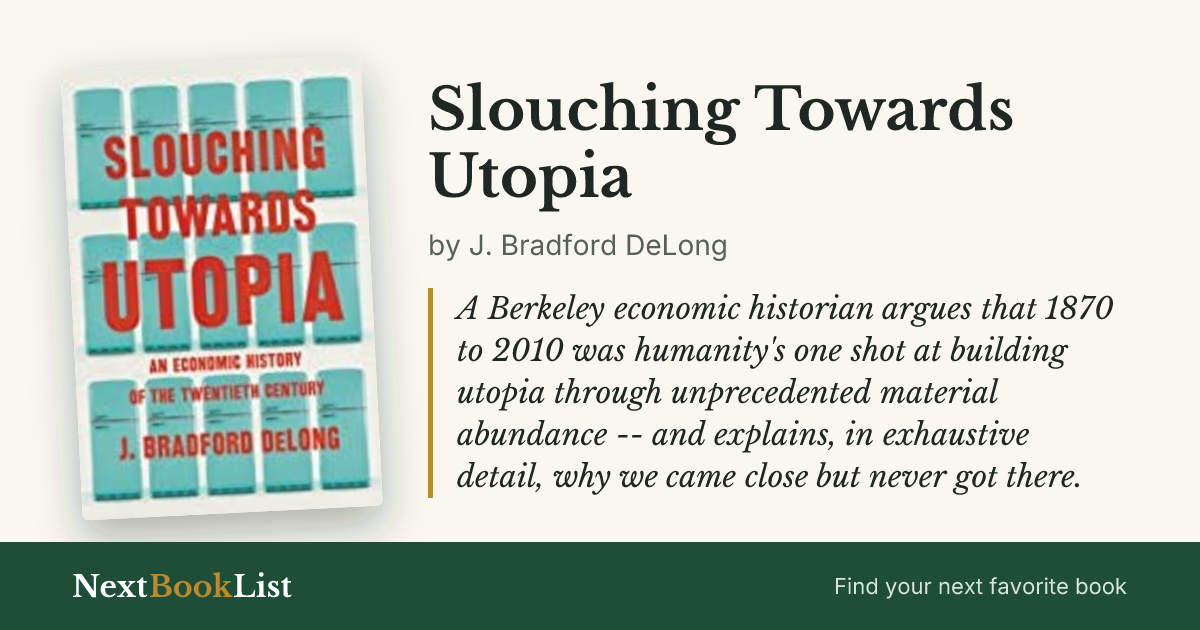
Slouching Towards Utopia
by J. Bradford DeLong · 2022
A Berkeley economic historian argues that 1870 to 2010 was humanity's one shot at building utopia through unprecedented material abundance -- and explains, in exhaustive detail, why we came close but never got there.
Worth reading? DeLong's framing device is simple and does a lot of work: he argues the 'long twentieth century' ran from 1870 (when technology, globalization, and the modern corporation combined to make sustained economic growth possible for the first time in human history) to 2010 (when the aftermath of the financial crisis marked the end of confident faith that growth alone would solve humanity's problems). In between, he tells the story as an unresolved argument between Friedrich Hayek (markets know best, leave them alone) and Karl Polanyi (society needs protecting from market forces, or it will tear itself apart), with John Maynard Keynes as the practical synthesizer who tried to have growth and stability at once. It's an ambitious, occasionally exhausting book -- DeLong covers the Depression, both World Wars, decolonization, the Cold War, and neoliberalism's rise, all through this same lens -- but the throughline holds, and the central irony (we built enough wealth to solve material scarcity and still didn't reach anything like utopia) is genuinely well argued rather than just asserted.
| Full Title | Slouching Towards Utopia: An Economic History of the Twentieth Century |
|---|---|
| Author | J. Bradford DeLong |
| Published | 2022 |
| Publisher | Basic Books |
| Category | Sociology & Culture |
The Verdict
DeLong isn’t writing a takedown of capitalism or a defense of it – he’s narrating an argument that ran the whole length of the century and never really resolved. The Hayek-versus-Polanyi framing sounds academic on paper, but in practice it gives you a genuinely useful lens for understanding why growth kept happening while the fights over its distribution never stopped. This is a book for readers who want the big picture connected end to end, not a chapter-by-chapter survey of decades in isolation.
Read it if you want one continuous, well-argued economic history of the twentieth century that connects the Depression, the World Wars, decolonization, and neoliberalism into a single throughline. Skip it if you want something shorter or more narrowly focused – this is a dense, 600-plus-page synthesis built for readers willing to commit to the whole argument.
you want a single, sweeping economic history of the entire twentieth century that connects growth, ideology, and politics into one continuous argument, written by an economist who can actually narrate rather than just chart
you want a short read or a narrow case study -- this is a dense, 600-plus-page synthesis covering roughly 140 years across the whole globe, built for readers willing to sit with a long argument rather than a focused narrative
Book Summary
Sustained economic growth is a historically recent and fragile achievement -- DeLong dates its true beginning to around 1870, when the combination of industrial research labs, global trade networks, and the modern corporation first made continuous compounding growth possible, after millennia where most humans lived at close to subsistence regardless of era or empire.
The twentieth century's central ideological conflict wasn't really capitalism versus communism -- it was the ongoing tension between Hayek's view that markets should be left alone to allocate resources efficiently and Polanyi's view that unregulated markets destroy the social fabric they depend on, with Keynesian economics functioning as an attempted middle path that tried to preserve growth while cushioning its social costs.
Material abundance alone doesn't produce a good society -- DeLong's title (echoing Yeats) is deliberately ironic: by 2010, humanity had generated more wealth than any prior era could have imagined, yet inequality, instability, and disillusionment with the growth-solves-everything premise were rising rather than fading, which is exactly the "slouching" instead of "arriving" the book is named for.
Top 9 Lessons from Slouching Towards Utopia
- DeLong dates the true start of sustained economic growth to around 1870, when industrial research labs, global trade, and the modern corporation combined for the first time to make compounding growth possible.
- For nearly all of human history before 1870, most people everywhere lived close to subsistence regardless of empire or era -- sustained growth is a genuinely recent phenomenon, not a permanent feature of human economies.
- The twentieth century's real ideological battle, in DeLong's framing, was Hayek (leave markets alone) versus Polanyi (protect society from markets), not simply capitalism versus communism.
- Keynesian economics functioned as an attempted synthesis between market efficiency and social stability -- trying to keep growth's benefits while cushioning its disruptions, rather than picking a side in the Hayek-Polanyi divide.
- The Great Depression is treated as a pivotal case study in what happens when market self-correction fails badly enough that political systems can no longer tolerate waiting for it.
- Post-World War II growth in the West (and the mixed economy consensus that came with it) is presented as the closest humanity got to the book's ideal, before neoliberal deregulation from the 1980s onward eroded that consensus.
- The 2008 financial crisis and its aftermath mark DeLong's chosen endpoint for the 'long twentieth century' -- not because growth stopped, but because confident faith that growth alone would resolve social and economic problems collapsed.
- Globalization and decolonization are treated as part of the same growth story, not separate narratives -- the reordering of global trade and empire is central to how growth spread (and didn't spread evenly) after 1870.
- Inequality rising alongside record aggregate wealth is the book's central irony: material abundance solved scarcity as a technical problem without automatically solving distribution or social cohesion as political problems.
Frequently Asked Questions
Is Slouching Towards Utopia worth reading?
Yes, if you want a single sweeping economic history connecting growth, ideology, and politics across the entire twentieth century -- it's dense but the central argument (near-utopian abundance without the utopia) is well supported.
What is Slouching Towards Utopia about?
J. Bradford DeLong argues that 1870 to 2010 -- what he calls the 'long twentieth century' -- was the period when humanity first achieved the material abundance to plausibly build utopia, and traces why persistent inequality and instability kept that promise unrealized.
Why does DeLong choose 1870 and 2010 as the book's boundaries?
1870 marks when industrial research, global trade, and the modern corporation first combined to enable sustained compounding growth; 2010 marks the aftermath of the financial crisis, when confident faith that growth alone would solve social problems broke down.
Is Slouching Towards Utopia a difficult read?
It's long and dense, covering roughly 140 years across the whole globe in one continuous argument, so it rewards readers willing to sit with a sustained synthesis rather than a quick overview.
Is Slouching Towards Utopia pro-capitalism or anti-capitalism?
Neither cleanly -- DeLong frames the century as an unresolved tension between Hayek's pro-market view and Polanyi's pro-social-protection view, with Keynes as an attempted middle path, rather than endorsing one side outright.
Ready to read it?
Get Slouching Towards Utopia on Amazon