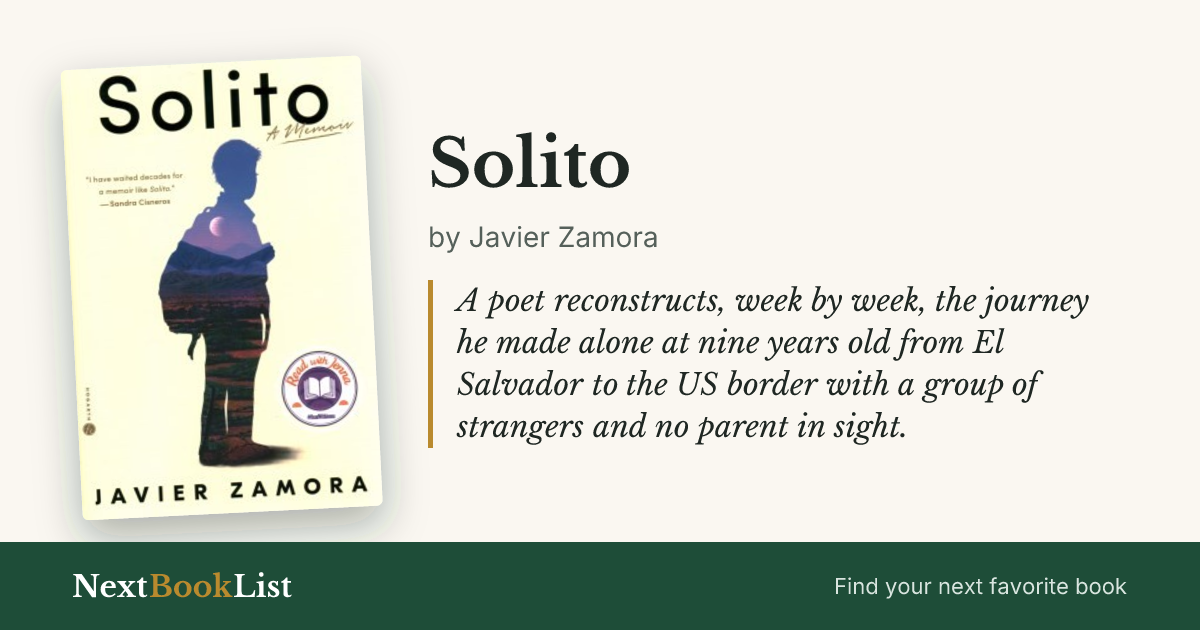
Solito
by Javier Zamora · 2022
A poet reconstructs, week by week, the journey he made alone at nine years old from El Salvador to the US border with a group of strangers and no parent in sight.
Worth reading? Solito earns its power from restriction, not scope: Zamora writes the entire book from what he understood and felt at nine years old, migrating unaccompanied from El Salvador to join his parents in the US, and refuses to add adult hindsight or policy framing. The weeks with 'coyotes,' the desert crossing, and the strangers who looked after him read as immediate and specific rather than symbolic. It sits closer to Educated than to a broad immigration-policy book -- it's one child's memory, rendered in exact detail, not an argument.
| Full Title | Solito: A Memoir |
|---|---|
| Author | Javier Zamora |
| Published | 2022 |
| Category | Biographies & Memoirs |
The Verdict
Zamora doesn’t let his adult self anywhere near this book. Every page stays inside what he understood at nine, migrating alone from El Salvador with a shifting group of strangers and smugglers, and that restriction is what makes it land. There’s no policy argument bolted on, no zoomed-out immigration-debate framing, just what it felt like to be a scared kid crossing a desert with people who weren’t his family but acted like it when it mattered.
It’s a heavier read than most memoirs on this site, and it should be treated that way. The desert-crossing chapters in particular are tense and specific, not softened for comfort. Go in knowing that, and it’s one of the more precise, unsentimental migration memoirs published in years.
you want a specific, unsentimental, child's-eye account of unaccompanied migration -- weeks with smugglers, crossing the desert, the strangers who became a makeshift family along the way
you want a policy-level or big-picture book about immigration -- this stays entirely inside one nine-year-old's limited understanding of what's happening to him, by design, and doesn't zoom out
Book Summary
Zamora was nine years old when he left El Salvador to reunite with parents who had already migrated to the US years earlier, making the multi-week journey through Guatemala and Mexico with smugglers and a shifting group of other migrants, without a parent or guardian present.
The book is written strictly from the child's perspective he had at the time -- confusion, boredom, fear, small joys -- rather than the adult writer's later understanding of immigration policy or his family's full circumstances. That restraint is a deliberate craft choice, not a limitation of the material.
Several adult strangers in the migrant group, effectively function as a temporary found family, protecting and comforting Zamora during the hardest stretches, including a harrowing desert crossing. The book is as much about improvised care between strangers under extreme conditions as it is about the physical journey itself.
Top 8 Lessons from Solito
- Zamora made the unaccompanied migration from El Salvador to the US at age nine, without a parent present for the journey.
- The book is written entirely from his nine-year-old understanding and vocabulary at the time, not from adult hindsight.
- The journey involved weeks of travel through Guatemala and Mexico with smugglers ('coyotes') and a shifting group of fellow migrants.
- A desert crossing forms one of the book's most intense and dangerous stretches.
- Several adult strangers in the migrant group functioned as improvised protectors and caretakers for Zamora during the trip.
- Zamora was reuniting with parents who had migrated to the US years earlier, leaving him with relatives in El Salvador in the meantime.
- The book avoids explicit policy argument or commentary, focusing instead on lived, specific, sensory detail of the journey.
- Zamora is a published poet, and the prose style reflects that background in its precision and restraint rather than in ornamentation.
Frequently Asked Questions
Is Solito by Javier Zamora worth reading?
Yes, if you want a specific, restrained, child's-eye account of migration rather than a policy argument. It earns its emotional weight through detail and restraint, not melodrama.
Is Solito appropriate for readers sensitive to difficult material?
Read with care. It covers a child crossing the desert with smugglers and strangers, real danger, and long stretches of fear and uncertainty. It's not graphic, but it is emotionally heavy and specific.
Is Solito written from an adult or a child's perspective?
The narration deliberately stays inside what Zamora understood and felt as a nine-year-old at the time of the journey, without adult hindsight or policy commentary layered on top.
Is Solito about Javier Zamora's whole life or just the migration?
Just the migration itself -- the weeks of the journey from El Salvador to the US border. It doesn't extend into his life afterward as an adult or his career as a poet.
Ready to read it?
Get Solito on Amazon