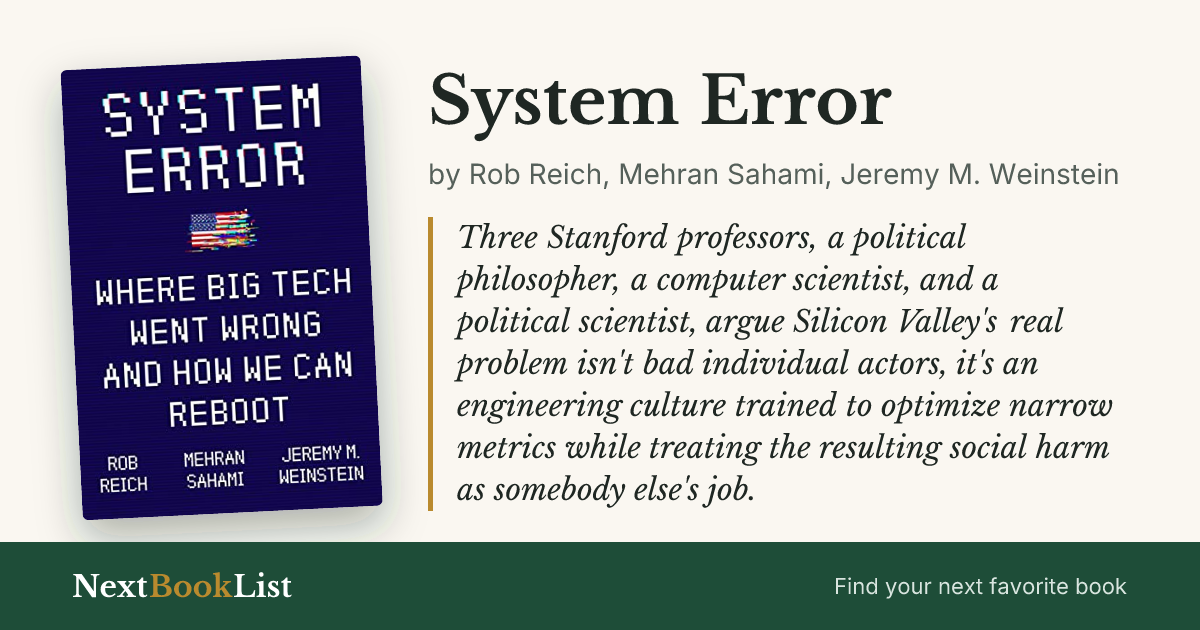
System Error
by Rob Reich, Mehran Sahami, Jeremy M. Weinstein · 2021
Three Stanford professors, a political philosopher, a computer scientist, and a political scientist, argue Silicon Valley's real problem isn't bad individual actors, it's an engineering culture trained to optimize narrow metrics while treating the resulting social harm as somebody else's job.
Worth reading? The book's core move is refusing the easy narrative that tech's problems come down to greedy or malicious executives. Instead the three authors, who together teach Stanford's popular 'Computers, Ethics, and Public Policy' course, argue the deeper issue is optimization culture itself: engineers are trained to relentlessly improve a narrow measurable target (engagement, growth, efficiency) without institutional structures forcing them to weigh the broader social costs, and that this pattern predates and outlasts any single company's leadership. It's a genuinely constructive book, offering concrete proposals on antitrust, algorithmic accountability, and engineering education reform, more textbook-adjacent in tone than a page-turner, but useful precisely because it comes from people who've spent careers inside the systems (both academic and industry-adjacent) they're critiquing.
| Full Title | System Error: Where Big Tech Went Wrong and How We Can Reboot |
|---|---|
| Author | Rob Reich, Mehran Sahami, Jeremy M. Weinstein |
| Published | 2021 |
| Publisher | Harper |
| Category | Sociology & Culture |
The Verdict
Most tech-critique books need a villain. System Error deliberately refuses to give you one. The three Stanford professors behind it, teaching one of the university’s most popular courses on tech ethics and policy, argue that swapping out a CEO or pointing at one company’s culture misses what’s actually structural: an entire discipline trained to optimize one measurable number, engagement, growth, efficiency, without any institutional habit of weighing what that optimization costs everyone else.
That’s a more useful and more depressing argument than the personality-driven version, because it explains why the pattern keeps recurring across different companies, different leadership styles, different eras of Silicon Valley, rather than resolving once any particular founder gets replaced or apologizes. If the problem is how computer science gets taught and how tech companies are structurally organized, changing the person at the top doesn’t touch it.
The “solutionism trap” chapter is worth the price of admission on its own: engineers trained to see every problem as an engineering problem end up proposing more technology as the fix for problems technology itself created. That diagnosis explains a lot of tech’s public messaging over the last decade, more transparency features, better content moderation algorithms, always another technical patch, rarely a step back to ask whether the underlying incentive structure is the actual problem.
Read it if you want the structural version of the tech-critique genre, one that comes with actual proposed reforms in engineering education, corporate accountability, and regulation, rather than just another well-reported scandal narrative.
Skip it if you want drama. This is co-written by three academics and reads like it, clear, well-organized, occasionally textbook-adjacent in tone. If you want the feel of investigative journalism with named villains and dramatic scenes, look elsewhere; if you want the clearest structural diagnosis of why tech keeps failing the same way, this delivers it.
you want a structural, non-conspiratorial explanation for why well-intentioned tech companies keep producing harmful outcomes, and concrete ideas for policy and engineering-education reform rather than just another expose of tech villains
you want dramatic reporting or personality-driven scandal narratives about specific tech executives -- this is co-written by three professors and reads like a serious, occasionally academic policy book, not journalism
Book Summary
The authors argue that tech's recurring harms, misinformation spread, algorithmic bias, addictive design, labor displacement from automation, stem from a shared underlying cause: an engineering culture trained to optimize a single measurable metric (engagement, efficiency, growth) without institutional structures that force engineers to weigh broader social costs as part of the job.
They distinguish this "optimization mindset" explanation from more common narratives blaming individual bad actors or specific company cultures, arguing the pattern recurs across different companies, leadership styles, and eras specifically because it's structural to how computer science and engineering are taught and how tech companies are organized, not because of any particular executive's personal ethics.
A recurring theme is the "solutionism trap": engineers trained to treat every problem as an engineering problem with a technical fix, which leads Silicon Valley to reliably propose more technology as the solution to problems technology itself helped create, rather than considering political, regulatory, or non-technical interventions.
The book's later chapters move from diagnosis to specific proposals, arguing for reforms in three areas simultaneously: how computer science is taught (building ethics and social-impact reasoning directly into technical curricula rather than as a bolt-on requirement), how democratic institutions regulate emerging technology, and how companies structure internal accountability for algorithmic and product decisions.
Top 7 Lessons from System Error
- Tech's recurring harms trace to a shared structural cause, an engineering culture optimizing narrow measurable metrics without institutional pressure to weigh broader social costs, not primarily to individual bad actors.
- The pattern recurs across different companies and leadership eras specifically because it's built into how computer science is taught and how tech companies are organized, which is why swapping out executives rarely fixes it.
- The 'solutionism trap' describes engineers trained to treat every problem as solvable by more technology, which leads the industry to propose technical fixes for problems that are actually political or social in nature.
- Computer science education traditionally treats ethics and social-impact reasoning as an optional add-on rather than integrated into core technical training, which the authors argue produces engineers unequipped to weigh the tradeoffs of what they build.
- Algorithmic systems optimized purely for engagement or growth metrics will reliably produce social harms as a side effect, not because anyone intended the harm, but because nothing in the system's design accounts for it.
- Effective reform requires simultaneous change across three levels: engineering education, corporate internal accountability structures, and democratic regulation, rather than any single fix at one level.
- Antitrust and algorithmic accountability regulation lag far behind the pace of technological change, leaving democratic institutions structurally unable to check tech power in real time.
Frequently Asked Questions
Is System Error worth reading?
Yes, if you want a structural, non-conspiratorial explanation for why tech keeps producing the same harms across different companies and eras, plus concrete proposals for reform rather than just another critique.
What is the book's main argument?
That tech's recurring problems come from optimization culture, engineers trained to relentlessly improve narrow measurable metrics without institutional pressure to weigh broader social costs, rather than from any particular company's or executive's individual ethics.
Who wrote System Error?
Rob Reich (political philosopher), Mehran Sahami (computer scientist), and Jeremy M. Weinstein (political scientist), who together teach Stanford's 'Computers, Ethics, and Public Policy' course, one of the university's most popular classes.
Does System Error offer solutions, or just criticism?
It's notably solutions-oriented for the genre, proposing specific reforms across three areas: how computer science is taught, how companies structure internal accountability, and how democratic institutions regulate emerging technology.
Ready to read it?
Get System Error on Amazon