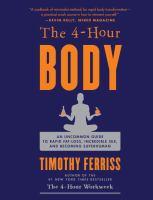
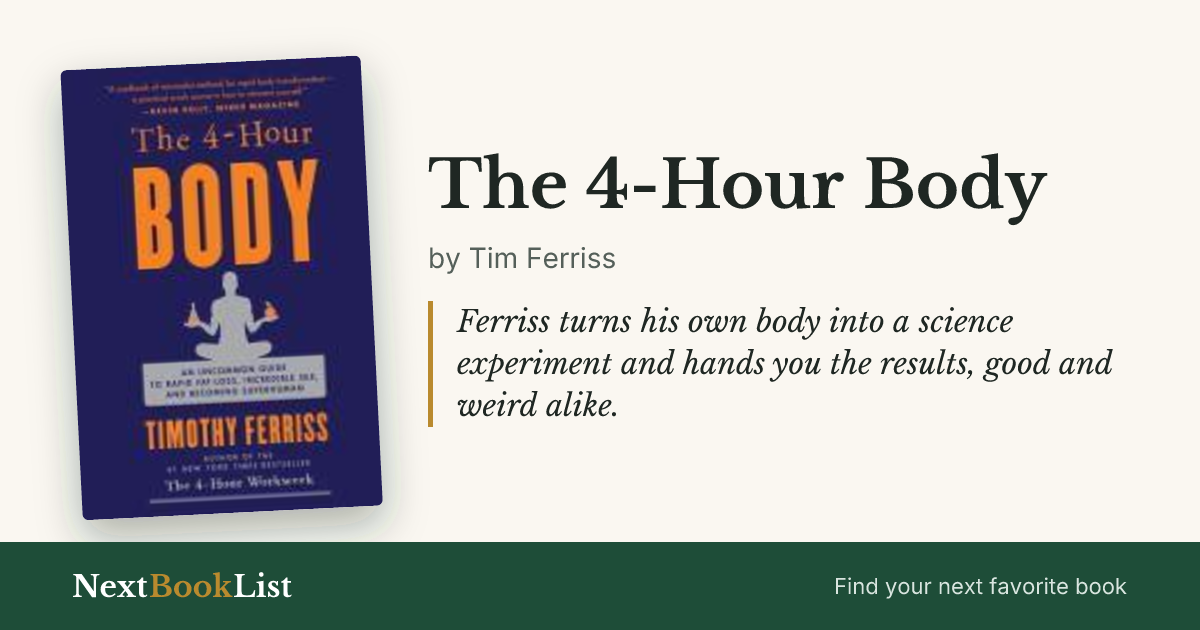
The 4-Hour Body
by Tim Ferriss · 2010
Ferriss turns his own body into a science experiment and hands you the results, good and weird alike.
Worth reading? The 4-Hour Body is Ferriss doing to fitness what he did to work in The 4-Hour Workweek: question every default, self-test relentlessly, and publish whatever actually moved the needle. The slow-carb diet and the minimum-effective-dose framing are the parts that hold up years later. Skip the more extreme chapters (there are some genuinely fringe experiments in here) and mine it for the handful of ideas that fit your life.
| Full Title | The 4-Hour Body: An Uncommon Guide to Rapid Fat-Loss, Incredible Sex, and Becoming Superhuman |
|---|---|
| Author | Tim Ferriss |
| Published | 2010 |
| Publisher | Crown |
| Category | Self-Improvement & Psychology |
| Favorite quote | “The minimum effective dose is defined simply: the smallest dose that will produce a desired outcome.” |
The Verdict
This is Ferriss at his most self-experimental, and the book is uneven because of it: some chapters (slow-carb, minimum effective dose) are genuinely useful years later, others are fringe enough that you should treat them as “here’s what worked for one guy,” not medical advice. Read it selectively.
The throughline that’s worth keeping regardless of which specific diet or workout you land on: question the default, test it on yourself, measure honestly, and drop what doesn’t work no matter how popular it is.
self-experimenters who want data-driven shortcuts to fitness instead of generic gym advice
you want a mainstream, medically-conventional fitness book -- Ferriss is deliberately fringe here
Book Summary
Most fitness advice is inherited dogma, not tested science. Ferriss treats his own body as a lab, running self-experiments and publishing the ones that produced real, measurable results rather than the ones that sound conventional.
Minimum effective dose beats maximum effort. The book's best chapters find the smallest input, whether it's exercise volume or diet complexity, that reliably produces the outcome you're after, and cuts everything else.
Consistency with a small amount of built-in flexibility (like a scheduled weekly cheat day) beats strict daily discipline for actually sticking with a change over the long run.
Top 9 Lessons from The 4-Hour Body
- The Slow-Carb Diet: eat a small rotation of meals repeatedly, cut white carbs, cheat one day a week.
- Minimum effective dose beats maximum effort -- find the smallest input that produces the result.
- Track everything; self-experimentation with real data beats generic advice.
- Occam's Protocol: you can build meaningful muscle with far less training volume than bodybuilding culture assumes.
- Sleep and temperature are underrated levers for fat loss and recovery, not just diet and exercise.
- A single scheduled cheat day helps long-term adherence more than strict daily discipline.
- Most fitness advice is culturally inherited dogma -- question the defaults before following them.
- Small, consistent measurement (photos, weight, tape) beats relying on how you 'feel' about progress.
- Treat your body like an experiment: hypothesis, test, measure, adjust.
Top 4 Quotes from The 4-Hour Body
"The minimum effective dose is defined simply: the smallest dose that will produce a desired outcome."
Tim Ferriss, The 4-Hour Body
"Controlling your body puts you in life's driver's seat."
Tim Ferriss, The 4-Hour Body
"In the end, the point of The 4-Hour Body is intelligent and responsible self-experimenting."
Tim Ferriss, The 4-Hour Body
"It is impossible to evaluate, or even understand, anything that you cannot measure."
Tim Ferriss, The 4-Hour Body
Frequently Asked Questions
Is The 4-Hour Body worth reading?
Yes, for the slow-carb diet and minimum-effective-dose framing specifically -- both hold up. Skip the more extreme, fringe chapters unless you're genuinely curious about self-experimentation for its own sake.
What is the Slow-Carb Diet from The 4-Hour Body?
Eat a small rotating set of meals, cut white/starchy carbs on most days, and take one scheduled cheat day a week to make the plan sustainable long term.
Is The 4-Hour Body scientifically reliable?
Mixed. Some chapters (slow-carb, minimum effective dose) are well-supported and aged well; others are Ferriss's own single-subject experiments and should be read as anecdote, not proven protocol.
Who should read The 4-Hour Body?
Self-experimenters who want data-driven shortcuts over generic gym advice. Skip it if you want a conventional, medically mainstream fitness book.
Ready to read it?
Get The 4-Hour Body on Amazon