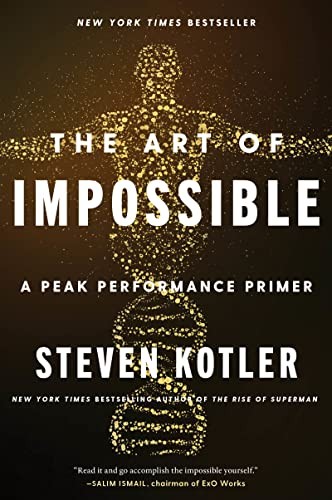
The Art of Impossible
by Steven Kotler · 2021
Twenty years of flow-state research compressed into a system for motivation, learning, creativity, and flow, in that order.
Worth reading? The Art of Impossible is the most complete peak-performance system built specifically around flow, not just willpower or habit design, and Kotler's own flow-research background gives it more rigor than the average high-performance book. Compared to a book like Flow itself, it's more actionable, Csikszentmihalyi explains the state, Kotler builds you a system to trigger it on demand. Skip it if you want something breezy; this is dense and best used as a reference you return to, not a single-sitting read.
| Full Title | The Art of Impossible: A Peak Performance Primer |
|---|---|
| Author | Steven Kotler |
| Published | 2021 |
| Publisher | Harper Wave |
| Category | Self-Improvement & Psychology |
| Favorite quote | “Prodigies, it seemed, were made, not born.” |
The Verdict
Kotler has spent two decades researching flow states specifically, and it shows in how this book is structured: not a grab-bag of performance tips, but a deliberate stack, motivation, learning, creativity, flow, where each layer sets up the next. Skipping straight to “how do I get in flow” without the groundwork is, per his own research, why most people can’t trigger it reliably.
The most useful reframe is on talent. Kotler’s research kept finding “exceptional conditions” where people expected to find “exceptional kids,” which lines up with the broader shift away from talent-worship you see in books like Hidden Potential. Environment and training stack are the bigger lever, not genetics.
Skip it if you want something breezy and quick, this is dense and research-heavy, more reference primer than page-turner. But if you’re chasing something genuinely hard and want the actual system behind performance, not just the pep talk, it earns its density.
you want a research-backed system for peak performance, not just motivational language about pushing harder
you want a light, quick read -- this leans dense and research-heavy, closer to a reference primer than a breezy motivational book
Book Summary
Peak performance builds in a specific stack: motivation first, then learning, then creativity, then flow. Trying to jump straight to flow without the groundwork underneath it rarely works, each stage sets up the conditions the next one needs.
Prodigies are made, not born. Kotler's research finding is that exceptional performers usually had exceptional conditions, not exceptional starting talent, which means the environment and training stack matter more than raw natural ability.
Fear and anxiety are mostly about the future, not the present. Breaking a huge, "impossible" goal into a long series of difficult but doable near-term goals converts abstract fear into concrete, achievable next steps.
Top 8 Lessons from The Art of Impossible
- Build the performance stack in order: motivation, then learning, then creativity, then flow -- skipping steps rarely works.
- Break an impossible-sounding goal into a series of difficult but doable near-term goals; the mission stays the same, the path gets concrete.
- Exceptional performers usually had exceptional conditions and training, not exceptional starting talent -- environment is a bigger lever than genetics.
- Most anxiety is about an imagined future, not the present moment; grounding yourself in the present reduces it directly.
- Your inner monologue needs to actually support the performance you want, not undermine it by default -- manage self-talk deliberately.
- Flow blends multiple brain pleasure chemicals at once, which is why it's remembered as uniquely rewarding, not just 'being focused.'
- Curiosity, passion, purpose, autonomy, and mastery are the five internal motivators worth stacking, in that rough order, before chasing external rewards.
- Deliberate, focused practice on the edge of your current skill level builds mastery faster than repetition within your comfort zone.
Top 4 Quotes from The Art of Impossible
"If you're interested in being your best, your inner monologue needs to support the best you want to be. In fact, when it comes to sustained performance, because doubt and disappointment are constant companions, controlling your thoughts is often the ball game."
Steven Kotler, The Art of Impossible
"Here, we want to break that mission statement down into smaller chunks, dividing up the impossible into a long series of difficult but doable goals that, if accomplished, render said impossible much more probable."
Steven Kotler, The Art of Impossible
"Flow may be the biggest neurochemical cocktail of all. The state appears to blend all six of the brain's major pleasure chemicals and may be one of the few times you get all six at once."
Steven Kotler, The Art of Impossible
"Prodigies, it seemed, were made, not born... We were looking for exceptional kids, but what we found were exceptional conditions."
Steven Kotler, The Art of Impossible
Frequently Asked Questions
Is The Art of Impossible worth reading?
Yes, for anyone chasing a genuinely ambitious goal who wants a research-backed system rather than motivational slogans. It's dense but far more actionable than most performance books.
What is the main idea of The Art of Impossible?
Peak performance builds in a stack: motivation, then learning, then creativity, then flow. Skipping stages, especially trying to force flow directly, rarely works.
How is it different from Flow by Csikszentmihalyi?
Csikszentmihalyi's book explains what flow is and why it matters. Kotler's book builds a practical system for triggering it deliberately, using motivation and skill-building as the setup.
Who should read The Art of Impossible?
Anyone pursuing a big, specific goal who wants the research behind peak performance, not just inspiration. Skip it if you want a light read -- this is dense and works best as a reference.
Ready to read it?
Get The Art of Impossible on Amazon