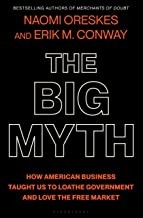
The Big Myth
by Naomi Oreskes and Erik M. Conway · 2023
The authors of Merchants of Doubt turn their doubt-manufacturing lens on a bigger target: a century-long, deliberately funded campaign by American business to convince the public that markets are always right and government is always the problem.
Worth reading? Oreskes and Conway made their name in Merchants of Doubt tracing how a handful of scientists and PR firms manufactured doubt about tobacco, acid rain, and climate change on behalf of paying clients. Here they apply the same method to a bigger and older campaign: the decades-long effort by American business associations (starting with the National Association of Manufacturers reacting to the New Deal) to sell 'market fundamentalism' -- the idea that free markets self-regulate and government intervention is inherently harmful -- as neutral economic fact rather than a funded political position. The book is long and dense with archival detail (foundation records, corporate memos, PR campaign documents), which is both its strength and its demand on the reader -- this isn't a breezy polemic, it's a documented paper trail. Where it succeeds is in showing market fundamentalism as a historical event with a start date, funders, and named strategists, rather than as a timeless truth people just came to believe on their own.
| Full Title | The Big Myth: How American Business Taught Us to Loathe Government and Love the Free Market |
|---|---|
| Author | Naomi Oreskes and Erik M. Conway |
| Published | 2023 |
| Publisher | Bloomsbury Publishing |
| Category | Sociology & Culture |
The Verdict
What separates this from a standard “capitalism bad” polemic is the sourcing. Oreskes and Conway aren’t asserting that market fundamentalism is wrong on the merits – they’re documenting, with named organizations, funders, and campaigns, that it was actively sold to the public rather than arrived at through open debate. That’s a harder claim to make and a harder one to dismiss, because it comes with a paper trail.
Read it if you want the historical receipts behind how “government bad, markets good” became American default thinking, and you’re willing to work through a dense, archive-heavy argument to get them. Skip it if you want a neutral primer on economic philosophy – this book is building a specific, documented case, not surveying both sides evenhandedly.
you want a rigorously sourced history of how 'the free market always knows best' became American common sense, told by two historians of science who specialize in tracing organized disinformation campaigns back to their funders
you're looking for a balanced pro-and-con treatment of market versus government -- Oreskes and Conway are building a documented argument that market fundamentalism was manufactured and sold, not a neutral survey of economic philosophy
Book Summary
"Market fundamentalism" -- the belief that markets are inherently self-correcting and government intervention in the economy is inherently counterproductive -- isn't a conclusion economists reached through neutral analysis. Oreskes and Conway trace it to a specific, funded campaign by business associations and ideologically aligned economists starting in the 1930s, reacting directly to the New Deal's regulatory expansion.
The campaign worked by rebranding self-interest as patriotism: business-funded initiatives packaged deregulation and anti-union positions as defenses of "the American Way" and individual freedom, embedding free-market ideology into school curricula, radio programming, and popular culture rather than confining the argument to economics journals.
Hayek and Friedman-style free-market economics didn't simply win an intellectual debate on the merits -- it won partly because it had a sustained, well-funded institutional infrastructure (think tanks, business associations, friendly media) promoting it for decades, a infrastructure that opposing or more mixed-economy viewpoints didn't have at comparable scale.
Top 9 Lessons from The Big Myth
- 'Market fundamentalism' -- the idea that markets always self-correct and government should stay out -- has a documented origin point in business reaction to the New Deal, not a timeless economic consensus.
- The National Association of Manufacturers ran sustained public-relations campaigns starting in the 1930s explicitly designed to shift public opinion against regulation and toward free-market ideology.
- Free-market messaging was deliberately packaged as patriotism and 'the American Way' rather than argued as economic theory, making it harder to challenge without sounding anti-American.
- The campaign extended into school curricula and educational materials, aiming to shape how young people understood economics before they encountered any competing framework.
- Friedrich Hayek and Milton Friedman's ideas gained mainstream traction partly through sustained institutional funding and promotion, not purely through winning an academic debate on the merits.
- Deregulation arguments in the Reagan era drew on decades of prior groundwork laid by business-funded messaging campaigns, rather than emerging fresh from 1980s political circumstances.
- Anti-union and anti-regulation positions were frequently bundled together under the same 'free market' banner, even though they serve distinct and separable business interests.
- The same doubt-manufacturing playbook Oreskes and Conway documented in tobacco and climate denial (fund friendly experts, seed uncertainty, target public opinion rather than peer review) appears earlier and at larger scale in the promotion of market fundamentalism.
- Presenting an ideological position as objective economic law is itself a rhetorical strategy -- one the book argues was used deliberately to foreclose debate about the actual tradeoffs of market versus government solutions.
Frequently Asked Questions
Is The Big Myth worth reading?
Yes, if you want a rigorously documented history of how free-market ideology became American conventional wisdom -- Oreskes and Conway back the argument with archival business and foundation records, not just commentary.
What is The Big Myth about?
Naomi Oreskes and Erik Conway trace a decades-long, business-funded campaign starting in reaction to the New Deal that sold 'market fundamentalism' -- the idea that markets self-regulate and government intervention is inherently harmful -- to the American public.
Is The Big Myth a sequel to Merchants of Doubt?
It's a companion book by the same authors, applying the doubt-manufacturing framework from Merchants of Doubt (tobacco, climate denial) to the history of free-market ideology.
Is The Big Myth biased against free markets?
The authors argue a documented historical case rather than presenting a neutral survey, so readers looking for an evenhanded pro-and-con treatment of market versus government should expect an argument, not a balanced debate format.
How long is The Big Myth?
It's a dense, heavily sourced book at over 500 pages, reflecting the archival research (corporate memos, foundation records, PR campaign documents) behind its argument.
Ready to read it?
Get The Big Myth on Amazon