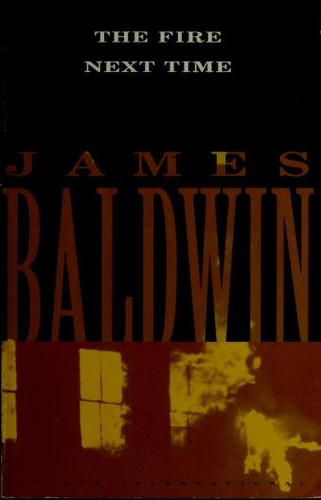
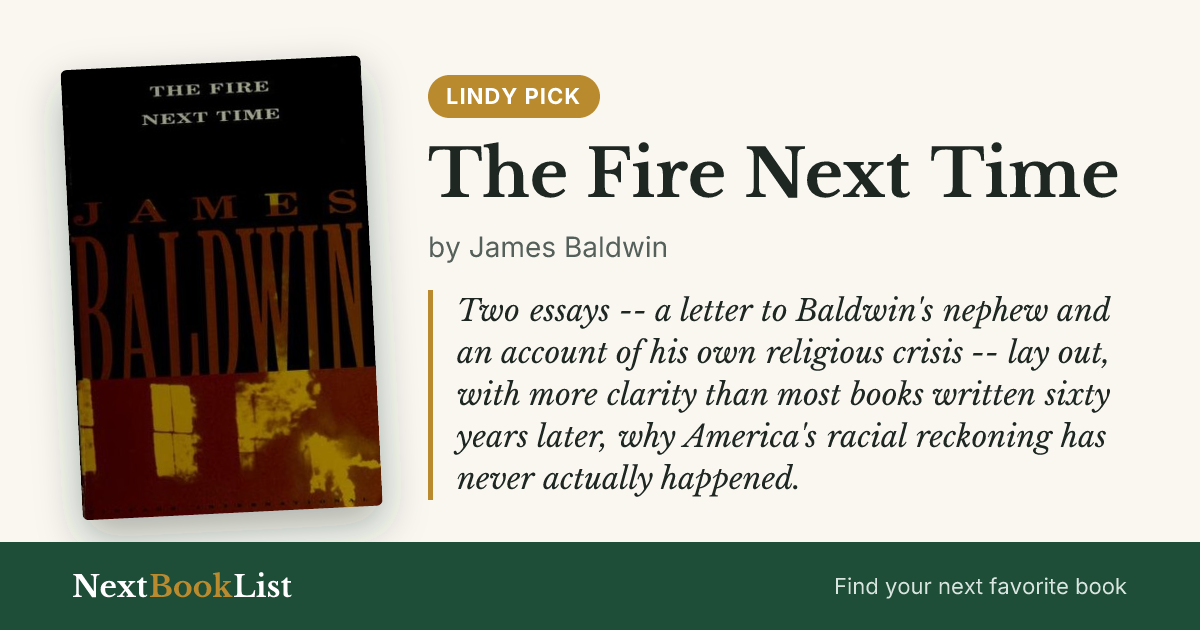
The Fire Next Time
by James Baldwin · 1963
Two essays -- a letter to Baldwin's nephew and an account of his own religious crisis -- lay out, with more clarity than most books written sixty years later, why America's racial reckoning has never actually happened.
Worth reading? The Fire Next Time earns its status as one of the essential American essays because Baldwin refuses both comfortable positions available to him: naive hope and total despair. He tells his nephew directly that the country's problem is white America's refusal to confront its own history, and he tells it without softening a single sentence for a white audience that might feel implicated. Sixty-plus years on, the essay's central claims about denial, religion as escape, and love as a demand rather than a comfort still land.
| Author | James Baldwin |
|---|---|
| Published | 1963 |
| Publisher | Vintage International |
| Category | Sociology & Culture |
| Favorite quote | “Not everything that is faced can be changed, but nothing can be changed until it is faced.” |
The Verdict
This is one of those short books that makes most longer books on the same subject feel padded. Baldwin isn’t building an academic case; he’s writing to his nephew and to himself, and that personal stake is what keeps the argument sharp instead of abstract.
The dinner with Elijah Muhammad is the essay’s most uncomfortable section, and Baldwin plays it straight: he takes the Nation of Islam’s anger seriously without pretending separatism is the answer. That refusal to pick an easy side is exactly what makes the book hold up instead of read like a period piece.
The line that gets quoted everywhere – “nothing can be changed until it is faced” – earns its overuse here, because the whole essay is Baldwin doing exactly that: facing his own history, his own break with religion, his own anger, without flinching and without offering false comfort.
Read it if you want a short, exact argument about race and denial that hasn’t dated. Skip it if you’re looking for a broad historical survey of the civil rights movement – this is one man’s essay, not a textbook.
you want a short, exact, still-uncomfortable argument about race and religion in America from someone who lived every claim he's making
you want a comprehensive history of the civil rights movement or a policy-focused text -- this is a personal essay, not a survey
Book Summary
The book is two essays. "My Dungeon Shook" is a letter to Baldwin's fourteen-year-old nephew, warning him that the danger isn't hatred but the country's system of denial -- white Americans, Baldwin argues, are "trapped in a history they do not understand" and cannot afford to face.
"Down at the Cross" is longer and more personal: Baldwin recounts his own adolescent religious crisis as a Harlem preacher's stepson, his eventual break from the church, and a real dinner meeting with Elijah Muhammad and the Nation of Islam, using both experiences to argue that separatism and traditional Christian piety are each, in different ways, evasions of the actual work.
Baldwin's core argument is that love -- not sentimental affection, but a demand for full honesty and accountability -- is the only way out, and that white America's inability to face its own history is the actual obstacle, not Black rage or Black separatism.
Top 8 Lessons from The Fire Next Time
- Baldwin argues the central danger facing his nephew isn't individual white hatred but a system of denial: white Americans are 'trapped in a history they do not understand,' and that unexamined history perpetuates the country's racial structure.
- The essay reframes love not as comfort or reassurance but as a demand -- love, for Baldwin, means insisting someone face reality rather than letting them retreat into innocence.
- Baldwin's own departure from the Black church as a teenager is presented as a rejection of religious ecstasy used as an escape from a real, immediate world that needed changing.
- His account of dining with Elijah Muhammad presents the Nation of Islam's separatism sympathetically as a rational response to white violence, while still arguing it offers no workable path forward for the country.
- 'Not everything that is faced can be changed, but nothing can be changed until it is faced' is the essay's structural argument in miniature: Baldwin insists confrontation with painful history has to come before any real progress.
- Baldwin argues that white Americans' 'innocence' -- their refusal to know their own history -- is itself a form of violence, not a neutral or excusable state.
- The essay was written and published during the peak of the civil rights movement, and Baldwin explicitly frames the moment as a choice point: real reckoning now, or continued crisis later, which the title's biblical reference to 'the fire next time' makes literal.
- Baldwin holds two things at once without resolving the tension: real anger at his country's failures, and a refusal to give up on the possibility that Black and white Americans could actually build something together.
Top 4 Quotes from The Fire Next Time
"Not everything that is faced can be changed, but nothing can be changed until it is faced."
James Baldwin, The Fire Next Time
"Love takes off the masks that we fear we cannot live without and know we cannot live within."
James Baldwin, The Fire Next Time
"I imagine one of the reasons people cling to their hates so stubbornly is because they sense, once hate is gone, that they will be forced to deal with pain."
James Baldwin, The Fire Next Time
"Whoever debases others is debasing himself."
James Baldwin, The Fire Next Time
Frequently Asked Questions
Is The Fire Next Time worth reading?
Yes -- it's short, exact, and still one of the clearest arguments written about race and denial in America, more than sixty years after publication.
What is The Fire Next Time about?
Two essays: a letter from Baldwin to his fourteen-year-old nephew, and a longer account of Baldwin's own religious crisis and a meeting with Elijah Muhammad, arguing that white America's refusal to face its own history is the country's core problem.
Is The Fire Next Time a memoir or a political essay?
Both -- Baldwin builds the political argument directly out of his own life, particularly his adolescence in the Black church and his eventual break from it.
How long is The Fire Next Time?
Short -- around 106 pages in the standard Vintage International edition, readable in a single sitting.
Is The Fire Next Time still relevant today?
Most readers and critics say yes -- Baldwin's argument about denial and 'innocence' as forms of harm is regularly cited in current writing on race in America.
Ready to read it?
Get The Fire Next Time on Amazon