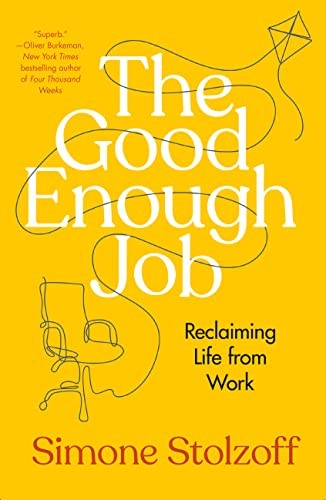
The Good Enough Job
by Simone Stolzoff · 2023
A design journalist argues that treating your job as your life's central meaning is a modern trap, and that a 'good enough' relationship with work is healthier than chasing a dream career.
Worth reading? The Good Enough Job is the best rebuttal to 'do what you love' career culture because Stolzoff backs the argument with real interviews and research instead of just vibes, showing what happens when people over-invest their identity in a job. Skip it if you want career-advancement tactics; this is about recalibrating your relationship to work, not climbing faster.
| Full Title | The Good Enough Job: Reclaiming Life from Work |
|---|---|
| Author | Simone Stolzoff |
| Published | 2023 |
| Publisher | Portfolio |
| Category | Self-Improvement & Psychology |
| Favorite quote | “It starts with a simple acknowledgment: you aren't what you do.” |
The Verdict
Stolzoff’s background as a design journalist shows in how he builds the case – real interviews with people across very different relationships to work, not just anecdotes cherry-picked to fit a thesis. That reporting is what separates this from another “quiet quitting” thinkpiece; the argument is earned, not asserted.
The useful shift here is subtle but real: work can matter to you without being the thing you build your entire identity around, and the book makes a genuinely convincing case that the second option is a trap dressed up as ambition. Read it if “do what you love” advice has ever made you feel like your ordinary, decent job is a personal failure. Skip it if you want tactics for getting promoted faster – that’s a different book.
you've bought into 'do what you love' career advice and want a well-reported counterargument for building identity and meaning outside your job
you're looking for tactical career-advancement advice -- this is a cultural critique of work-as-identity, not a how-to-get-promoted guide
Book Summary
"Do what you love" culture -- the modern expectation that work should be a primary source of identity, passion, and meaning -- sets most people up for disappointment, because jobs are structurally unlikely to deliver on that promise, and over-investing your sense of self in a job leaves you fragile when that job changes, disappoints, or disappears.
Stolzoff profiles people across different relationships to work -- from workaholics whose identity collapsed when they lost their job, to people who deliberately treat work as "just a job" and build meaning elsewhere -- to argue that a healthier default is treating work as one important part of life, not the organizing principle of it.
The book connects this cultural shift to specific economic and social forces (the decline of unions and stable long-term employment, the rise of gig and knowledge work, employers marketing jobs as "callings" to extract more unpaid effort) rather than treating "workism" as purely a personal mindset problem to fix through better attitude.
Top 8 Lessons from The Good Enough Job
- Treat 'do what you love' career advice with skepticism -- it can set unrealistic expectations that make ordinary, useful jobs feel like personal failures.
- Diversify your sources of identity and meaning (relationships, hobbies, community) so your sense of self doesn't collapse if your job changes or ends.
- Recognize when an employer's 'we're a family' or 'this is a calling' messaging is being used to extract more unpaid effort or loyalty than the job actually deserves.
- A 'good enough' relationship with work -- competent, reasonably engaged, bounded -- is often more sustainable and satisfying than chasing a dream job that fully expresses your identity.
- Notice workaholism as a risk factor, not just a sign of ambition -- several profiled workers describe real identity crises when work was taken away.
- Separate 'career' from 'calling' deliberately -- you can do meaningful, engaged work without needing that job to be your life's central purpose.
- Structural forces (weaker unions, gig work, employer branding around passion) shape how much of your identity gets pulled toward work, not just individual mindset.
- Setting boundaries around work hours and availability is framed as a rational response to structural pressure, not a lack of ambition or dedication.
Top 5 Quotes from The Good Enough Job
"It starts with a simple acknowledgment: you aren't what you do."
Simone Stolzoff, The Good Enough Job
"Work will always be work. Some people work doing what they love. Other people work so that they can do what they love when they're not working. Neither is more noble."
Simone Stolzoff, The Good Enough Job
"When you don't take an active role in determining what you value, you inherit the values of the systems around you."
Simone Stolzoff, The Good Enough Job
"Even the language we commonly use for rest -- unplug, recharge -- presumes rest is simply a prerequisite for getting back to work."
Simone Stolzoff, The Good Enough Job
"When we don't trust our own definition of what is good, we let other people define it for us."
Simone Stolzoff, The Good Enough Job
Frequently Asked Questions
Is The Good Enough Job worth reading?
Yes, if you've internalized 'do what you love' career advice and want a well-reported counterargument for building a healthier, more bounded relationship with work.
Is The Good Enough Job anti-ambition?
No -- it doesn't argue against caring about your work or doing it well. It argues against making your job the sole source of your identity and meaning, which is a different claim.
Who should read The Good Enough Job?
Anyone feeling burned out chasing a 'dream job,' or anyone whose sense of self feels overly tied to their career title or performance at work.
How is The Good Enough Job different from burnout books like Rest Is Resistance?
Rest Is Resistance makes a political and spiritual argument for rest as resistance against grind culture broadly. The Good Enough Job is more specifically about career identity and expectations -- why treating work as your life's meaning backfires -- and leans more on interviews and workplace research than manifesto-style argument.
Ready to read it?
Get The Good Enough Job on Amazon