The Innovators
by Walter Isaacson · 2014
The history of computing told as a relay race between teams, not a lone-genius origin story.
Worth reading? Where Isaacson's Steve Jobs biography sells the lone-genius myth, The Innovators is the correction: nearly every breakthrough here -- the computer, the microchip, the internet, the PC -- came from a team, usually one that paired a visionary with an execution partner. It's a better book for understanding innovation as a process than any single-founder biography, because it shows the pattern repeating across a century instead of one company. Read it if you want the real, collaborative history behind the tech you use daily, told through Ada Lovelace, Turing, the ARPANET team, and the Homebrew Computer Club alike. Skip it if you want a tight single narrative -- Isaacson covers a century of overlapping threads, and it reads more like a very good textbook than a page-turner.
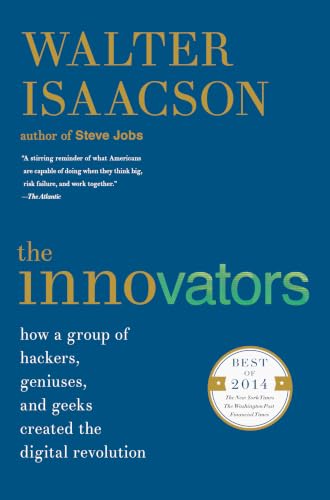
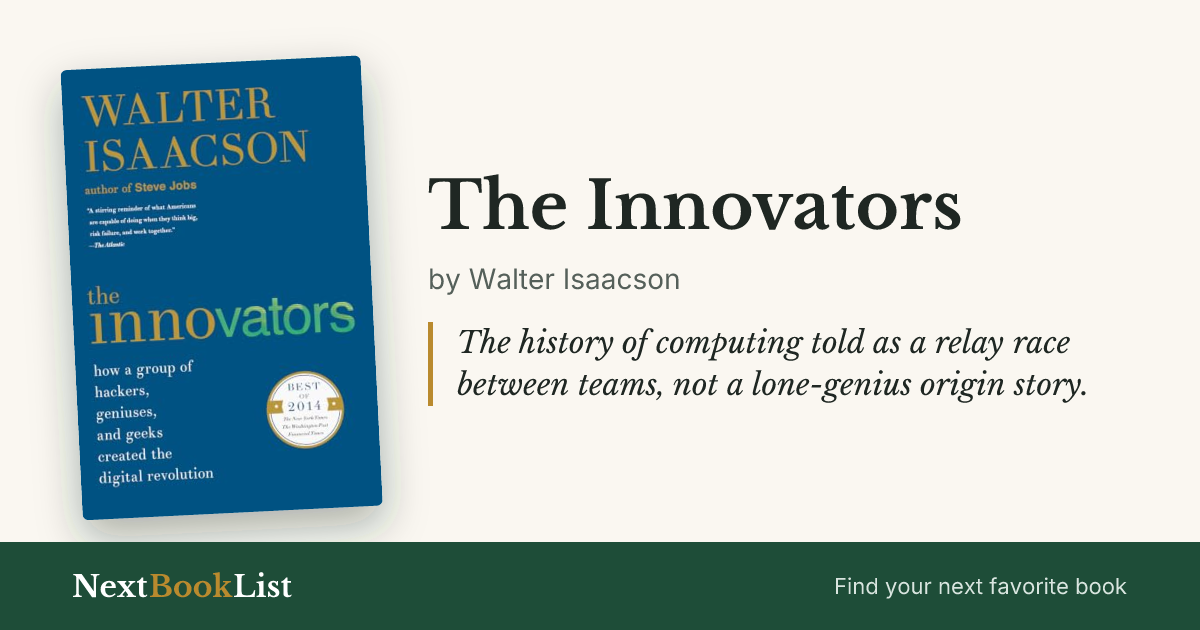
| Full Title | The Innovators: How a Group of Hackers, Geniuses, and Geeks Created the Digital Revolution |
|---|---|
| Author | Walter Isaacson |
| Published | 2014 |
| Publisher | Simon & Schuster |
| Category | Business & Money |
| Favorite quote | “Innovation is a collaborative process, requiring the cross-fertilization of ideas rather than solitary genius.” |
The Verdict
Isaacson spent his Jobs biography years half-convinced by the lone-genius myth, then wrote this book to correct it. The real history of computing is a relay race – Lovelace to Turing to the ARPANET team to Homebrew Computer Club hobbyists – and almost nobody in it worked alone.
you want to understand how computers, the microchip, and the internet actually got built, through the people who built them
you want a quick read -- this is a 500-page march through a century of innovation, not a breezy narrative
Book Summary
Innovation is collaborative, not solitary. From Ada Lovelace's insight that computers could manipulate symbols and music, not just numbers, through the transistor, the microchip, and the internet, Isaacson traces a consistent pattern: breakthroughs happened when people from different disciplines -- engineers and artists, hardware people and software people -- worked together, not when a single genius worked alone.
Government and university funding built the foundational infrastructure -- DARPA money underwrote the ARPANET, university labs incubated early computing research -- well before private companies commercialized any of it. The garage-startup myth undersells how much public investment and open collaboration did the early heavy lifting.
Many "inventions" were arrived at independently by multiple teams around the same time, which suggests timing and context mattered as much as individual brilliance. And the innovators who won long-term were usually the ones who paired a vision person with an execution person -- Jobs and Wozniak, Noyce and Moore -- rather than solo operators.
Top 10 Lessons from The Innovators
- Innovation almost always comes from teams and collaboration, not a single lone genius working alone.
- Ada Lovelace saw computers could manipulate symbols, music, and art -- not just numbers -- a century before one existed.
- The most durable innovations paired engineering with a humanities or design sensibility, not pure technical skill.
- Government and university funding (DARPA, military contracts) built the infrastructure private companies later commercialized.
- Multiple teams often arrived at the same breakthrough independently -- timing and context mattered as much as genius.
- Open, collaborative standards scaled faster than closed, proprietary ones, as the internet's protocols show.
- The personal computer revolution needed hobbyist communities as much as it needed corporate R&D labs.
- Gates and Allen won early by betting that software, not hardware, was where the value would concentrate.
- The strongest teams paired a vision person with an execution person -- Jobs and Wozniak, Noyce and Moore.
- Most 'overnight' breakthroughs took a decade of dead ends and false starts before they worked.
Top 1 Quotes from The Innovators
"Innovation is a collaborative process, requiring the cross-fertilization of ideas rather than solitary genius."
Walter Isaacson, The Innovators
Frequently Asked Questions
Is The Innovators worth reading?
Yes, if you want the real, collaborative history of computing rather than a lone-genius narrative. Skip it if you're looking for a quick read -- it's a dense, century-spanning history.
What is the main idea of The Innovators?
Digital-age breakthroughs came from teams and collaboration -- pairing visionaries with executors, and humanities thinking with engineering -- not from solitary genius.
Who should read The Innovators?
Anyone curious how the computer, the internet, and the personal computer actually got built, and who built them.
How is The Innovators different from Isaacson's Steve Jobs biography?
Steve Jobs is a single-founder narrative. The Innovators is the corrective wide-angle view, showing the same collaborative pattern repeat across a century and dozens of teams.
Ready to read it?
Get The Innovators on Amazon