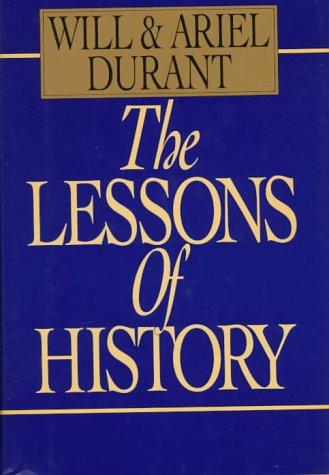
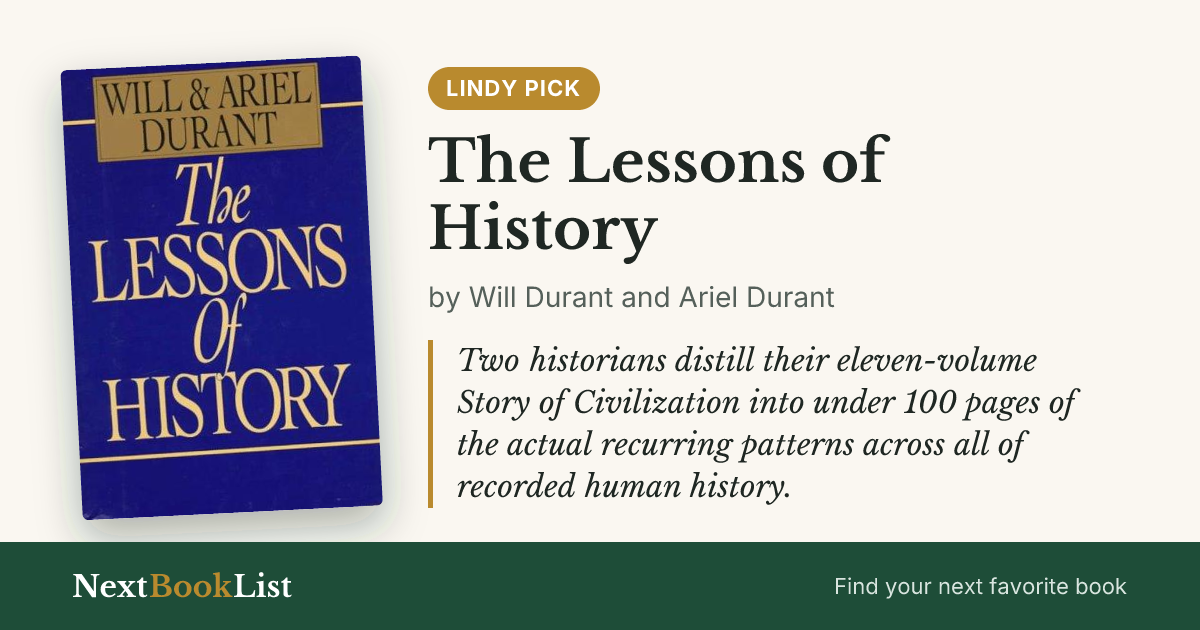
The Lessons of History
by Will Durant and Ariel Durant · 1968
Two historians distill their eleven-volume Story of Civilization into under 100 pages of the actual recurring patterns across all of recorded human history.
Worth reading? After spending decades writing their eleven-volume Story of Civilization, the Durants distilled what they saw as the actual recurring patterns, the role of biology, race, character, morals, religion, economics, government, and war in shaping civilizations, into a slim, dense volume built for re-reading rather than one linear pass. Naval Ravikant has praised it specifically for covering enormous ground in remarkably little space, calling it incisive despite its brevity. Read it as one of the highest insight-per-page books in the history genre. Skip it if you want narrative storytelling, this is closer to a set of extracted principles than a story.
| Author | Will Durant and Ariel Durant |
|---|---|
| Published | 1968 |
| Category | History |
| Favorite quote | “Civilization exists by geological consent, subject to change without notice.” |
The Verdict
Most history books ask for a serious time commitment. This one asks for almost none and still leaves you with more genuinely transferable patterns than books ten times its length. Read it once fast, then keep it around to reread slowly.
readers who want the highest-density, most re-readable summary of what actually repeats across history
you want detailed narrative history, this is pure distilled pattern-recognition, almost no storytelling
Book Summary
The Durants' central method: after a lifetime studying civilizations across every era and continent, they organize what they found into chapters by theme, biology's role in history, the effect of race, character and historical change, religion's function, economics and government's recurring tensions, rather than chronology, letting patterns that repeat across wildly different eras and cultures stand out clearly.
Their overarching thesis is cautious rather than triumphalist: history doesn't repeat in exact detail, but certain structural forces (competition for resources, the tension between order and freedom, the role of inequality in driving both innovation and unrest) recur across virtually every civilization they studied, making some historical lessons genuinely transferable rather than merely anecdotal.
Top 7 Lessons from The Lessons of History
- Organizing history by recurring theme, rather than chronology, surfaces patterns a linear narrative would bury.
- Certain structural tensions (order versus freedom, inequality driving both innovation and unrest) recur across nearly every civilization studied.
- History doesn't repeat in exact detail, but structural forces genuinely do recur, making some lessons transferable.
- A lifetime of research can be distilled into under 100 pages without losing its substance, if the distillation is done with real discipline.
- Biology, character, and religion shaped civilizational outcomes as much as economics and government did.
- Competition for resources is a constant across history, only the specific resources and technologies change.
- Density and re-readability can matter more than length, this book rewards rereading more than a single pass.
Top 3 Quotes from The Lessons of History
"Civilization exists by geological consent, subject to change without notice."
Will Durant and Ariel Durant, The Lessons of History
"History repeats itself, but only in outline and in the large."
Will Durant and Ariel Durant, The Lessons of History
"So the first biological lesson of history is that life is competition."
Will Durant and Ariel Durant, The Lessons of History
Frequently Asked Questions
Is The Lessons of History worth reading?
Yes, it's one of the highest insight-per-page books in the history genre, distilling the Durants' eleven-volume career into under 100 dense, re-readable pages.
What is The Lessons of History about?
Historians Will and Ariel Durant's distillation of the recurring patterns, biological, economic, religious, political, they identified across a lifetime studying world civilization, organized by theme rather than chronology.
Why does Naval Ravikant recommend The Lessons of History?
Naval has praised it for covering an unusually large amount of historical ground in a remarkably small book, calling it incisive precisely because of, not despite, its brevity.
Ready to read it?
Get The Lessons of History on Amazon