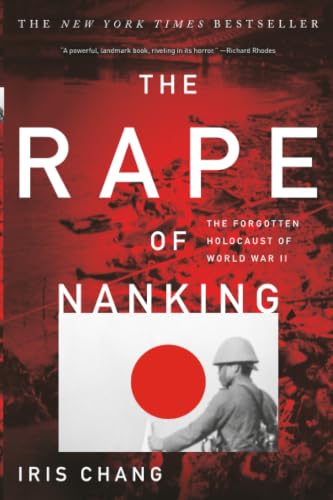
The Rape of Nanking
by Iris Chang · 1997
The book that forced a largely Western audience to confront a 1937 atrocity in China that had been left out of most WWII histories entirely.
Worth reading? Chang, a 29-year-old journalist when she wrote this, drew on survivor testimony, diplomatic records, and the diaries of Western witnesses (including a Nazi businessman who sheltered Chinese refugees) to document the Japanese military's six-week massacre of an estimated 200,000 to 300,000 civilians and soldiers in Nanking, China, in 1937 and 1938. The book's impact went beyond publishing, it's widely credited with pushing the Nanking Massacre into Western historical consciousness where it had been largely absent. Read it as essential, if devastating, WWII history most curricula skip entirely. Skip it only if you're not prepared for sustained graphic detail.
| Full Title | The Rape of Nanking: The Forgotten Holocaust of World War II |
|---|---|
| Author | Iris Chang |
| Published | 1997 |
| Category | History |
| Favorite quote | “The Rape of Nanking did not penetrate the world consciousness in the same manner as the Holocaust or Hiroshima because the victims themselves had remained silent.” |
The Verdict
Chang wrote this in her twenties and it became the book that put the Nanking Massacre on the map for readers who had never encountered it in a WWII history course. It’s harrowing by necessity, not for effect, and it belongs on any serious 20th-century history shelf.
readers who want a documented, harrowing account of an atrocity that's still underrepresented in most WWII education
you're not prepared for sustained, graphic historical detail about mass killing and sexual violence
Book Summary
Chang's book is structured in three parts: the massacre itself, told through Japanese soldiers' own accounts and Chinese survivor testimony; the international safety zone, where a small group of Western expatriates (including the German businessman John Rabe) sheltered hundreds of thousands of Chinese civilians; and postwar amnesia, examining why the massacre received far less acknowledgment and historical attention than comparable WWII atrocities.
Her central argument extends beyond documenting the atrocity itself, she makes the case that incomplete historical memory, driven partly by Cold War politics and partly by insufficient postwar reckoning within Japan, allowed an atrocity of this scale to remain marginal in global WWII history for decades, and that this gap in memory carries its own consequences.
Top 7 Lessons from The Rape of Nanking
- An atrocity's scale doesn't guarantee its place in historical memory, political and cultural factors shape what gets remembered.
- Individual moral courage (John Rabe sheltering refugees despite being a member of the Nazi party) can exist independent of the broader system a person belongs to.
- Survivor testimony and perpetrator accounts together build a more complete historical record than either alone.
- Postwar national narratives can shape what gets taught, and what gets omitted, for generations.
- Journalistic rigor (primary sources, direct interviews) can accomplish what decades of academic neglect didn't.
- Gaps in historical memory aren't neutral, they have real consequences for reconciliation and accountability.
- A single well-researched book can meaningfully shift what an atrocity's place in public memory becomes.
Top 4 Quotes from The Rape of Nanking
"The Rape of Nanking did not penetrate the world consciousness in the same manner as the Holocaust or Hiroshima because the victims themselves had remained silent."
Iris Chang, The Rape of Nanking
"Almost all people have this potential for evil, which would be unleashed only under certain dangerous social circumstances."
Iris Chang, The Rape of Nanking
"Looking back upon millennia of history, it appears clear that no race or culture has monopoly on wartime cruelty. The veneer of civilization seems to be exceedingly thin -- one that can be easily stripped away, especially by the stresses of war."
Iris Chang, The Rape of Nanking
"One Buddhist nun and a little girl avoided rape and murder because they lay still in a ditch filled with bodies and feigned death for five days."
Iris Chang, The Rape of Nanking
Frequently Asked Questions
Is The Rape of Nanking worth reading?
Yes, it's the book most responsible for bringing the 1937 Nanking Massacre into Western historical awareness, built on survivor testimony, soldier accounts, and diplomatic records.
What is The Rape of Nanking about?
Iris Chang's account of the Japanese military's six-week massacre of an estimated 200,000 to 300,000 civilians and soldiers in Nanking, China, in 1937 to 1938, and the decades of underrepresentation that followed.
Who was John Rabe, mentioned in The Rape of Nanking?
A German businessman and Nazi party member in Nanking who helped establish and lead the International Safety Zone, sheltering an estimated 200,000 Chinese civilians during the massacre, a striking example of individual moral action independent of political affiliation.
Ready to read it?
Get The Rape of Nanking on Amazon